Native SSE, JSONL & WebSockets
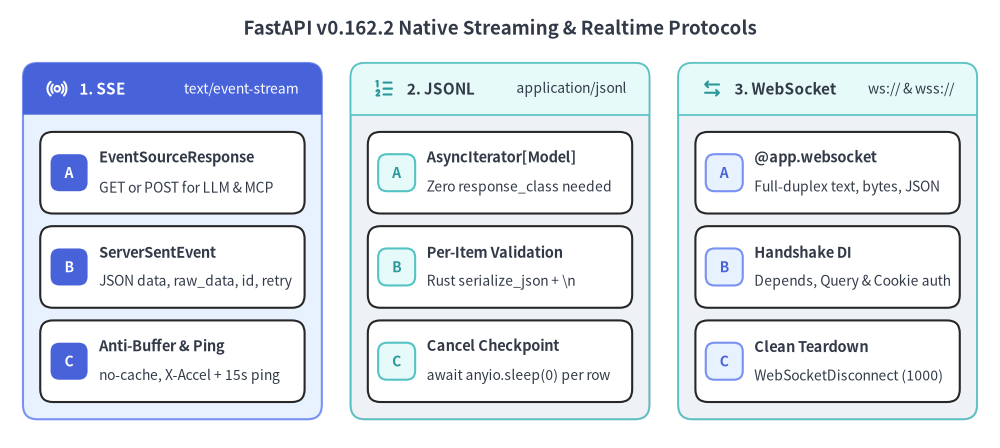
FastAPI v0.162.2 ships three first-class real-time and streaming primitives out of the box—native Server-Sent Events (EventSourceResponse), typed JSON Lines (AsyncIterator[Model]), and full-duplex WebSocket endpoints—with automatic Pydantic serialization, proxy anti-buffering headers, and cooperative cancellation checkpoints.
Source Code
from drawlib.canvas import save, setup
from drawlib.icons import phosphor
from drawlib.smartarts import CardList, Panel
from drawlib.styles import Styles
from drawlib.text import text

setup(width=174, height=78)

text(
    (87.0, 73.0),
    "FastAPI v0.162.2 Native Streaming & Realtime Protocols",
    style=Styles.DarkBold.patch(text_size=13.5),
)

# Column 1: Native SSE (Focal Primary Panel)
p_sse = Panel(
    "1. SSE",
    "text/event-stream",
    style=Styles.PrimaryNeutral,
    header_style=Styles.PrimaryFlat,
    text_style=Styles.WhiteBold.patch(text_size=11.0),
    description_style=Styles.White.patch(text_size=10.0),
    icon=phosphor.broadcast,
    icon_style=Styles.WhiteBold,
    header_height=9.0,
)
p_sse.draw((4.0, 5.0), width=52.0, height=62.0)
xy1, w1, h1 = p_sse.get_content_box((4.0, 5.0), width=52.0, height=62.0, padding=(3.0, 3.0))

cl_sse = CardList(
    style=Styles.White,
    text_style=Styles.DarkBold.patch(text_size=10.5),
    description_style=Styles.Dark.patch(text_size=10.0),
    badge_style=Styles.PrimaryFlat,
    badge_text_style=Styles.WhiteBold.patch(text_size=10.0),
    spacing=2.2,
)
cl_sse.add("EventSourceResponse", "GET or POST for LLM & MCP", badge_text="A")
cl_sse.add("ServerSentEvent", "JSON data, raw_data, id, retry", badge_text="B")
cl_sse.add("Anti-Buffer & Ping", "no-cache, X-Accel + 15s ping", badge_text="C")
cl_sse.draw(xy1, width=w1, height=h1)

# Column 2: Native JSON Lines (Neutral Panel)
p_jsonl = Panel(
    "2. JSONL",
    "application/jsonl",
    style=Styles.Neutral,
    header_style=Styles.SecondaryNeutral.patch(shape_line_width=1.2),
    text_style=Styles.DarkBold.patch(text_size=11.0),
    description_style=Styles.Dark.patch(text_size=10.0),
    icon=phosphor.list_numbers,
    icon_style=Styles.SecondaryBold,
    header_height=9.0,
)
p_jsonl.draw((61.0, 5.0), width=52.0, height=62.0)
xy2, w2, h2 = p_jsonl.get_content_box((61.0, 5.0), width=52.0, height=62.0, padding=(3.0, 3.0))

cl_jsonl = CardList(
    style=Styles.White,
    text_style=Styles.DarkBold.patch(text_size=10.5),
    description_style=Styles.Dark.patch(text_size=10.0),
    badge_style=Styles.SecondaryNeutral,
    badge_text_style=Styles.SecondaryBold.patch(text_size=10.0),
    spacing=2.2,
)
cl_jsonl.add("AsyncIterator[Model]", "Zero response_class needed", badge_text="A")
cl_jsonl.add("Per-Item Validation", "Rust serialize_json + \\n", badge_text="B")
cl_jsonl.add("Cancel Checkpoint", "await anyio.sleep(0) per row", badge_text="C")
cl_jsonl.draw(xy2, width=w2, height=h2)

# Column 3: Bidirectional WebSockets (Neutral Panel)
p_ws = Panel(
    "3. WebSocket",
    "ws:// & wss://",
    style=Styles.Neutral,
    header_style=Styles.SecondaryNeutral.patch(shape_line_width=1.2),
    text_style=Styles.DarkBold.patch(text_size=11.0),
    description_style=Styles.Dark.patch(text_size=10.0),
    icon=phosphor.arrows_left_right,
    icon_style=Styles.SecondaryBold,
    header_height=9.0,
)
p_ws.draw((118.0, 5.0), width=52.0, height=62.0)
xy3, w3, h3 = p_ws.get_content_box((118.0, 5.0), width=52.0, height=62.0, padding=(3.0, 3.0))

cl_ws = CardList(
    style=Styles.White,
    text_style=Styles.DarkBold.patch(text_size=10.5),
    description_style=Styles.Dark.patch(text_size=10.0),
    badge_style=Styles.PrimaryNeutral,
    badge_text_style=Styles.PrimaryBold.patch(text_size=10.0),
    spacing=2.2,
)
cl_ws.add("@app.websocket", "Full-duplex text, bytes, JSON", badge_text="A")
cl_ws.add("Handshake DI", "Depends, Query & Cookie auth", badge_text="B")
cl_ws.add("Clean Teardown", "WebSocketDisconnect (1000)", badge_text="C")
cl_ws.draw(xy3, width=w3, height=h3)

save()
1. Choosing the Right Streaming Protocol
Before writing a streaming endpoint, match your client topology and framing guarantees to the simplest protocol that fits:
| Capability | Native SSE (EventSourceResponse) |
Native JSON Lines (AsyncIterator[T]) |
WebSocket (@app.websocket) |
|---|---|---|---|
| Directionality | Server-to-client push (GET or POST) |
Server-to-client chunked HTTP | Full-duplex bidirectional |
| Wire Media Type | text/event-stream |
application/jsonl |
Stateful RFC 6455 frames |
| Auto-Reconnect | Built into browser EventSource (Last-Event-ID) |
Client-managed HTTP retry | Client-managed backoff |
| Keep-Alive Pings | Automatic : ping comment every 15s |
Chunk-driven | Protocol ping/pong frames |
| Ideal Workload | LLM token streams, MCP over POST, live feeds |
Bulk dataset exports, service-to-service pipelines | Collaborative rooms, live telemetry control |
Source Code
from drawlib.canvas import save, setup
from drawlib.diagrams.sequence import Participant, PhosphorIcon, SequenceDiagram
from drawlib.styles import Styles
from drawlib.text import text

setup(width=172, height=144)

text(
    (86.0, 138.5),
    "Native SSE (EventSourceResponse) vs Stateful WebSocket Lifecycle",
    style=Styles.DarkBold.patch(text_size=13.2),
)

d = SequenceDiagram(
    node_style=Styles.Primary,
    node_text_style=Styles.DarkBold.patch(text_size=10.5),
    edge_style=Styles.DarkBold,
    edge_text_style=Styles.Dark.patch(text_size=10.0),
    node_card_style=Styles.Neutral,
    autonumber=True,
    col_width=56.0,
    step_y=6.6,
)

client = d.add(
    Participant("Browser / SDK Client", width=36, height=13, icon=PhosphorIcon.MONITOR, icon_size=6.0)
)
router = d.add(
    Participant(
        "FastAPI Routing Layer",
        width=38,
        height=13,
        icon=PhosphorIcon.LIGHTNING,
        icon_size=6.0,
        card_style=Styles.PrimaryNeutral,
    )
)
worker = d.add(
    Participant("Async Generator / Room", width=38, height=13, icon=PhosphorIcon.BROADCAST, icon_size=6.0)
)

with d.opt("SSE over POST") as sse_blk:
    sse_blk.style = Styles.Neutral.patch(line_style="dashed")
    sse_blk.text_style = Styles.PrimaryBold.patch(text_size=10.0)
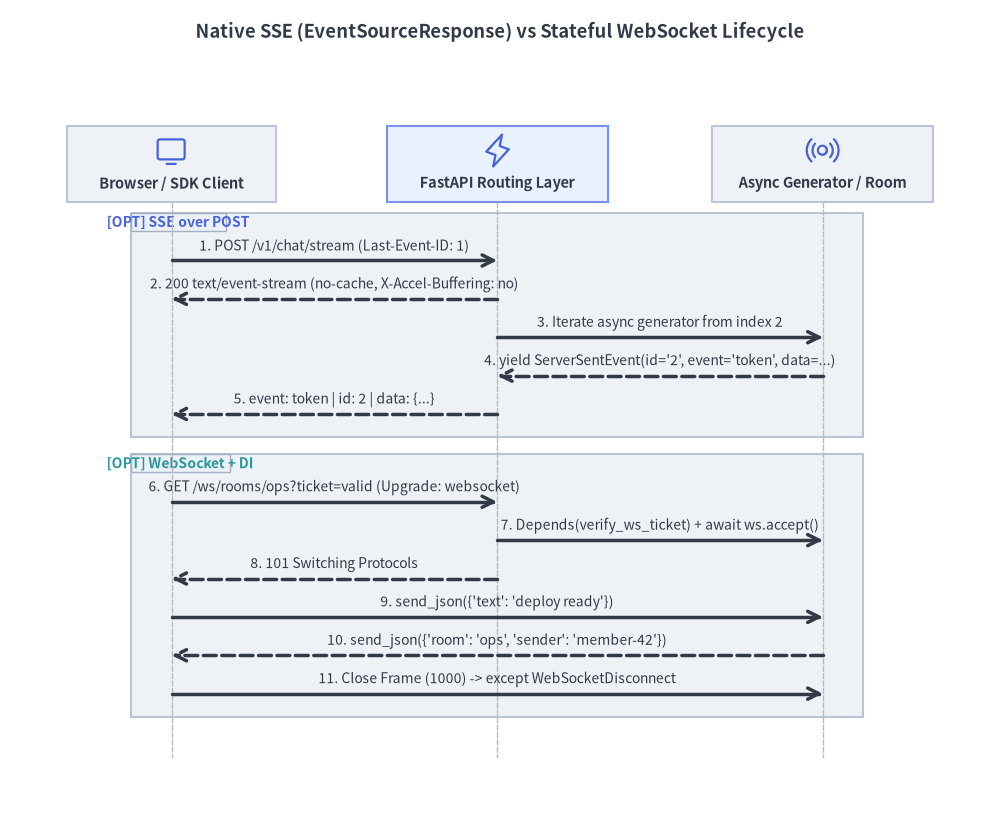
    client.request(router, "POST /v1/chat/stream (Last-Event-ID: 1)")
    router.reply(client, "200 text/event-stream (no-cache, X-Accel-Buffering: no)")
    router.request(worker, "Iterate async generator from index 2")
    worker.reply(router, "yield ServerSentEvent(id='2', event='token', data=...)")
    router.reply(client, "event: token | id: 2 | data: {...}")

with d.opt("WebSocket + DI") as ws_blk:
    ws_blk.style = Styles.Neutral.patch(line_style="dashed")
    ws_blk.text_style = Styles.SecondaryBold.patch(text_size=10.0)
    client.request(router, "GET /ws/rooms/ops?ticket=valid (Upgrade: websocket)")
    router.request(worker, "Depends(verify_ws_ticket) + await ws.accept()")
    router.reply(client, "101 Switching Protocols")
    client.request(worker, "send_json({'text': 'deploy ready'})")
    worker.reply(client, "send_json({'room': 'ops', 'sender': 'member-42'})")
    client.request(worker, "Close Frame (1000) -> except WebSocketDisconnect")

d.draw(xy=(86.0, 67.0), align="center")
save()
2. Native Server-Sent Events (fastapi.sse)
FastAPI v0.162.2 includes a dedicated fastapi.sse module (EventSourceResponse and ServerSentEvent) engineered directly into the routing layer:
- Works on
GETandPOST: Unlike legacyEventSourcewrappers restricted toGET,response_class=EventSourceResponseworks onPOSTendpoints—essential for LLM prompt streaming and MCP (Model Context Protocol) transports. - Proxy & Keep-Alive Hardening: FastAPI automatically sets
Cache-Control: no-cacheandX-Accel-Buffering: no(disabling Nginx proxy buffering) and runs an isolated AnyIO memory-stream keepalive task onfastapi_inner_astackthat emits: pingevery15seconds without injectingCancelledErrorinto your generator. - Structured
ServerSentEventValidation:datapayloads (Pydantic models, dicts, or strings) are always JSON-encoded, whileraw_dataemits pre-formatted strings verbatim ([DONE], HTML fragments). Single-line constraints oneventandidprevent SSE wire-injection bugs.
from collections.abc import AsyncIterator
from typing import Annotated

from fastapi import FastAPI, Header
from fastapi.sse import EventSourceResponse, ServerSentEvent
from fastapi.testclient import TestClient
from pydantic import BaseModel

app = FastAPI()


class PromptRequest(BaseModel):
    prompt: str


TOKENS = ["FastAPI", "v0.162.2", "streams", "SSE"]


@app.post("/v1/chat/stream", response_class=EventSourceResponse)
async def stream_completion(
    body: PromptRequest,
    last_event_id: Annotated[str | None, Header()] = None,
) -> AsyncIterator[ServerSentEvent]:
    start_idx = int(last_event_id) + 1 if last_event_id is not None else 0
    yield ServerSentEvent(comment="stream-open", retry=3000)
    for idx in range(start_idx, len(TOKENS)):
        yield ServerSentEvent(
            data={"index": idx, "token": TOKENS[idx], "prompt": body.prompt},
            event="token",
            id=str(idx),
        )
    yield ServerSentEvent(raw_data="[DONE]", event="done")


client = TestClient(app)
res = client.post(
    "/v1/chat/stream",
    json={"prompt": "explain sse"},
    headers={"Last-Event-ID": "1"},
)
assert res.headers["content-type"].startswith("text/event-stream")
assert res.headers["x-accel-buffering"] == "no"
assert "id: 2\n" in res.text
3. Native Typed JSON Lines (application/jsonl)
When streaming typed records between backend microservices, CLI tools, or data pipelines, simply annotate a generator path operation with AsyncIterator[MyModel] (or Iterator[MyModel]) without specifying any custom response_class:
- FastAPI automatically selects
media_type="application/jsonl"and documents the item schema in OpenAPI 3.1. - Each yielded item is validated and serialized directly to UTF-8 JSON bytes (
+ b"\n") through Pydantic's RustTypeAdapter(stream_item_field.serialize_json). If an item violates the response contract mid-stream, FastAPI raisesResponseValidationError. - After every yielded chunk on an async generator, FastAPI executes
await anyio.sleep(0)so client disconnects immediately cancel fast in-memory producers instead of burning CPU until stream exhaustion.
from collections.abc import AsyncIterator

from fastapi import FastAPI
from fastapi.testclient import TestClient
from pydantic import BaseModel

app = FastAPI()


class MetricSample(BaseModel):
    seq: int
    service: str
    latency_ms: float


@app.get("/v1/metrics/export")
async def export_metrics() -> AsyncIterator[MetricSample]:
    samples = [
        MetricSample(seq=1, service="gateway", latency_ms=4.2),
        MetricSample(seq=2, service="billing", latency_ms=11.8),
    ]
    for sample in samples:
        yield sample


client = TestClient(app)
res = client.get("/v1/metrics/export")
assert res.headers["content-type"].startswith("application/jsonl")
rows = [MetricSample.model_validate_json(line) for line in res.text.splitlines() if line]
assert len(rows) == 2
4. Full-Duplex WebSocket Endpoints with Dependency Injection
When clients must push low-latency messages back to the server over a single persistent socket, declare @app.websocket(...). WebSocket endpoints share the exact same Depends(), Query(), Header(), and Cookie() resolution engine as HTTP routes:
- Reject Unauthorized Handshakes Early: Validate tickets or session cookies inside a dependency before calling
await ws.accept(), raisingWebSocketException(code=status.WS_1008_POLICY_VIOLATION)on failure. - Always Catch
WebSocketDisconnect: Wrap the receive loop intry ... except WebSocketDisconnect:(orfinally:) so room memberships and pub/sub subscriptions are cleaned up deterministically when clients close tabs or lose connectivity.
from typing import Annotated

from fastapi import (
    Depends,
    FastAPI,
    Query,
    WebSocket,
    WebSocketDisconnect,
    WebSocketException,
    status,
)
from fastapi.testclient import TestClient

app = FastAPI()
events: list[str] = []


async def verify_ws_ticket(
    ticket: Annotated[str | None, Query()] = None,
) -> str:
    if ticket != "valid-ticket":
        raise WebSocketException(
            code=status.WS_1008_POLICY_VIOLATION,
            reason="Invalid or missing ticket",
        )
    return "member-42"


@app.websocket("/ws/rooms/{room_id}")
async def room_socket(
    ws: WebSocket,
    room_id: str,
    member_id: Annotated[str, Depends(verify_ws_ticket)],
) -> None:
    await ws.accept()
    events.append(f"join:{room_id}:{member_id}")
    try:
        while True:
            payload = await ws.receive_json()
            await ws.send_json(
                {"room": room_id, "sender": member_id, "text": payload["text"]}
            )
    except WebSocketDisconnect:
        events.append(f"leave:{room_id}:{member_id}")


client = TestClient(app)
with client.websocket_connect("/ws/rooms/ops?ticket=valid-ticket") as socket:
    socket.send_json({"text": "deploy ready"})
    assert socket.receive_json()["sender"] == "member-42"
assert events == ["join:ops:member-42", "leave:ops:member-42"]
Next, see how FastAPI traces every dependency, endpoint, stream, and exception in Native OpenTelemetry & Exceptions.