SPA frontend(), StaticFiles, Templates & Sub-Apps
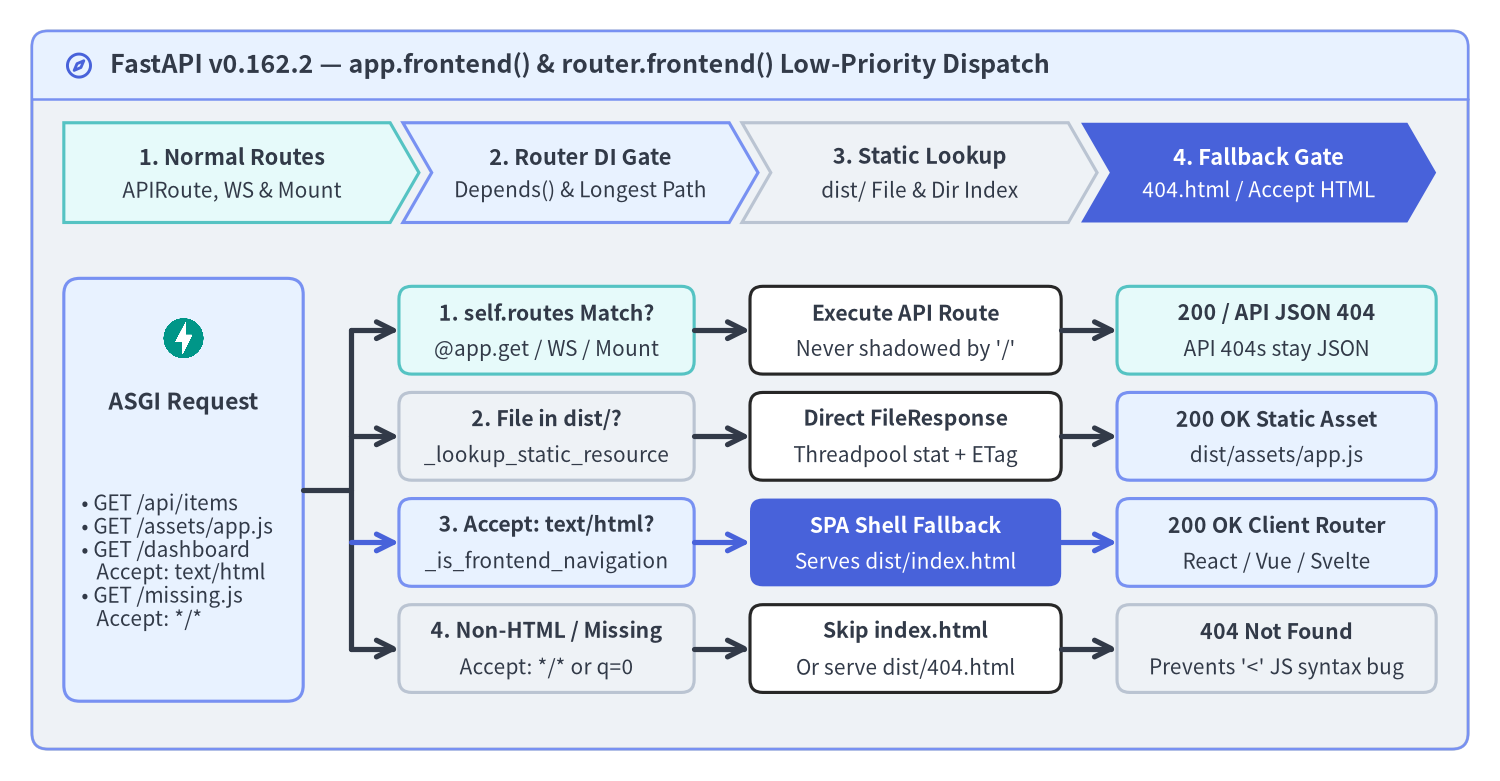
FastAPI v0.162.2 unifies modern Single-Page Application (SPA) delivery, server-rendered HTML templates, isolated ASGI sub-applications, and incremental WSGI migrations on a single process—anchored by the native app.frontend() and router.frontend() low-priority static routing engine.
Source Code
from drawlib.canvas import save, setup
from drawlib.icons import code, phosphor
from drawlib.lines import line, lines
from drawlib.shapes import rectangle
from drawlib.smartarts import ChevronProcess, Panel
from drawlib.styles import Styles
from drawlib.text import text

setup(width=188, height=98, dpi=150)

outer = Panel(
    "FastAPI v0.162.2 — app.frontend() & router.frontend() Low-Priority Dispatch",
    style=Styles.Neutral.patch(shape_r=2.0),
    header_style=Styles.PrimaryNeutral.patch(shape_line_width=1.2),
    text_style=Styles.DarkBold.patch(text_size=12.0),
    icon=phosphor.compass,
    icon_style=Styles.PrimaryBold,
    header_variant="filled",
    header_height=8.5,
)
outer.draw((4.0, 4.0), width=180.0, height=90.0)

# Top 4-Stage Evaluation Order inside APIRouter.app()
stages = ChevronProcess(
    style=Styles.Neutral,
    text_style=Styles.DarkBold.patch(text_size=10.5),
    description_style=Styles.Dark.patch(text_size=10.0),
    corner_angle=60.0,
    spacing=1.6,
    flat_left_end=True,
)
stages.add("1. Normal Routes", description="APIRoute, WS & Mount", style=Styles.SecondaryNeutral)
stages.add("2. Router DI Gate", description="Depends() & Longest Path", style=Styles.PrimaryNeutral)
stages.add("3. Static Lookup", description="dist/ File & Dir Index", style=Styles.Neutral)
stages.add(
    "4. Fallback Gate",
    description="404.html / Accept HTML",
    style=Styles.PrimaryFlat,
    text_style=Styles.WhiteBold.patch(text_size=10.5),
    description_style=Styles.White.patch(text_size=10.0),
)
stages.draw(xy=(8.0, 70.0), width=172.0, height=12.5)

# Left Ingress Card (cx=23, cy=36.5, w=30, h=53 -> x=8..38, y=10..63)
rectangle((23.0, 36.5), width=30.0, height=53.0, style=Styles.PrimaryNeutral.patch(shape_r=2.0))
code.fastapi((23.0, 55.5), width=5.6, style=Styles.Primary)
text((23.0, 47.5), "ASGI Request", style=Styles.DarkBold.patch(text_size=11.0))
text(
    (10.2, 27.5),
    "• GET /api/items\n• GET /assets/app.js\n• GET /dashboard\n   Accept: text/html\n• GET /missing.js\n   Accept: */*",
    style=Styles.Dark.patch(text_size=10.0, halign="left"),
)

# 4 Outcome Tracks (y = 56.5, 43.2, 29.9, 16.6)
tracks = [
    (
        56.5,
        ("1. self.routes Match?", "@app.get / WS / Mount", Styles.SecondaryNeutral, False),
        ("Execute API Route", "Never shadowed by '/'", Styles.White, False),
        ("200 / API JSON 404", "API 404s stay JSON", Styles.SecondaryNeutral, False),
        False,
    ),
    (
        43.2,
        ("2. File in dist/?", "_lookup_static_resource", Styles.Neutral, False),
        ("Direct FileResponse", "Threadpool stat + ETag", Styles.White, False),
        ("200 OK Static Asset", "dist/assets/app.js", Styles.PrimaryNeutral, False),
        False,
    ),
    (
        29.9,
        ("3. Accept: text/html?", "_is_frontend_navigation", Styles.PrimaryNeutral, False),
        ("SPA Shell Fallback", "Serves dist/index.html", Styles.PrimaryFlat, True),
        ("200 OK Client Router", "React / Vue / Svelte", Styles.PrimaryNeutral, False),
        True,
    ),
    (
        16.6,
        ("4. Non-HTML / Missing", "Accept: */* or q=0", Styles.Neutral, False),
        ("Skip index.html", "Or serve dist/404.html", Styles.White, False),
        ("404 Not Found", "Prevents '<' JS syntax bug", Styles.Neutral, False),
        False,
    ),
]

# Orthogonal trunk x=38 -> x=44 -> 4 tracks entering x=50 (6.0u arrow gap)
line((38.0, 36.5), (44.0, 36.5), style=Styles.DarkBold)
lines([(44.0, 16.6), (44.0, 56.5)], style=Styles.DarkBold)

for ty, c1, c2, c3, is_focal in tracks:
    arr_style = Styles.PrimaryBold if is_focal else Styles.DarkBold
    line((44.0, ty), (50.0, ty), arrow_head="->", style=arr_style)

    # Column 1: cx=68.5, w=37 -> x=50..87
    rectangle((68.5, ty), width=37.0, height=11.0, style=c1[2].patch(shape_r=1.6))
    text((68.5, ty + 2.2), c1[0], style=Styles.DarkBold.patch(text_size=10.2))
    text((68.5, ty - 2.4), c1[1], style=Styles.Dark.patch(text_size=10.0))

    # Gap 87 -> 94 (7.0u)
    line((87.0, ty), (94.0, ty), arrow_head="->", style=arr_style)

    # Column 2: cx=113.5, w=39 -> x=94..133
    rectangle((113.5, ty), width=39.0, height=11.0, style=c2[2].patch(shape_r=1.6))
    h_st = Styles.WhiteBold if c2[3] else Styles.DarkBold
    b_st = Styles.White if c2[3] else Styles.Dark
    text((113.5, ty + 2.2), c2[0], style=h_st.patch(text_size=10.2))
    text((113.5, ty - 2.4), c2[1], style=b_st.patch(text_size=10.0))

    # Gap 133 -> 140 (7.0u)
    line((133.0, ty), (140.0, ty), arrow_head="->", style=arr_style)

    # Column 3: cx=160.0, w=40 -> x=140..180
    rectangle((160.0, ty), width=40.0, height=11.0, style=c3[2].patch(shape_r=1.6))
    text((160.0, ty + 2.2), c3[0], style=Styles.DarkBold.patch(text_size=10.2))
    text((160.0, ty - 2.4), c3[1], style=Styles.Dark.patch(text_size=10.0))

save()
1. Native SPA Serving with app.frontend() & router.frontend()
Historically, serving a React, Vue, or Svelte build at "/" via app.mount("/", StaticFiles(directory="dist", html=True)) forced awkward registration ordering—mounting "/" too early shadowed @app.get("/api/..."), and StaticFiles(html=True) returned 404 whenever a user refreshed a client-side route like /dashboard/analytics.
FastAPI v0.162.2 solves both problems natively with app.frontend() and router.frontend(). Instead of appending a greedy ASGI Mount onto router.routes, FastAPI registers a _FrontendRouteGroup inside router._low_priority_routes, which APIRouter.app() evaluates only after all normal routes, WebSocket endpoints, and slash redirects across the entire router tree fail to match.
| Parameter & Option | Default | Runtime Behavior in _FrontendStaticFiles (fastapi/routing.py) |
|---|---|---|
fallback="auto" |
Yes | Serves 404.html (404) if present in directory; else serves index.html (200) on HTML navigation requests; else raises 404 |
fallback="index.html" |
No | Serves index.html (200) on HTML navigation even if 404.html also exists; validates index.html at startup when check_dir is enabled |
fallback="404.html" |
No | Serves 404.html with HTTP status 404 for any missing path under the frontend prefix; validates 404.html at startup |
fallback=None |
No | Disables fallback completely; only exact files and subdirectory index.html files resolve, returning JSON 404 otherwise |
check_dir="auto" |
Yes | Skips startup directory check with a UserWarning when FASTAPI_ENV="development" (set by fastapi dev), and enforces RuntimeError in production |
Global Route Precedence, Segment Specificity & Router Dependencies
Under the hood, _FrontendRoute and _FrontendRouteGroup enforce four production safeguards that hand-rolled catch-all @app.get("/{full_path:path}") handlers routinely get wrong:
- Global API Precedence & Preserved API
404s: NormalAPIRouteandWebSockethandlers win regardless ofinclude_router()registration order. If@app.get("/api/items/{item_id}")matches the path and raisesHTTPException(404), FastAPI returns that JSON404—it never masks backend errors withdist/index.html. - Content-Negotiated Browser Navigation (
_is_frontend_navigation_request): When falling back toindex.html, FastAPI parses theAcceptheader's media types and quality weights (q). OnlyGET/HEADrequests explicitly acceptingtext/htmlorapplication/xhtml+xml(q != 0) receiveindex.html(200 OK). Missing scripts (GET /assets/missing.jswithAccept: */*) or mistyped API fetches (Accept: application/json) receive a clean404, preventing browsers from choking onUncaught SyntaxError: Unexpected token '<'. - Longest Segment-Boundary Prefix: Registering both
app.frontend("/", directory="site")androuter.frontend("/admin", directory="admin_dist")matches on strict path segments (/adminnever intercepts/administration) and selects the highest-specificity prefix. - Full Dependency Injection on Protected Frontends:
router.frontend()executes app-level,include_router()-level, andAPIRouter(dependencies=[Depends(...)])dependencies in outer-to-inner order—supporting cookie session gates, customResponseheaders,BackgroundTasks, andapp.dependency_overridesin tests.
from pathlib import Path
from fastapi import APIRouter, Depends, FastAPI, HTTPException, Request
from fastapi.testclient import TestClient


def build_spa_service(dist_dir: Path, admin_dist: Path) -> FastAPI:
    app = FastAPI(title="Unified API + SPA Service")

    @app.get("/api/items/{item_id}")
    async def read_item(item_id: int) -> dict[str, object]:
        if item_id == 0:
            raise HTTPException(status_code=404, detail="Item not found")
        return {"item_id": item_id, "source": "api"}

    def require_admin_cookie(request: Request) -> None:
        if request.cookies.get("__Host-admin_session") != "verified-session":
            raise HTTPException(status_code=401, detail="Admin session required")

    admin_router = APIRouter(dependencies=[Depends(require_admin_cookie)])
    admin_router.frontend("/admin", directory=admin_dist, fallback="index.html")
    app.include_router(admin_router)

    # Low-priority SPA mount at "/" never shadows /api/* or /admin/*
    app.frontend("/", directory=dist_dir, fallback="auto")
    return app
2. Choosing Between SPA frontend(), Templates, Mounts & WSGI
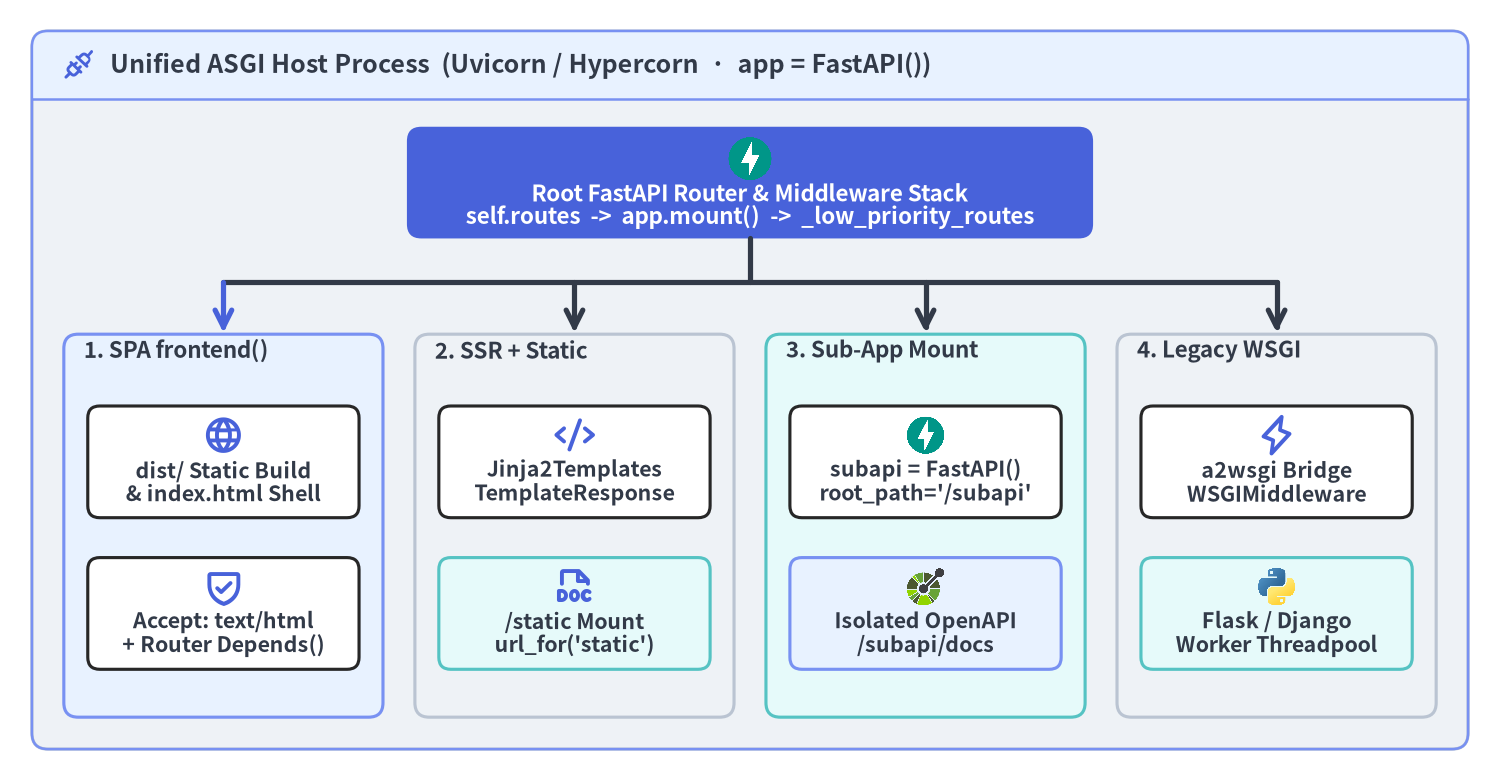
A single FastAPI ASGI host can combine multiple UI delivery and service-composition strategies side by side, depending on whether rendering happens in the browser, in Jinja2 on the server, in an isolated sub-team FastAPI app, or inside a legacy synchronous WSGI codebase:
Source Code
from drawlib.canvas import save, setup
from drawlib.diagrams.architecture import (
    ArchitectureDiagram,
    CodeIcon,
    Node,
    NodeGroup,
    PhosphorIcon,
)
from drawlib.icons import phosphor
from drawlib.lines import line, lines
from drawlib.smartarts import Panel
from drawlib.styles import Styles

setup(width=188, height=98, dpi=150)

outer = Panel(
    "Unified ASGI Host Process  (Uvicorn / Hypercorn  ·  app = FastAPI())",
    style=Styles.Neutral.patch(shape_r=2.0),
    header_style=Styles.PrimaryNeutral.patch(shape_line_width=1.2),
    text_style=Styles.DarkBold.patch(text_size=12.0),
    icon=phosphor.plugs,
    icon_style=Styles.PrimaryBold,
    header_variant="filled",
    header_height=8.5,
)
outer.draw((4.0, 4.0), width=180.0, height=90.0)

diag = ArchitectureDiagram(
    node_style=Styles.PrimaryBold,
    node_text_style=Styles.DarkBold.patch(text_size=10.3),
    edge_style=Styles.DarkBold,
    edge_text_style=Styles.Dark.patch(text_size=10.0),
    node_card_style=Styles.White.patch(shape_r=1.5),
)

# Top Focal Dispatcher Node (center at y=75.0 -> bottom=68.0)
diag.add(
    Node(
        "Root FastAPI Router & Middleware Stack\nself.routes  ->  app.mount()  ->  _low_priority_routes",
        width=86.0,
        height=14.0,
        icon=CodeIcon.FASTAPI,
        icon_size=6.0,
        card_style=Styles.PrimaryFlat.patch(shape_r=1.8),
        text_style=Styles.WhiteBold.patch(text_size=10.8),
        style=Styles.WhiteBold,
    ),
    (94.0, 75.0),
)

# 4 Strategy Columns: x = 8, 52, 96, 140 (width=40, height=48, y=8..56, centers cx=28, 72, 116, 160)
g_spa = diag.add(
    NodeGroup(
        title="1. SPA frontend()",
        width=40.0,
        height=48.0,
        style=Styles.PrimaryNeutral.patch(shape_r=1.8),
        text_style=Styles.DarkBold.patch(halign="left", text_size=10.8),
    ),
    (8.0, 8.0),
)
g_spa.add(
    Node("dist/ Static Build\n& index.html Shell", width=34.0, height=14.0, icon=PhosphorIcon.GLOBE, icon_size=5.2),
    (20.0, 32.0),
)
g_spa.add(
    Node("Accept: text/html\n+ Router Depends()", width=34.0, height=14.0, icon=PhosphorIcon.SHIELD_CHECK, icon_size=5.2),
    (20.0, 13.0),
)

g_ssr = diag.add(
    NodeGroup(
        title="2. SSR + Static",
        width=40.0,
        height=48.0,
        style=Styles.Neutral.patch(shape_r=1.8),
        text_style=Styles.DarkBold.patch(halign="left", text_size=10.8),
    ),
    (52.0, 8.0),
)
g_ssr.add(
    Node("Jinja2Templates\nTemplateResponse", width=34.0, height=14.0, icon=PhosphorIcon.CODE, icon_size=5.2),
    (20.0, 32.0),
)
g_ssr.add(
    Node("/static Mount\nurl_for('static')", width=34.0, height=14.0, icon=PhosphorIcon.FILE_DOC, icon_size=5.2, card_style=Styles.SecondaryNeutral),
    (20.0, 13.0),
)

g_sub = diag.add(
    NodeGroup(
        title="3. Sub-App Mount",
        width=40.0,
        height=48.0,
        style=Styles.SecondaryNeutral.patch(shape_r=1.8),
        text_style=Styles.DarkBold.patch(halign="left", text_size=10.8),
    ),
    (96.0, 8.0),
)
g_sub.add(
    Node("subapi = FastAPI()\nroot_path='/subapi'", width=34.0, height=14.0, icon=CodeIcon.FASTAPI, icon_size=5.2),
    (20.0, 32.0),
)
g_sub.add(
    Node("Isolated OpenAPI\n/subapi/docs", width=34.0, height=14.0, icon=CodeIcon.OPENAPI, icon_size=5.2, card_style=Styles.PrimaryNeutral),
    (20.0, 13.0),
)

g_wsgi = diag.add(
    NodeGroup(
        title="4. Legacy WSGI",
        width=40.0,
        height=48.0,
        style=Styles.Neutral.patch(shape_r=1.8),
        text_style=Styles.DarkBold.patch(halign="left", text_size=10.8),
    ),
    (140.0, 8.0),
)
g_wsgi.add(
    Node("a2wsgi Bridge\nWSGIMiddleware", width=34.0, height=14.0, icon=PhosphorIcon.LIGHTNING, icon_size=5.2),
    (20.0, 32.0),
)
g_wsgi.add(
    Node("Flask / Django\nWorker Threadpool", width=34.0, height=14.0, icon=CodeIcon.PYTHON, icon_size=5.2, card_style=Styles.SecondaryNeutral),
    (20.0, 13.0),
)

diag.draw()

# Orthogonal fan-out bus from Root Node bottom (y=68.0) -> bus (y=62.5) -> group tops (y=56.0, 6.3u terminal gap)
line((94.0, 68.0), (94.0, 62.5), style=Styles.DarkBold)
lines([(28.0, 62.5), (160.0, 62.5)], style=Styles.DarkBold)
for cx in (28.0, 72.0, 116.0, 160.0):
    line((cx, 62.5), (cx, 56.2), arrow_head="->", style=Styles.PrimaryBold if cx == 28.0 else Styles.DarkBold)

save()
| Integration Mechanism | Registration API | Priority & Scope Isolation | Best Fit |
|---|---|---|---|
| SPA Static Build | app.frontend("/", directory="dist") |
Lowest priority (_low_priority_routes); supports Depends() |
Vite, React, Vue, Svelte, Astro, or static docs co-hosted with /api |
| Named Asset Mount | app.mount("/static", StaticFiles(...), name="static") |
Prefix Mount in self.routes; enables url_for("static", ...) |
Versioned CSS/JS/images referenced by Jinja2 or self-hosted Swagger UI |
| Server-Side Templates | Jinja2Templates(directory="templates") |
Standard APIRoute (response_class=HTMLResponse) |
HTMX fragments, transactional emails, SEO landing pages |
| Isolated Sub-App | app.mount("/subapi", subapi) |
Independent FastAPI instance (root_path="/subapi", own /docs) |
Multi-version public APIs (/v2), partner portals, admin micro-apps |
| Legacy WSGI Mount | app.mount("/v1", WSGIMiddleware(flask_app)) |
Synchronous WSGI bridged onto worker threads via a2wsgi |
Incremental Strangler-Fig migration from Flask or Django to FastAPI |
3. Server-Rendered HTML with Jinja2Templates & StaticFiles
When building server-rendered pages or HTMX endpoints, install jinja2 and pair fastapi.templating.Jinja2Templates with a named StaticFiles mount:
- Modern Keyword Signature (
TemplateResponse): Always passrequest=request, name="item.html", context={...}as keyword arguments (Starlette deprecated the legacy positionalTemplateResponse("item.html", {"request": request})call signature). - Reverse Asset URLs (
url_for): Naming the mount (name="static") lets templates generate proxy-aware URLs via{{ url_for('static', path='/styles.css') }}, automatically respecting upstreamroot_pathprefixes. - XSS Auto-Escaping by Default: Jinja2 enables
autoescapeautomatically for.html,.htm, and.xmltemplates. Always wrap interpolated HTML attributes in double quotes (data-item-id="{{ id }}") and avoid| safeon untrusted strings.
from pathlib import Path
from typing import Annotated
from fastapi import FastAPI, Path as PathParam, Request
from fastapi.responses import HTMLResponse
from fastapi.staticfiles import StaticFiles
from fastapi.templating import Jinja2Templates


def create_ssr_app(static_dir: Path, templates_dir: Path) -> FastAPI:
    app = FastAPI()
    app.mount("/static", StaticFiles(directory=static_dir), name="static")
    templates = Jinja2Templates(directory=templates_dir)

    # templates/item.html:
    # <link href="{{ url_for('static', path='/styles.css') }}" rel="stylesheet">
    # <h1 data-item-id="{{ id }}">Item: {{ title }}</h1>
    @app.get("/items/{id}", response_class=HTMLResponse)
    async def read_item_page(
        request: Request,
        id: Annotated[str, PathParam(pattern=r"^[a-zA-Z0-9_-]+$")],
        title: str = "Wireless Keyboard",
    ) -> HTMLResponse:
        return templates.TemplateResponse(
            request=request,
            name="item.html",
            context={"id": id, "title": title},
        )

    return app
4. Isolated Sub-Applications & Legacy WSGI Migration (a2wsgi)
Independent Sub-Apps & Automatic ASGI root_path Propagation
Unlike app.include_router(), which merges routes into a single OpenAPI schema and shared middleware stack, app.mount("/subapi", subapi) attaches a completely independent ASGI application:
- Isolated OpenAPI & Docs UI: The host app exposes
/openapi.jsonand/docscontaining only host routes, whilesubapiserves its own isolated/subapi/openapi.jsonand/subapi/docs. - Automatic
root_pathInjection: Starlette'sMountappends"/subapi"ontoscope["root_path"]before invokingsubapi, so Swagger UI at/subapi/docsautomatically resolves its schema and interactive "Try it out" requests relative to/subapi. - Lifespan Note: Mounted sub-applications do not have their
lifespanevents executed automatically by Starlette'sMount; initialize shared pools in the top-level hostlifespanor compose sub-app lifespans explicitly withcontextlib.AsyncExitStack(see Enterprise DI, Lifespan & Testing).
Strangler-Fig WSGI Migration with a2wsgi.WSGIMiddleware
When migrating an existing Flask or Django monolith incrementally to FastAPI, mount the legacy WSGI callable under a prefix while building new async endpoints on the outer FastAPI host. Because Starlette deprecated starlette.middleware.wsgi.WSGIMiddleware, FastAPI recommends a2wsgi.WSGIMiddleware (pip install a2wsgi), which streams request/response chunks safely between the async event loop and synchronous WSGI worker threads while populating SCRIPT_NAME from the mount prefix:
from a2wsgi import WSGIMiddleware
from fastapi import FastAPI, Request
from flask import Flask, jsonify, request as flask_request

# 1. Independent FastAPI sub-application with isolated /subapi/docs
subapi = FastAPI(title="Partner Sub-API", version="2.0.0")


@subapi.get("/sub")
def read_sub(request: Request) -> dict[str, str]:
    return {
        "message": "Hello from sub-application",
        "root_path": request.scope.get("root_path", ""),
    }


# 2. Legacy synchronous Flask (WSGI) application
flask_app = Flask(__name__)


@flask_app.get("/orders")
def legacy_orders():
    return jsonify({"service": "legacy-flask", "script_name": flask_request.script_root})


# 3. Unified FastAPI host mounting both the sub-app and WSGI bridge
app = FastAPI(title="Main Gateway API", version="1.0.0")


@app.get("/app")
def read_main() -> dict[str, str]:
    return {"message": "Hello World from main app"}


app.mount("/subapi", subapi)
app.mount("/v1", WSGIMiddleware(flask_app))
Next, explore how FastAPI extends OpenAPI 3.1.0 for asynchronous event push, client SDK code generation, and air-gapped documentation portals in Webhooks, Callbacks, SDKs & Docs UI, or review reverse-proxy --forwarded-allow-ips deployment in FastAPI CLI, Proxies, GraphQL & AI.