JWT (PyJWT + Argon2) & WebSocket Security
Production FastAPI v0.162.2 services pair memory-hard pwdlib Argon2id password hashing (with DUMMY_HASH anti-enumeration) and stateless PyJWT bearer verification for HTTP APIs, while extending the exact same Security() and SecurityScopes dependency graph to WebSocket handshakes via Starlette's shared HTTPConnection abstraction (v0.144.0+).
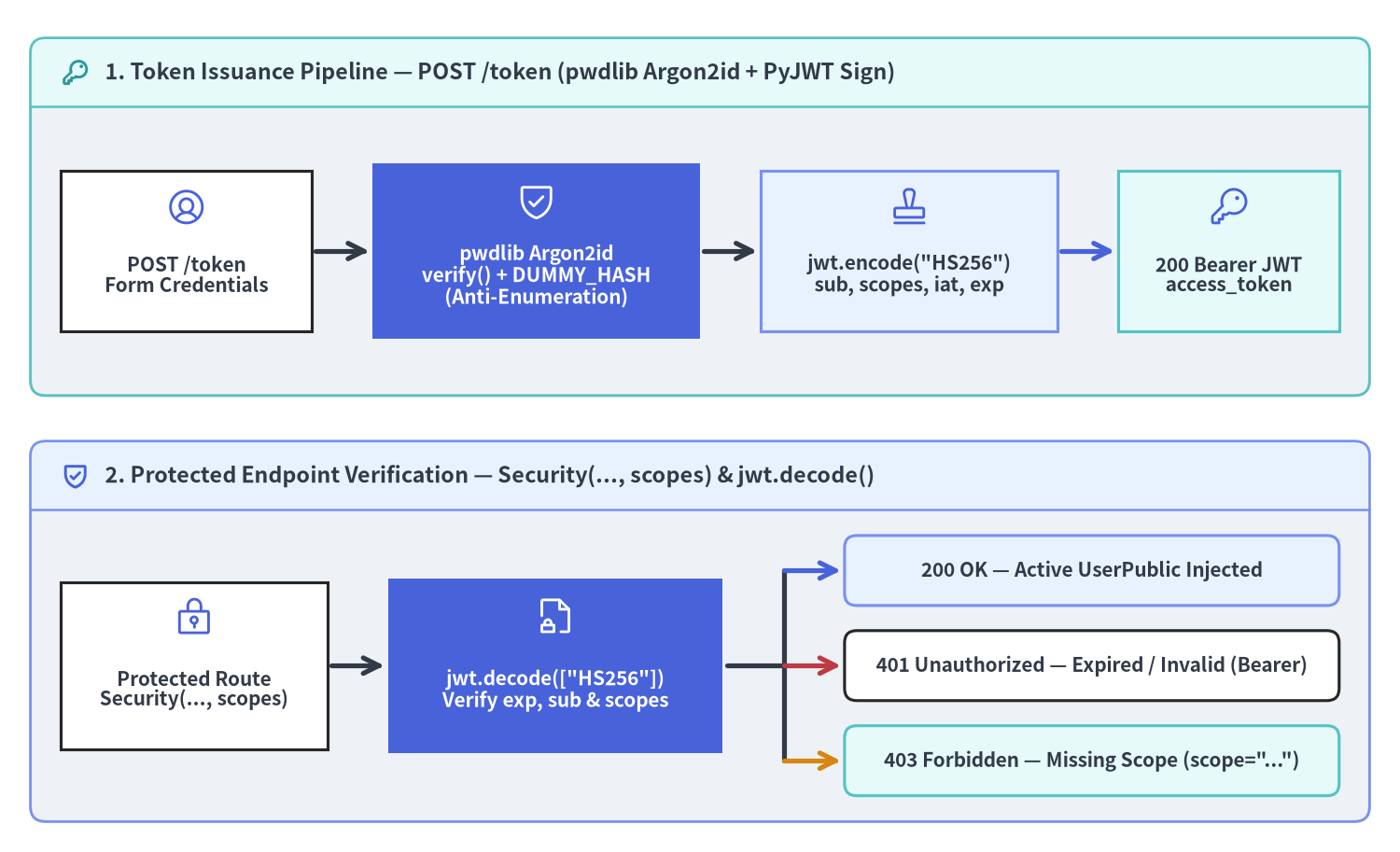
Source Code
from drawlib.canvas import save, setup
from drawlib.diagrams.architecture import ArchitectureDiagram, Node, PhosphorIcon
from drawlib.icons import phosphor
from drawlib.lines import line
from drawlib.shapes import rectangle
from drawlib.smartarts import Panel
from drawlib.styles import Styles
from drawlib.text import text

setup(width=184, height=112, dpi=150)

# Top Lane: Phase 1 — POST /token Credential Verification & JWT Issuance
issue_panel = Panel(
    "1. Token Issuance Pipeline — POST /token (pwdlib Argon2id + PyJWT Sign)",
    style=Styles.Neutral.patch(shape_r=2.0),
    header_style=Styles.SecondaryNeutral.patch(shape_line_width=1.2),
    text_style=Styles.DarkBold.patch(text_size=11.2),
    icon=phosphor.key,
    icon_style=Styles.SecondaryBold,
    header_variant="filled",
    header_height=9.0,
)
issue_panel.draw((4.0, 60.0), width=176.0, height=47.0, align="bottom_left")

# Bottom Lane: Phase 2 — Protected Route Stateless Decode & Scope Check
verify_panel = Panel(
    "2. Protected Endpoint Verification — Security(..., scopes) & jwt.decode()",
    style=Styles.Neutral.patch(shape_r=2.0),
    header_style=Styles.PrimaryNeutral.patch(shape_line_width=1.2),
    text_style=Styles.DarkBold.patch(text_size=11.2),
    icon=phosphor.shield_check,
    icon_style=Styles.PrimaryBold,
    header_variant="filled",
    header_height=9.0,
)
verify_panel.draw((4.0, 4.0), width=176.0, height=50.0, align="bottom_left")

arch = ArchitectureDiagram(
    width=184.0,
    height=112.0,
    node_style=Styles.Primary,
    node_text_style=Styles.DarkBold.patch(text_size=10.0),
    edge_style=Styles.DarkBold,
    edge_text_style=Styles.Dark.patch(text_size=10.0),
    node_card_style=Styles.Neutral,
)

# Phase 1 Nodes (cy = 79.0, inside y in [62.0, 96.0])
n_form = arch.add(
    Node(
        "POST /token\nForm Credentials",
        width=33.0,
        height=21.0,
        icon=PhosphorIcon.USER_CIRCLE,
        icon_size=5.6,
        card_style=Styles.White,
    ),
    xy=(24.5, 79.0),
)

n_argon = arch.add(
    Node(
        "pwdlib Argon2id\nverify() + DUMMY_HASH\n(Anti-Enumeration)",
        width=43.0,
        height=23.0,
        icon=PhosphorIcon.SHIELD_CHECK,
        icon_size=5.6,
        style=Styles.White,
        card_style=Styles.PrimaryFlat,
        text_style=Styles.WhiteBold.patch(text_size=10.0),
    ),
    xy=(70.5, 79.0),
)

n_encode = arch.add(
    Node(
        'jwt.encode("HS256")\nsub, scopes, iat, exp',
        width=39.0,
        height=21.0,
        icon=PhosphorIcon.STAMP,
        icon_size=5.6,
        card_style=Styles.PrimaryNeutral,
    ),
    xy=(119.5, 79.0),
)

n_jwt_out = arch.add(
    Node(
        "200 Bearer JWT\naccess_token",
        width=29.0,
        height=21.0,
        icon=PhosphorIcon.KEY,
        icon_size=5.6,
        card_style=Styles.SecondaryNeutral,
    ),
    xy=(161.5, 79.0),
)

# Phase 2 Nodes (cy = 24.5, inside y in [6.0, 43.0])
n_route = arch.add(
    Node(
        "Protected Route\nSecurity(..., scopes)",
        width=35.0,
        height=22.0,
        icon=PhosphorIcon.LOCK_KEY,
        icon_size=5.6,
        card_style=Styles.White,
    ),
    xy=(25.5, 24.5),
)

n_decode = arch.add(
    Node(
        'jwt.decode(["HS256"])\nVerify exp, sub & scopes',
        width=44.0,
        height=23.0,
        icon=PhosphorIcon.FILE_LOCK,
        icon_size=5.6,
        style=Styles.White,
        card_style=Styles.PrimaryFlat,
        text_style=Styles.WhiteBold.patch(text_size=10.0),
    ),
    xy=(73.0, 24.5),
)

arch.draw(xy=(0.0, 0.0))

# Phase 1 Horizontal Connectors (all gaps = 8.0 units)
line((41.5, 79.0), (48.5, 79.0), arrow_head="->", style=Styles.DarkBold)
line((92.5, 79.0), (99.5, 79.0), arrow_head="->", style=Styles.DarkBold)
line((139.5, 79.0), (146.5, 79.0), arrow_head="->", style=Styles.PrimaryBold)

# Phase 2 Connector + 3 Outcome Cards on Right (x in [111.0, 176.0], cx = 143.5)
line((43.5, 24.5), (50.5, 24.5), arrow_head="->", style=Styles.DarkBold)
line((95.5, 24.5), (103.0, 24.5), style=Styles.DarkBold)
line((103.0, 12.0), (103.0, 37.0), style=Styles.DarkBold)

outcomes = [
    (
        37.0,
        Styles.PrimaryNeutral,
        Styles.PrimaryBold,
        "200 OK — Active UserPublic Injected",
    ),
    (
        24.5,
        Styles.White,
        Styles.DangerBold,
        "401 Unauthorized — Expired / Invalid (Bearer)",
    ),
    (
        12.0,
        Styles.SecondaryNeutral,
        Styles.WarningBold,
        '403 Forbidden — Missing Scope (scope="...")',
    ),
]
for cy, card_st, arrow_st, label in outcomes:
    line((103.0, cy), (110.5, cy), arrow_head="->", style=arrow_st)
    rectangle((143.5, cy), width=65.0, height=9.2, style=card_st.patch(shape_r=1.6))
    text((143.5, cy), label, style=Styles.DarkBold.patch(text_size=10.0))

save()
1. Password Hashing (pwdlib Argon2id) & Stateless PyJWT Tokens
Modern FastAPI deployments standardize on pwdlib[argon2] (PasswordHash.recommended()) and PyJWT (import jwt) rather than legacy passlib or python-jose, avoiding bcrypt 72-byte truncation pitfalls and unmaintained cryptographic wrappers. Combining pwdlib and PyJWT inside the Authentication & OAuth2 Scopes dependency tree requires four defensive invariants:
| Security Control | Recommended Implementation | Vulnerability Prevented |
|---|---|---|
| Memory-Hard Password KDF | PasswordHash.recommended() (pwdlib[argon2]) |
Defeats GPU/ASIC offline cracking with Argon2id memory-hardness and unique random per-user salts |
Anti-Enumeration DUMMY_HASH |
Precompute DUMMY_HASH = password_hash.hash(...) at startup; run password_hash.verify(pw, DUMMY_HASH) when user is missing |
Eliminates ~50ms+ response-time discrepancy between unknown usernames and wrong passwords |
| Algorithm Pinning & Required Claims | jwt.decode(token, KEY, algorithms=["HS256"], options={"require": ["sub", "iat", "exp"]}) |
Blocks "alg": "none" signature bypasses, RS256/HS256 public-key confusion, and Immortal tokens |
| Key Entropy & Zero Hardcoding | Load 256-bit+ keys from KMS / environment (pydantic-settings); never commit fallback literals |
Prevents offline JWT forgery from leaked repository source code |
1.1 Production /token Issuance, DUMMY_HASH & get_current_active_user
In the implementation below, authenticate_user() always runs a full Argon2id verification pass even when username does not exist in users_db. Downstream, get_current_user() decodes the JWT with an explicit algorithms=["HS256"] allowlist, maps ExpiredSignatureError and InvalidTokenError to RFC 6750 401 Unauthorized responses, and enforces accumulated SecurityScopes (403 Forbidden on missing permissions) before get_current_active_user() checks account suspension state:
import os
import secrets
from datetime import datetime, timedelta, timezone
from typing import Annotated

import jwt
from fastapi import Depends, FastAPI, HTTPException, Security, status
from fastapi.security import (
    OAuth2PasswordBearer,
    OAuth2PasswordRequestForm,
    SecurityScopes,
)
from fastapi.testclient import TestClient
from jwt.exceptions import ExpiredSignatureError, InvalidTokenError
from pwdlib import PasswordHash
from pydantic import BaseModel

SECRET_KEY = os.environ.get("JWT_SECRET_KEY") or secrets.token_hex(32)
ALGORITHM = "HS256"
ACCESS_TOKEN_EXPIRE_MINUTES = 15

password_hash = PasswordHash.recommended()
DUMMY_HASH = password_hash.hash("dummypassword")


class Token(BaseModel):
    access_token: str
    token_type: str


class UserRecord(BaseModel):
    username: str
    hashed_password: str
    scopes: list[str]
    disabled: bool = False


class UserPublic(BaseModel):
    username: str
    scopes: list[str]
    disabled: bool = False


alice_password = secrets.token_urlsafe(12)
users_db: dict[str, UserRecord] = {
    "alice": UserRecord(
        username="alice",
        hashed_password=password_hash.hash(alice_password),
        scopes=["me:read", "reports:export"],
    ),
}

oauth2_scheme = OAuth2PasswordBearer(
    tokenUrl="/token",
    scopes={
        "me:read": "Read current user profile",
        "reports:export": "Export audit reports",
    },
)


def authenticate_user(
    db: dict[str, UserRecord],
    username: str,
    password: str,
) -> UserRecord | None:
    user = db.get(username)
    if user is None:
        # Always run Argon2id against DUMMY_HASH to defeat timing user-enumeration
        password_hash.verify(password, DUMMY_HASH)
        return None
    if not password_hash.verify(password, user.hashed_password):
        return None
    return user


def create_access_token(
    *,
    subject: str,
    scopes: list[str],
    expires_delta: timedelta,
) -> str:
    now = datetime.now(timezone.utc)
    payload = {
        "sub": subject,
        "scopes": scopes,
        "iat": now,
        "exp": now + expires_delta,
    }
    return jwt.encode(payload, SECRET_KEY, algorithm=ALGORITHM)


app = FastAPI()


@app.post("/token", response_model=Token)
async def login_for_access_token(
    form_data: Annotated[OAuth2PasswordRequestForm, Depends()],
) -> Token:
    user = authenticate_user(users_db, form_data.username, form_data.password)
    if user is None:
        raise HTTPException(
            status_code=status.HTTP_401_UNAUTHORIZED,
            detail="Incorrect username or password",
            headers={"WWW-Authenticate": "Bearer"},
        )
    granted_scopes = [s for s in form_data.scopes if s in user.scopes]
    access_token = create_access_token(
        subject=user.username,
        scopes=granted_scopes,
        expires_delta=timedelta(minutes=ACCESS_TOKEN_EXPIRE_MINUTES),
    )
    return Token(access_token=access_token, token_type="bearer")


async def get_current_user(
    security_scopes: SecurityScopes,
    token: Annotated[str, Depends(oauth2_scheme)],
) -> UserRecord:
    auth_header = (
        f'Bearer scope="{security_scopes.scope_str}"'
        if security_scopes.scopes
        else "Bearer"
    )
    try:
        payload = jwt.decode(
            token,
            SECRET_KEY,
            algorithms=[ALGORITHM],
            options={"require": ["sub", "iat", "exp"]},
        )
    except ExpiredSignatureError as exc:
        raise HTTPException(
            status_code=status.HTTP_401_UNAUTHORIZED,
            detail="Token has expired",
            headers={"WWW-Authenticate": auth_header},
        ) from exc
    except InvalidTokenError as exc:
        raise HTTPException(
            status_code=status.HTTP_401_UNAUTHORIZED,
            detail="Could not validate credentials",
            headers={"WWW-Authenticate": auth_header},
        ) from exc

    username = payload.get("sub")
    token_scopes = payload.get("scopes", [])
    if not isinstance(username, str) or not isinstance(token_scopes, list):
        raise HTTPException(
            status_code=status.HTTP_401_UNAUTHORIZED,
            detail="Could not validate credentials",
            headers={"WWW-Authenticate": auth_header},
        )
    user = users_db.get(username)
    if user is None:
        raise HTTPException(
            status_code=status.HTTP_401_UNAUTHORIZED,
            detail="Could not validate credentials",
            headers={"WWW-Authenticate": auth_header},
        )
    for required_scope in security_scopes.scopes:
        if required_scope not in token_scopes:
            raise HTTPException(
                status_code=status.HTTP_403_FORBIDDEN,
                detail=f"Not enough permissions (missing {required_scope})",
                headers={"WWW-Authenticate": auth_header},
            )
    return user


async def get_current_active_user(
    current_user: Annotated[
        UserRecord,
        Security(get_current_user, scopes=["me:read"]),
    ],
) -> UserPublic:
    if current_user.disabled:
        raise HTTPException(
            status_code=status.HTTP_400_BAD_REQUEST,
            detail="Inactive user",
        )
    return UserPublic(
        username=current_user.username,
        scopes=current_user.scopes,
        disabled=current_user.disabled,
    )


@app.get("/users/me", response_model=UserPublic)
async def read_users_me(
    current_user: Annotated[UserPublic, Depends(get_current_active_user)],
) -> UserPublic:
    return current_user


@app.get("/reports/export")
async def export_audit_report(
    current_user: Annotated[
        UserPublic,
        Security(get_current_active_user, scopes=["reports:export"]),
    ],
) -> dict[str, str]:
    return {"exported_by": current_user.username, "status": "ready"}


client = TestClient(app)
login_res = client.post(
    "/token",
    data={"username": "alice", "password": alice_password, "scope": "me:read"},
)
narrow_jwt = login_res.json()["access_token"]
assert client.get("/users/me", headers={"Authorization": f"Bearer {narrow_jwt}"}).status_code == 200
assert client.get("/reports/export", headers={"Authorization": f"Bearer {narrow_jwt}"}).status_code == 403
Because stateless JWTs remain valid until exp, keep access-token lifetimes short (5–15 minutes) and validate user status (disabled or a token_version counter in your database/cache) whenever immediate session revocation is required on logout or privilege downgrade.
2. WebSocket Authentication & v0.144.0+ Security() Support
Prior to FastAPI v0.144.0, built-in fastapi.security extractors annotated their __call__ parameter as request: Request, which prevented reusing OAuth2PasswordBearer or APIKeyCookie directly inside @app.websocket(...) routes. Starting in v0.144.0 through v0.162.2, every SecurityBase subclass (APIKeyCookie, APIKeyQuery, APIKeyHeader, OAuth2PasswordBearer, OAuth2AuthorizationCodeBearer, HTTPBearer, HTTPBasic, OpenIdConnect) accepts Starlette's HTTPConnection base class—shared by both Request and WebSocket (fastapi/dependencies/utils.py injects websocket into dependant.http_connection_param_name).
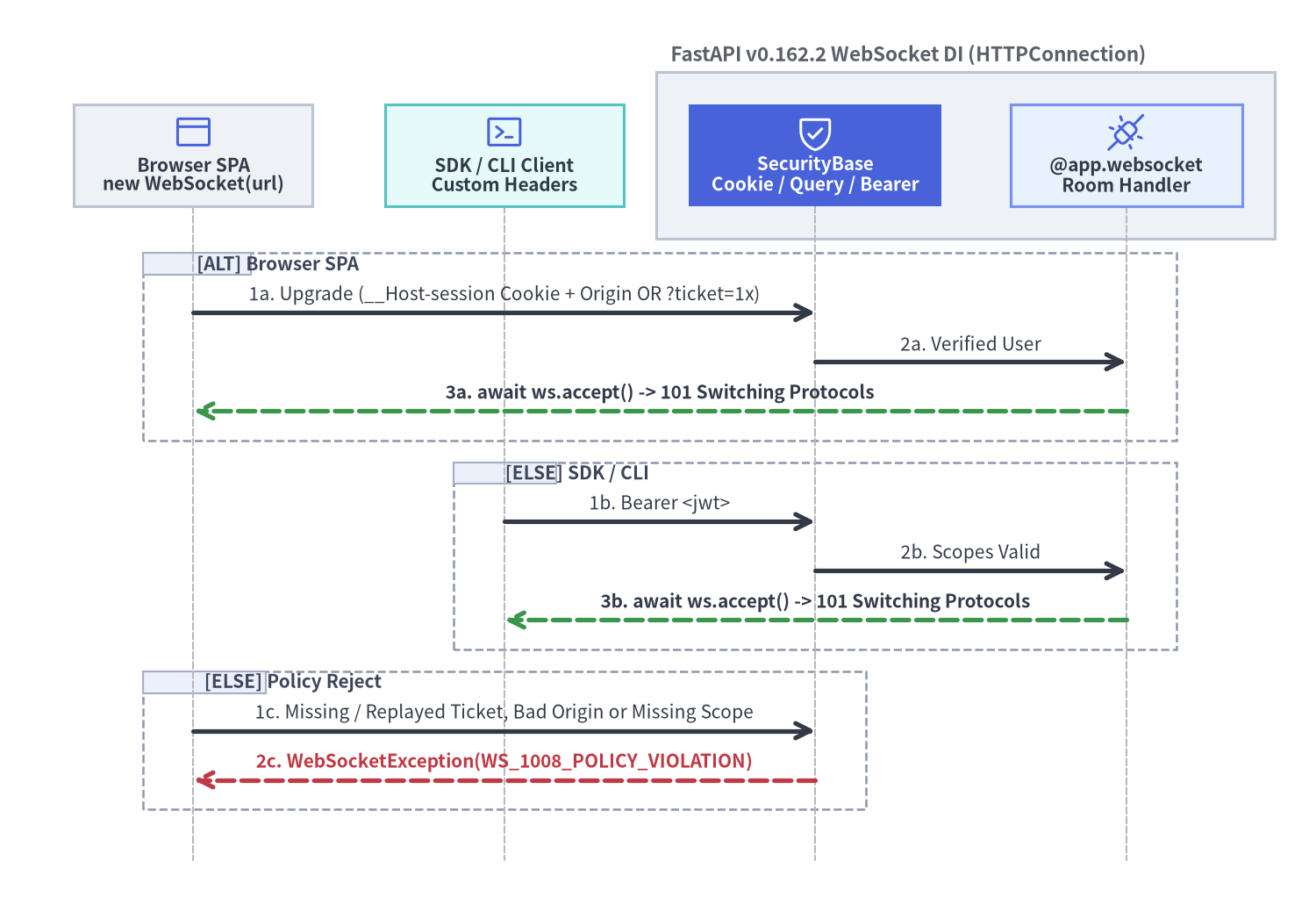
Source Code
from drawlib.canvas import save, setup
from drawlib.diagrams.sequence import Participant, ParticipantGroup, PhosphorIcon, SequenceDiagram
from drawlib.styles import Style, Styles

setup(width=182, height=126, dpi=150)

seq = SequenceDiagram(
    node_style=Styles.Primary,
    node_text_style=Styles.DarkBold.patch(text_size=10.0),
    edge_style=Styles.DarkBold,
    edge_text_style=Styles.Dark.patch(text_size=10.0),
    node_card_style=Styles.Neutral,
    col_width=43.0,
    step_y=6.8,
    margin=5.0,
)

browser = seq.add(
    Participant(
        "Browser SPA\nnew WebSocket(url)",
        width=33,
        height=14,
        icon=PhosphorIcon.BROWSER,
        icon_size=5.6,
        card_style=Styles.Neutral,
    )
)

sdk_client = seq.add(
    Participant(
        "SDK / CLI Client\nCustom Headers",
        width=33,
        height=14,
        icon=PhosphorIcon.TERMINAL_WINDOW,
        icon_size=5.6,
        card_style=Styles.SecondaryNeutral,
    )
)

ws_group = seq.add(
    ParticipantGroup(
        title="FastAPI v0.162.2 WebSocket DI (HTTPConnection)",
        padding=4.5,
        style=Styles.Neutral,
        text_style=Style(text_size=10.8),
    )
)

sec_dep = ws_group.add(
    Participant(
        "SecurityBase\nCookie / Query / Bearer",
        width=35,
        height=14,
        icon=PhosphorIcon.SHIELD_CHECK,
        icon_size=5.6,
        style=Styles.White,
        card_style=Styles.PrimaryFlat,
        text_style=Styles.WhiteBold.patch(text_size=10.0),
    )
)

ws_route = ws_group.add(
    Participant(
        "@app.websocket\nRoom Handler",
        width=32,
        height=14,
        icon=PhosphorIcon.PLUGS_CONNECTED,
        icon_size=5.6,
        card_style=Styles.PrimaryNeutral,
    )
)

with seq.alt("Browser SPA") as blk_browser:
    blk_browser.style = Styles.MutedDashed.patch(shape_line_width=1.2)
    blk_browser.text_style = Style(text_size=10.0, halign="left")
    browser.request(
        sec_dep,
        "1a. Upgrade (__Host-session Cookie + Origin OR ?ticket=1x)",
    )
    sec_dep.request(ws_route, "2a. Verified User")
    ws_route.reply(
        browser,
        "3a. await ws.accept() -> 101 Switching Protocols",
        style=Styles.SuccessBold,
        text_style=Styles.DarkBold.patch(text_size=10.0),
    )

with seq.else_("SDK / CLI") as blk_sdk:
    blk_sdk.style = Styles.MutedDashed.patch(shape_line_width=1.2)
    blk_sdk.text_style = Style(text_size=10.0, halign="left")
    sdk_client.request(sec_dep, "1b. Bearer <jwt>")
    sec_dep.request(ws_route, "2b. Scopes Valid")
    ws_route.reply(
        sdk_client,
        "3b. await ws.accept() -> 101 Switching Protocols",
        style=Styles.SuccessBold,
        text_style=Styles.DarkBold.patch(text_size=10.0),
    )

with seq.else_("Policy Reject") as blk_deny:
    blk_deny.style = Styles.MutedDashed.patch(shape_line_width=1.2)
    blk_deny.text_style = Style(text_size=10.0, halign="left")
    browser.request(
        sec_dep,
        "1c. Missing / Replayed Ticket, Bad Origin or Missing Scope",
    )
    sec_dep.reply(
        browser,
        "2c. WebSocketException(WS_1008_POLICY_VIOLATION)",
        style=Styles.DangerBold,
        text_style=Styles.DangerBold.patch(text_size=10.0),
    )

seq.draw(xy=(91.0, 63.0), align="center")
save()
2.1 Browser DOM Constraints vs HTTPConnection Extractors
Even though FastAPI v0.162.2 supports OAuth2PasswordBearer and APIKeyHeader on WebSocket routes at the server layer, browser JavaScript clients face a WHATWG DOM constraint: new WebSocket(url, protocols) provides no API to attach custom Authorization or X-API-Key headers. Choose your handshake credential transport according to the client environment:
| Transport Pattern | fastapi.security Extractor |
Target Client & Mandatory Hardening |
|---|---|---|
__Host-session Cookie |
APIKeyCookie(name="__Host-session", auto_error=False) |
Same-origin browser SPAs: Set HttpOnly; Secure; SameSite=Lax and always validate the Origin header against an allowlist to block Cross-Site WebSocket Hijacking (CSWSH), since WebSockets skip CORS preflights |
| Single-Use Ephemeral Ticket | APIKeyQuery(name="ticket", auto_error=False) |
Cross-origin browser SPAs: Mint a 30s random opaque ticket over POST /ws/tickets (Bearer auth) and .pop() it atomically on connect—never pass long-lived JWTs in ?token= URLs |
Authorization: Bearer / Header |
OAuth2PasswordBearer(..., auto_error=False) / APIKeyHeader |
Python/Go workers, CLI tools & native mobile apps: Attach standard HTTP headers directly on the WebSocket Upgrade request |
2.2 Pre-Handshake Rejection (WS_1008_POLICY_VIOLATION vs auto_error=True)
When auto_error=True on a SecurityBase extractor and the credential is absent, FastAPI raises HTTPException(status_code=401) inside solve_dependencies(), aborting the HTTP Upgrade with a 401 denial response (WebSocketDenialResponse in TestClient). For multi-transport WebSocket endpoints, set auto_error=False on each extractor, evaluate Origin and SecurityScopes inside a unified dependency before await ws.accept(), and raise WebSocketException(code=status.WS_1008_POLICY_VIOLATION) on any policy failure:
import secrets
import time
from datetime import timedelta
from typing import Annotated

import pytest
from fastapi import (
    FastAPI,
    Header,
    Security,
    WebSocket,
    WebSocketDisconnect,
    WebSocketException,
    status,
)
from fastapi.security import (
    APIKeyCookie,
    APIKeyQuery,
    OAuth2PasswordBearer,
    SecurityScopes,
)
from fastapi.testclient import TestClient
from pydantic import BaseModel

ALLOWED_WS_ORIGINS = {"https://app.example.com"}

ws_cookie_scheme = APIKeyCookie(name="__Host-session", auto_error=False)
ws_ticket_scheme = APIKeyQuery(name="ticket", auto_error=False)
ws_bearer_scheme = OAuth2PasswordBearer(tokenUrl="/token", auto_error=False)


class EphemeralTicket(BaseModel):
    username: str
    scopes: list[str]
    exp: float


session_cookies: dict[str, EphemeralTicket] = {}
one_time_tickets: dict[str, EphemeralTicket] = {}

ws_app = FastAPI()


@ws_app.post("/ws/tickets")
async def issue_ws_ticket(
    principal: Annotated[
        UserRecord,
        Security(get_current_user, scopes=["rooms:stream"]),
    ],
) -> dict[str, str]:
    ticket_id = secrets.token_urlsafe(24)
    one_time_tickets[ticket_id] = EphemeralTicket(
        username=principal.username,
        scopes=["rooms:stream"],
        exp=time.time() + 30.0,
    )
    return {"ticket": ticket_id}


async def authenticate_ws_caller(
    security_scopes: SecurityScopes,
    session_id: Annotated[str | None, Security(ws_cookie_scheme)] = None,
    ticket: Annotated[str | None, Security(ws_ticket_scheme)] = None,
    bearer_token: Annotated[str | None, Security(ws_bearer_scheme)] = None,
    origin: Annotated[str | None, Header()] = None,
) -> str:
    username: str | None = None
    granted_scopes: list[str] = []

    if session_id is not None:
        # Enforce strict Origin allowlist on cookie-authenticated browser sockets (anti-CSWSH)
        if origin not in ALLOWED_WS_ORIGINS:
            raise WebSocketException(
                code=status.WS_1008_POLICY_VIOLATION,
                reason="Untrusted Origin for cookie session",
            )
        record = session_cookies.get(session_id)
        if record is not None and record.exp > time.time():
            username, granted_scopes = record.username, record.scopes
    elif ticket is not None:
        # Consume atomically so query tickets cannot be replayed from proxy logs
        record = one_time_tickets.pop(ticket, None)
        if record is not None and record.exp > time.time():
            username, granted_scopes = record.username, record.scopes
    elif bearer_token is not None:
        try:
            payload = jwt.decode(
                bearer_token,
                SECRET_KEY,
                algorithms=[ALGORITHM],
                options={"require": ["sub", "exp"]},
            )
            sub = payload.get("sub")
            scopes = payload.get("scopes", [])
            if isinstance(sub, str) and isinstance(scopes, list):
                username, granted_scopes = sub, [str(s) for s in scopes]
        except InvalidTokenError:
            pass

    if username is None:
        raise WebSocketException(
            code=status.WS_1008_POLICY_VIOLATION,
            reason="Missing or invalid WebSocket credentials",
        )

    for required_scope in security_scopes.scopes:
        if required_scope not in granted_scopes:
            raise WebSocketException(
                code=status.WS_1008_POLICY_VIOLATION,
                reason=f"Missing required scope: {required_scope}",
            )
    return username


@ws_app.websocket("/ws/rooms/{room_id}")
async def secure_room_socket(
    ws: WebSocket,
    room_id: str,
    username: Annotated[
        str,
        Security(authenticate_ws_caller, scopes=["rooms:stream"]),
    ],
) -> None:
    await ws.accept()
    try:
        while True:
            msg = await ws.receive_json()
            await ws.send_json(
                {"room": room_id, "user": username, "echo": msg["text"]}
            )
    except WebSocketDisconnect:
        pass


ws_client = TestClient(ws_app)
users_db["alice"].scopes.append("rooms:stream")
stream_jwt = create_access_token(
    subject="alice",
    scopes=["rooms:stream"],
    expires_delta=timedelta(minutes=5),
)
ticket_val = ws_client.post(
    "/ws/tickets",
    headers={"Authorization": f"Bearer {stream_jwt}"},
).json()["ticket"]

with ws_client.websocket_connect(f"/ws/rooms/ops?ticket={ticket_val}") as socket:
    socket.send_json({"text": "deploy-ok"})
    assert socket.receive_json() == {"room": "ops", "user": "alice", "echo": "deploy-ok"}

with pytest.raises(WebSocketDisconnect) as replay_err:
    with ws_client.websocket_connect(f"/ws/rooms/ops?ticket={ticket_val}"):
        pass
assert replay_err.value.code == status.WS_1008_POLICY_VIOLATION
[!TIP] For long-lived
WebSocketconnections (minutestohours), re-check tokenexpor revocation events periodically inside the message loop and close expired sessions gracefully withawait ws.close(code=status.WS_1008_POLICY_VIOLATION). Next, explore full-duplex room lifecycles and Server-Sent Events in Native SSE, JSONL & WebSockets and ASGI origin/CORS layers in ASGI Middleware & Threadpool.