ASGI Middleware & Threadpool
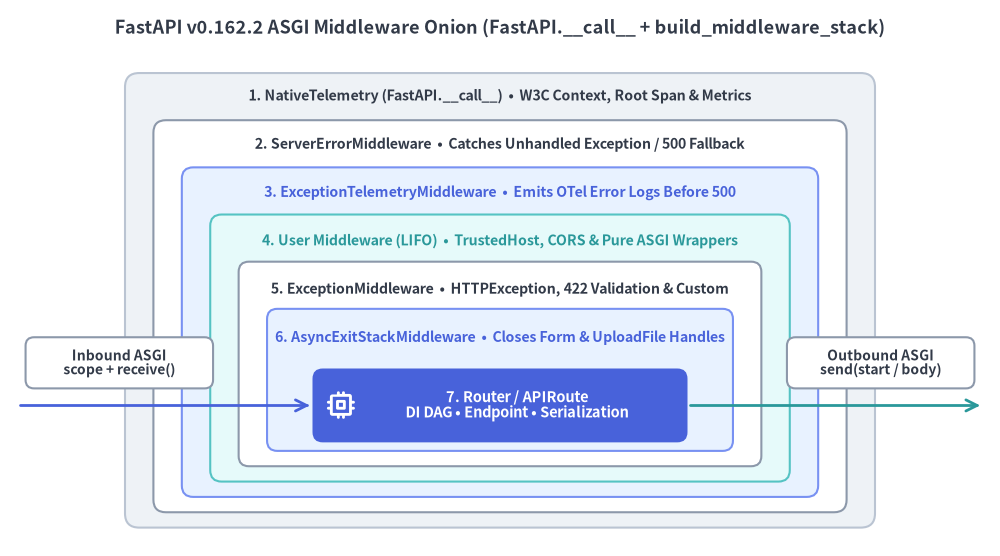
FastAPI v0.162.2 orchestrates every HTTP request and WebSocket connection through a deterministic seven-layer ASGI middleware onion while routing async def coroutines onto the single-threaded AnyIO event loop and offloading plain def callables to a bounded worker threadpool.
Source Code
from drawlib.canvas import save, setup
from drawlib.icons import phosphor
from drawlib.lines import line
from drawlib.shapes import rectangle
from drawlib.styles import Colors, Styles
from drawlib.text import text

setup(width=176, height=98)

text(
    (88.0, 93.0),
    "FastAPI v0.162.2 ASGI Middleware Onion (FastAPI.__call__ + build_middleware_stack)",
    style=Styles.DarkBold.patch(text_size=13.0),
)

# 7 Concentric ASGI Layers (outermost L1 -> innermost L7 core)
layers = [
    (88.0, 45.0, 132.0, 80.0, Styles.Neutral.patch(line_style="dashed", shape_r=2.5),
     81.0, "1. NativeTelemetry (FastAPI.__call__)  •  W3C Context, Root Span & Metrics", Styles.DarkBold),
    (88.0, 42.2, 122.0, 69.0, Styles.White.patch(shape_r=2.2, shape_line_color=Colors.Gray5),
     72.5, "2. ServerErrorMiddleware  •  Catches Unhandled Exception / 500 Fallback", Styles.DarkBold),
    (88.0, 39.4, 112.0, 58.0, Styles.PrimaryNeutral.patch(shape_r=2.0),
     64.0, "3. ExceptionTelemetryMiddleware  •  Emits OTel Error Logs Before 500", Styles.PrimaryBold),
    (88.0, 36.6, 102.0, 47.0, Styles.SecondaryNeutral.patch(shape_r=2.0),
     55.5, "4. User Middleware (LIFO)  •  TrustedHost, CORS & Pure ASGI Wrappers", Styles.SecondaryBold),
    (88.0, 33.8, 92.0, 36.0, Styles.White.patch(shape_r=1.8, shape_line_color=Colors.Gray5),
     47.0, "5. ExceptionMiddleware  •  HTTPException, 422 Validation & Custom", Styles.DarkBold),
    (88.0, 31.0, 82.0, 25.0, Styles.PrimaryNeutral.patch(shape_r=1.8),
     38.5, "6. AsyncExitStackMiddleware  •  Closes Form & UploadFile Handles", Styles.PrimaryBold),
]

for cx, cy, w, h, box_style, label_y, label, txt_style in layers:
    rectangle((cx, cy), width=w, height=h, style=box_style)
    text((cx, label_y), label, style=txt_style.patch(text_size=10.2))

# Core Layer 7: APIRouter & APIRoute
rectangle((88.0, 26.5), width=66.0, height=13.0, style=Styles.PrimaryFlat.patch(shape_r=1.8))
phosphor.cpu((60.0, 26.5), width=5.2, style=Styles.WhiteBold)
text(
    (91.0, 26.5),
    "7. Router / APIRoute\nDI DAG • Endpoint • Serialization",
    style=Styles.WhiteBold.patch(text_size=10.5),
)

# Inbound ASGI Request & Outbound ASGI Response arrows piercing into the core
line((3.5, 26.5), (54.5, 26.5), arrow_head="->", style=Styles.PrimaryBold.patch(line_width=2.0))
rectangle((21.0, 34.0), width=33.0, height=9.0, style=Styles.White.patch(shape_r=1.5, shape_line_color=Colors.Gray5))
text((21.0, 34.0), "Inbound ASGI\nscope + receive()", style=Styles.DarkBold.patch(text_size=10.0))

line((121.5, 26.5), (172.5, 26.5), arrow_head="->", style=Styles.SecondaryBold.patch(line_width=2.0))
rectangle((155.0, 34.0), width=33.0, height=9.0, style=Styles.White.patch(shape_r=1.5, shape_line_color=Colors.Gray5))
text((155.0, 34.0), "Outbound ASGI\nsend(start / body)", style=Styles.DarkBold.patch(text_size=10.0))

save()
1. The Seven-Layer ASGI Middleware Onion
When an ASGI server such as Uvicorn invokes await app(scope, receive, send), FastAPI executes FastAPI.__call__ followed by the lazily compiled build_middleware_stack() pipeline. Understanding the exact nesting order prevents subtle bugs around CORS headers on 500 responses, OpenTelemetry error correlation, and contextvars propagation:
| Layer (Outer to Inner) | Class / Stage | Core Responsibility in v0.162.2 |
|---|---|---|
| 1. Telemetry Entry | NativeTelemetry (FastAPI.__call__) |
Extracts W3C traceparent/baggage, starts the root HTTP/WebSocket span, tracks active requests, and attaches _RequestTelemetry to context. |
| 2. Last-Resort 500 Guard | ServerErrorMiddleware |
Invokes @app.exception_handler(500) or @app.exception_handler(Exception) and guarantees a safe 500 Internal Server Error response if an unhandled exception escapes inner layers. |
| 3. Telemetry Crash Observer | ExceptionTelemetryMiddleware |
Observes unhandled exceptions before ServerErrorMiddleware turns them into a 500 response, emitting structured OTel ERROR logs and re-raising. |
| 4. User Middleware Stack | self.user_middleware |
Runs middlewares added via app.add_middleware(...) in LIFO order (the last registered middleware wraps outermost). |
| 5. Handled Exceptions | ExceptionMiddleware |
Catches HTTPException, RequestValidationError (422), WebSocketRequestValidationError (1008), and custom domain exception handlers. |
| 6. Request File Cleanup | AsyncExitStackMiddleware |
Pushes fastapi_middleware_astack inside all user middlewares so temporary Form and UploadFile handles close cleanly within the same contextvars scope. |
| 7. Routing & DI Engine | APIRouter / APIRoute |
Parses bodies, resolves the Dependency Injection DAG on fastapi_inner_astack, executes the endpoint, serializes output, and attaches BackgroundTasks. |
Pure ASGI Middleware vs BaseHTTPMiddleware
Using @app.middleware("http") (which wraps Starlette's BaseHTTPMiddleware) spawns an extra AnyIO task group per request, copies contextvars boundaries, and can add overhead to high-throughput SSE or JSONL streams. For production cross-cutting concerns—request timing, correlation IDs, tenant enforcement, or security headers—implement a pure ASGI middleware class that intercepts http.response.start directly with zero body buffering:
from time import perf_counter

from fastapi import FastAPI
from fastapi.middleware.cors import CORSMiddleware
from fastapi.middleware.trustedhost import TrustedHostMiddleware
from fastapi.testclient import TestClient
from starlette.types import ASGIApp, Message, Receive, Scope, Send


class ProcessTimeMiddleware:
    """Zero-buffering pure ASGI middleware that injects X-Process-Time-Ms."""

    def __init__(self, app: ASGIApp) -> None:
        self.app = app

    async def __call__(self, scope: Scope, receive: Receive, send: Send) -> None:
        if scope["type"] != "http":
            await self.app(scope, receive, send)
            return

        started = perf_counter()

        async def send_with_timing(message: Message) -> None:
            if message["type"] == "http.response.start":
                elapsed_ms = (perf_counter() - started) * 1000.0
                raw_headers = list(message.get("headers", []))
                raw_headers.append(
                    (b"x-process-time-ms", f"{elapsed_ms:.2f}".encode("latin-1"))
                )
                message = {**message, "headers": raw_headers}
            await send(message)

        await self.app(scope, receive, send_with_timing)


app = FastAPI()

# LIFO wrapping order: TrustedHost (outer) -> CORS -> ProcessTime (inner)
app.add_middleware(ProcessTimeMiddleware)
app.add_middleware(
    CORSMiddleware,
    allow_origins=["https://app.example.com"],
    allow_methods=["GET", "POST"],
    allow_headers=["Authorization", "Content-Type"],
)
app.add_middleware(
    TrustedHostMiddleware,
    allowed_hosts=["api.example.com", "testserver"],
)


@app.get("/ping")
async def ping() -> dict[str, str]:
    return {"status": "ok"}


client = TestClient(app)
res = client.get("/ping", headers={"Origin": "https://app.example.com"})
assert res.status_code == 200
assert "x-process-time-ms" in res.headers
CORS on Unhandled 500s: Because
ServerErrorMiddlewaresits outsideself.user_middleware, an unhandled500response generated at Layer 2 bypassesCORSMiddlewareat Layer 4 unless you register a custom@app.exception_handler(Exception)or ensure reverse-proxy error responses include explicit origin policies. Never setallow_origins=["*"]on authenticated APIs.
2. Event Loop vs Worker Threadpool & BackgroundTasks
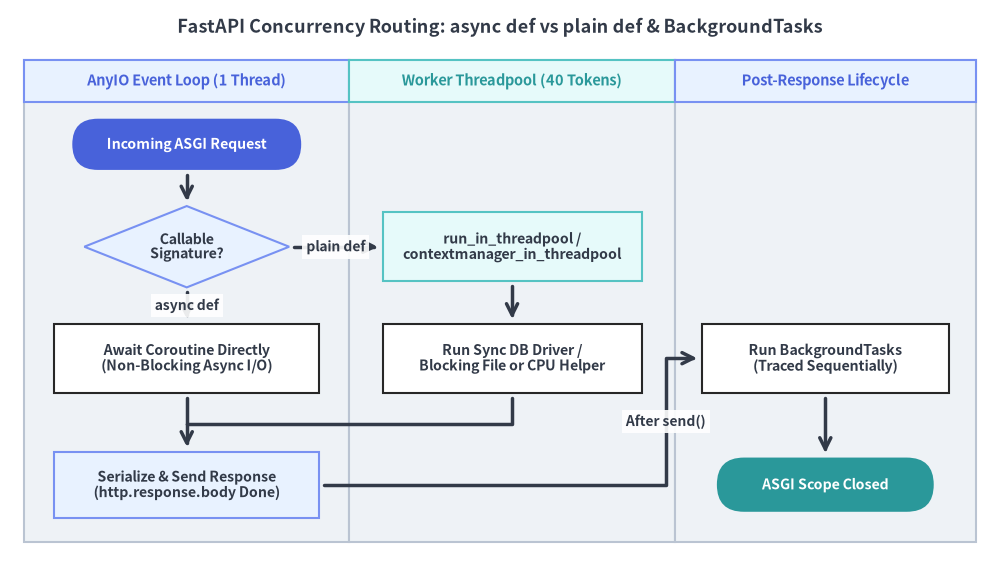
FastAPI inspects every endpoint and dependency callable at route registration time (_is_coroutine_callable) to choose between direct event-loop execution and AnyIO worker threadpool offloading:
Source Code
from drawlib.canvas import save, setup
from drawlib.diagrams.flow import Decision, End, FlowDiagram, Process, Start
from drawlib.styles import Styles
from drawlib.text import text

setup(width=166, height=94)

text(
    (83.0, 89.5),
    "FastAPI Concurrency Routing: async def vs plain def & BackgroundTasks",
    style=Styles.DarkBold.patch(text_size=13.0),
)

node_txt = Styles.DarkBold.patch(text_size=10.2)

flow = FlowDiagram(
    node_style=Styles.Neutral.patch(text_size=10.2),
    edge_style=Styles.DarkBold,
    edge_text_style=Styles.DarkBold.patch(text_size=10.0),
    width=158,
    height=80,
    lane_orientation="vertical",
)

# 3 Vertical Swimlanes: widths 54 + 54 + 50 = 158 (centerlines X = 27, 81, 133)
flow.add_lane(
    "AnyIO Event Loop (1 Thread)",
    width=54,
    style=Styles.Neutral,
    header_style=Styles.PrimaryNeutral,
    text_style=Styles.PrimaryBold.patch(text_size=10.5),
    header_size=7.0,
)
flow.add_lane(
    "Worker Threadpool (40 Tokens)",
    width=54,
    style=Styles.Neutral,
    header_style=Styles.SecondaryNeutral,
    text_style=Styles.SecondaryBold.patch(text_size=10.5),
    header_size=7.0,
)
flow.add_lane(
    "Post-Response Lifecycle",
    width=50,
    style=Styles.Neutral,
    header_style=Styles.PrimaryNeutral,
    text_style=Styles.PrimaryBold.patch(text_size=10.5),
    header_size=7.0,
)

start = flow.add(
    Start("Incoming ASGI Request", width=38, height=8.5, style=Styles.PrimaryFlat, text_style=Styles.WhiteBold.patch(text_size=10.2)),
    xy=(27, 66),
)
dispatch = flow.add(
    Decision("Callable\nSignature?", width=34, height=13.5, style=Styles.PrimaryNeutral, text_style=node_txt),
    xy=(27, 49),
)
async_exec = flow.add(
    Process("Await Coroutine Directly\n(Non-Blocking Async I/O)", width=44, height=11.5, style=Styles.White, text_style=node_txt),
    xy=(27, 30.5),
)
pool_enter = flow.add(
    Process("run_in_threadpool /\ncontextmanager_in_threadpool", width=43, height=11.5, style=Styles.SecondaryNeutral, text_style=node_txt),
    xy=(81, 49),
)
sync_exec = flow.add(
    Process("Run Sync DB Driver /\nBlocking File or CPU Helper", width=43, height=11.5, style=Styles.White, text_style=node_txt),
    xy=(81, 30.5),
)
merge = flow.junction((27, 19.5))
send_resp = flow.add(
    Process("Serialize & Send Response\n(http.response.body Done)", width=44, height=11.0, style=Styles.PrimaryNeutral, text_style=node_txt),
    xy=(27, 9.5),
)
bg_tasks = flow.add(
    Process("Run BackgroundTasks\n(Traced Sequentially)", width=41, height=11.5, style=Styles.White, text_style=node_txt),
    xy=(133, 30.5),
)
done = flow.add(
    End("ASGI Scope Closed", width=36, height=9.0, style=Styles.SecondaryFlat, text_style=Styles.WhiteBold.patch(text_size=10.2)),
    xy=(133, 9.5),
)

start.connect(dispatch, padding=0.8)
dispatch.connect(async_exec, label="async def", start_side="bottom", end_side="top", padding=0.8)
dispatch.connect(pool_enter, label="plain def", start_side="right", end_side="left", padding=0.8)
pool_enter.connect(sync_exec, padding=0.8)
async_exec.connect(merge, start_side="bottom", padding=(0.8, 0.0))
sync_exec.connect(merge, start_side="bottom", padding=(0.8, 0.0)).via((81, 19.5))
merge.connect(send_resp, end_side="top", padding=(0.0, 0.8))
send_resp.connect(bg_tasks, label="After send()", start_side="right", end_side="left", padding=0.8).via((106.5, 9.5), (106.5, 30.5))
bg_tasks.connect(done, padding=0.8)

flow.draw(xy=(4.0, 4.0))
save()
Golden Rules of Concurrency in FastAPI
async defRuns Directly on the Event Loop: Useasync defwhenever callingawait-native drivers (httpx.AsyncClient,asyncpg,redis.asyncio,anyio). Never call blocking synchronous functions (time.sleep(),requests.get(), synchronous ORM queries, or heavy CPU loops) directly insideasync def—doing so stalls the entire worker loop and freezes every concurrent request on that process.- Plain
def& SyncyieldDependencies Use the Threadpool: Declaring a plaindefroute or dependency tells FastAPI to run it viarun_in_threadpool(orcontextmanager_in_threadpoolfor syncyielddependencies), governed by AnyIO's default40-tokenCapacityLimiterper worker process. If anasync defendpoint must invoke one synchronous helper, offload just that call viaawait run_in_threadpool(fn, *args). BackgroundTasksRuns In-Process Aftersend(): Tasks added toBackgroundTasksexecute sequentially after the client receives the HTTP response, wrapped infastapi.background_taskOpenTelemetry spans. ReserveBackgroundTasksfor lightweight, best-effort work (audit events, cache invalidation, webhook notifications); use an external durable job queue for retries, multi-minute workflows, or heavy CPU processing.
from collections.abc import Iterator
from typing import Annotated

import anyio
from fastapi import BackgroundTasks, Depends, FastAPI, status
from fastapi.testclient import TestClient
from starlette.concurrency import run_in_threadpool

app = FastAPI()
audit_log: list[str] = []


def compute_digest_sync(payload: str) -> str:
    return f"len:{len(payload)}"


def get_sync_session() -> Iterator[str]:
    # Entered & exited safely via contextmanager_in_threadpool
    audit_log.append("session:open")
    try:
        yield "tx-101"
    finally:
        audit_log.append("session:close")


@app.get("/reports/sync")
def read_sync_report(
    tx_id: Annotated[str, Depends(get_sync_session)],
) -> dict[str, str]:
    return {"tx_id": tx_id, "summary": compute_digest_sync("quarterly-ledger")}


@app.post("/reports/async", status_code=status.HTTP_202_ACCEPTED)
async def submit_async_report(
    payload: str,
    tasks: BackgroundTasks,
) -> dict[str, str]:
    digest = await run_in_threadpool(compute_digest_sync, payload)
    await anyio.sleep(0)
    tasks.add_task(audit_log.append, f"audit:{digest}")
    return {"accepted": digest}


client = TestClient(app)
assert client.get("/reports/sync").json() == {"tx_id": "tx-101", "summary": "len:16"}
assert client.post("/reports/async", params={"payload": "hello"}).status_code == 202
assert audit_log == ["session:open", "session:close", "audit:len:5"]
Continue to Native SSE, JSONL & WebSockets to explore how FastAPI extends this async execution engine to real-time server push and full-duplex streams.