Why FastAPI & Design Philosophy
FastAPI (v0.162.2) is engineered around a deceptively powerful premise: standard Python type annotations should serve as the single executable contract for HTTP extraction, runtime data validation, dependency resolution, static type checking, and OpenAPI schema synthesis.
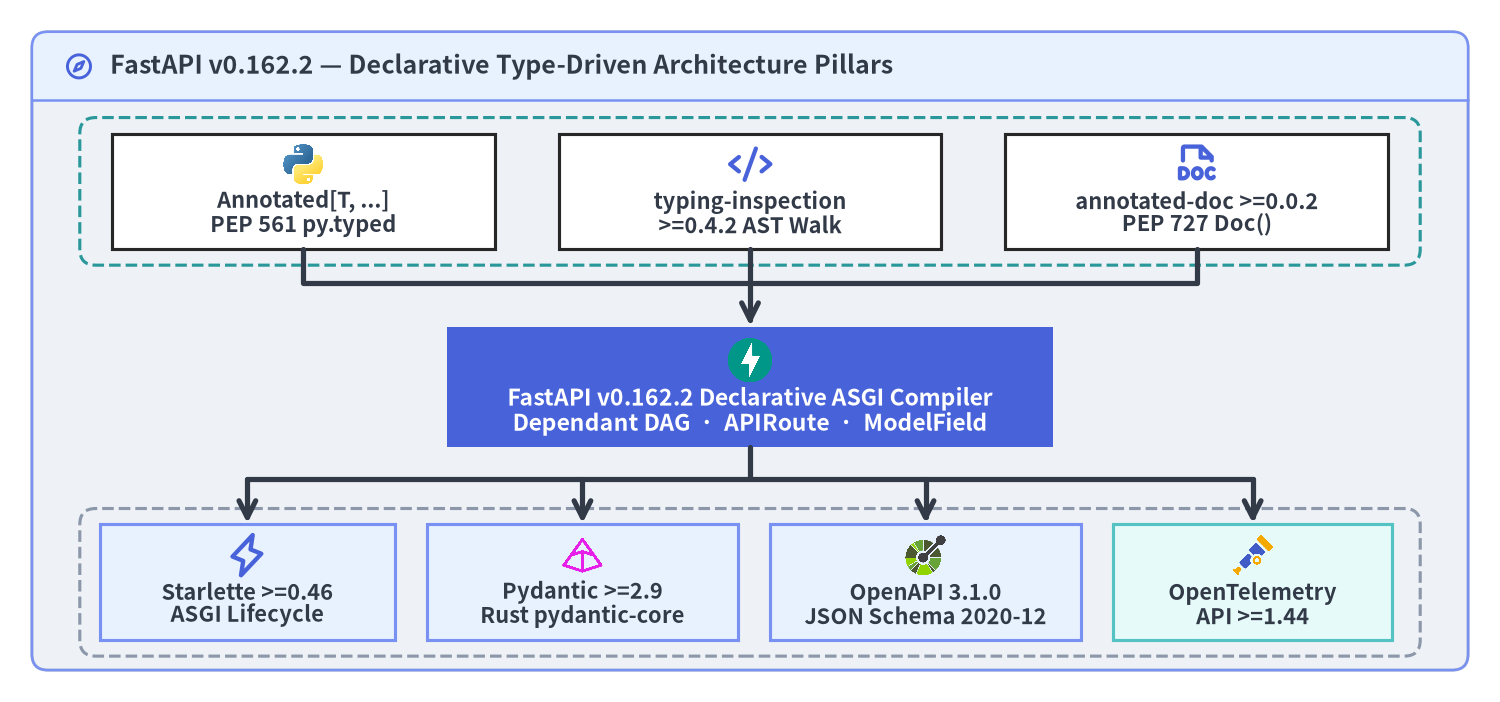
Source Code
from drawlib.canvas import save, setup
from drawlib.diagrams.architecture import (
    ArchitectureDiagram,
    CnativeIcon,
    CodeIcon,
    Node,
    PhosphorIcon,
)
from drawlib.icons import phosphor
from drawlib.lines import line, lines
from drawlib.shapes import rectangle
from drawlib.smartarts import Panel
from drawlib.styles import Styles

setup(width=188, height=88, dpi=150)

outer = Panel(
    "FastAPI v0.162.2 — Declarative Type-Driven Architecture Pillars",
    style=Styles.Neutral.patch(shape_r=2.0),
    header_style=Styles.PrimaryNeutral.patch(shape_line_width=1.2),
    text_style=Styles.DarkBold.patch(text_size=12.0),
    icon=phosphor.compass,
    icon_style=Styles.PrimaryBold,
    header_variant="filled",
    header_height=8.5,
)
outer.draw((4.0, 4.0), width=180.0, height=80.0)

# Subtle dashed bands for Top Developer Surface and Bottom Runtime Pillars
rectangle((94.0, 64.0), width=168.0, height=18.5, style=Styles.SecondaryDashed.patch(shape_r=2.0))
rectangle((94.0, 15.0), width=168.0, height=18.5, style=Styles.MutedDashed.patch(shape_r=2.0))

diag = ArchitectureDiagram(
    node_style=Styles.PrimaryBold,
    node_text_style=Styles.DarkBold.patch(text_size=10.5),
    edge_style=Styles.DarkBold,
    edge_text_style=Styles.Dark.patch(text_size=10.0),
    node_card_style=Styles.White,
)

# Top Row: Python Typing Standards (centers at y=64.0, bottom edge at y=56.75)
diag.add(
    Node(
        "Annotated[T, ...]\nPEP 561 py.typed",
        width=48,
        height=14.5,
        icon=CodeIcon.PYTHON,
        icon_size=5.6,
    ),
    (38, 64.0),
)
diag.add(
    Node(
        "typing-inspection\n>=0.4.2 AST Walk",
        width=48,
        height=14.5,
        icon=PhosphorIcon.CODE,
        icon_size=5.6,
    ),
    (94, 64.0),
)
diag.add(
    Node(
        "annotated-doc >=0.0.2\nPEP 727 Doc()",
        width=48,
        height=14.5,
        icon=PhosphorIcon.FILE_DOC,
        icon_size=5.6,
    ),
    (150, 64.0),
)

# Center Compiler Hub (y=39.5, top=47.0, bottom=32.0)
diag.add(
    Node(
        "FastAPI v0.162.2 Declarative ASGI Compiler\nDependant DAG  ·  APIRoute  ·  ModelField",
        width=76,
        height=15.0,
        icon=CodeIcon.FASTAPI,
        icon_size=6.2,
        card_style=Styles.PrimaryFlat,
        text_style=Styles.WhiteBold.patch(text_size=11.0),
        style=Styles.WhiteBold,
    ),
    (94, 39.5),
)

# Bottom Row: Three Core Pillars + Native Telemetry (y=15.0, top=22.25)
diag.add(
    Node(
        "Starlette >=0.46\nASGI Lifecycle",
        width=37,
        height=14.5,
        icon=PhosphorIcon.LIGHTNING,
        icon_size=5.6,
        card_style=Styles.PrimaryNeutral,
    ),
    (31, 15.0),
)
diag.add(
    Node(
        "Pydantic >=2.9\nRust pydantic-core",
        width=39,
        height=14.5,
        icon=CodeIcon.PYDANTIC,
        icon_size=5.6,
        card_style=Styles.PrimaryNeutral,
    ),
    (73, 15.0),
)
diag.add(
    Node(
        "OpenAPI 3.1.0\nJSON Schema 2020-12",
        width=39,
        height=14.5,
        icon=CodeIcon.OPENAPI,
        icon_size=5.6,
        card_style=Styles.PrimaryNeutral,
    ),
    (116, 15.0),
)
diag.add(
    Node(
        "OpenTelemetry\nAPI >=1.44",
        width=35,
        height=14.5,
        icon=CnativeIcon.OPENTELEMETRY,
        icon_size=5.6,
        card_style=Styles.SecondaryNeutral,
    ),
    (157, 15.0),
)

diag.draw()

# Symmetrical top-to-bottom bus connectors with >=5u terminal arrow segments
lines([(38.0, 56.75), (38.0, 52.5), (150.0, 52.5), (150.0, 56.75)], style=Styles.DarkBold)
line((94.0, 56.75), (94.0, 47.2), arrow_head="->", style=Styles.DarkBold)

line((94.0, 32.0), (94.0, 28.0), style=Styles.DarkBold)
line((31.0, 28.0), (157.0, 28.0), style=Styles.DarkBold)
for bx in (31.0, 73.0, 116.0, 157.0):
    line((bx, 28.0), (bx, 22.4), arrow_head="->", style=Styles.DarkBold)

save()
Eliminating Duplicate Validation & Contract Code
In traditional imperative web frameworks, adding or renaming one API field forces engineers to update four separate artifacts: imperative request.args.get(...) parsing logic, a separate validation schema, a response serializer, and a hand-maintained OpenAPI YAML file. Whenever one artifact lags behind, production clients suffer silent contract drift.
| Concern | Imperative Frameworks (4 Artifacts) | FastAPI v0.162.2 (Single Signature) |
|---|---|---|
| HTTP Parameter Extraction | Manual request.query_params / request.json() lookups |
Inferred automatically from path templates, scalars, and BaseModel |
| Boundary Input Validation | Separate validator classes or ad-hoc if checks |
Enforced at the boundary via Path(...), Query(...), and Rust pydantic-core |
Static Type Safety (mypy / pyright) |
Unchecked Any dicts passed into business logic |
PEP 561 py.typed preserves exact narrowed types inside the endpoint |
| OpenAPI & Client SDK Specs | Hand-edited YAML prone to drift from runtime code | Synthesized deterministically as OpenAPI 3.1.0 + PEP 727 Doc() descriptions |
Compile Once at Startup, Zero Reflection on Hot Traffic
A common misconception is that type-driven frameworks call inspect.signature() on every incoming HTTP request. FastAPI avoids per-request Python reflection by splitting execution into one-time route registration and a pre-bound ASGI request closure:
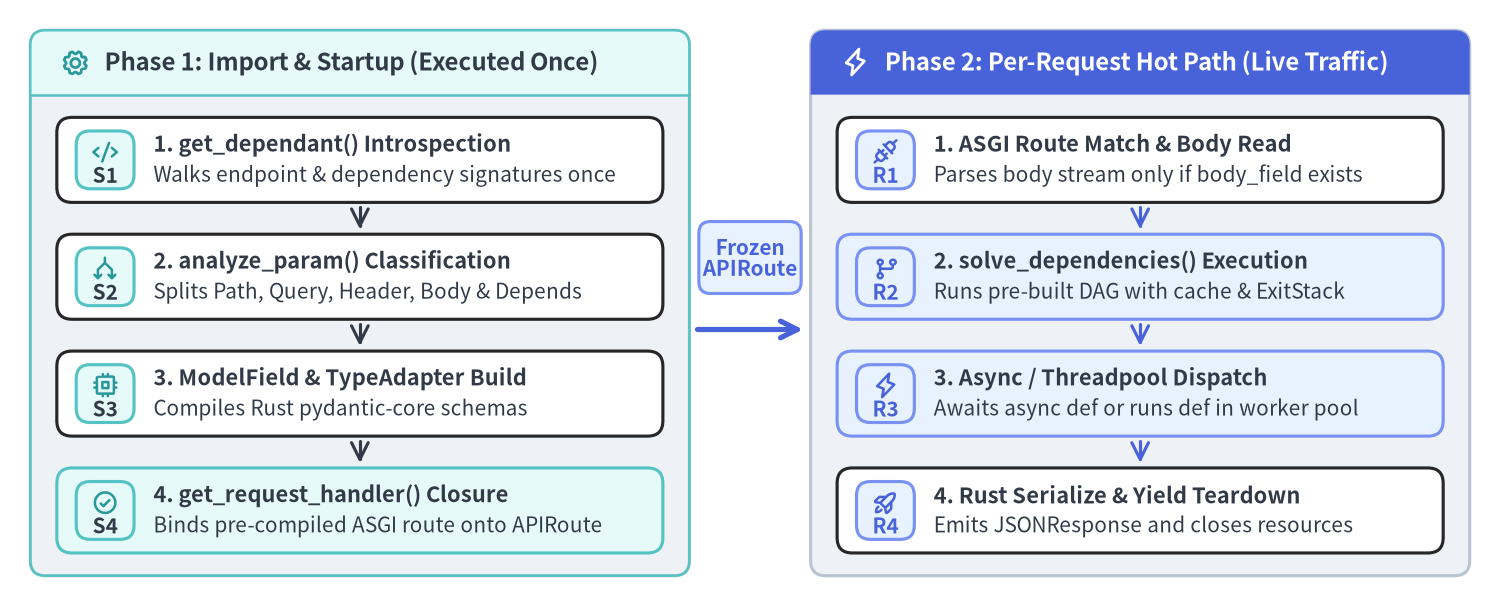
Source Code
from drawlib.canvas import save, setup
from drawlib.icons import phosphor
from drawlib.lines import line
from drawlib.shapes import rectangle
from drawlib.smartarts import CardList, Panel
from drawlib.styles import Styles
from drawlib.text import text

setup(width=198, height=80, dpi=150)

# Left Panel: Startup Compilation
p_start = Panel(
    "Phase 1: Import & Startup (Executed Once)",
    style=Styles.Neutral.patch(shape_r=2.0),
    header_style=Styles.SecondaryNeutral.patch(shape_line_width=1.2),
    text_style=Styles.DarkBold.patch(text_size=11.5),
    icon=phosphor.gear,
    icon_style=Styles.SecondaryBold,
    header_variant="filled",
    header_height=8.5,
)
p_start.draw((4.0, 4.0), width=87.0, height=72.0)
s_xy, s_w, s_h = p_start.get_content_box((4.0, 4.0), width=87.0, height=72.0, padding=(3.5, 3.0))

cl_start = CardList(
    style=Styles.White,
    text_style=Styles.DarkBold.patch(text_size=10.5),
    description_style=Styles.Dark.patch(text_size=10.0),
    badge_shape="rounded_rect",
    badge_style=Styles.SecondaryNeutral,
    badge_text_style=Styles.DarkBold.patch(text_size=10.0),
    icon_style=Styles.SecondaryBold,
    direction="vertical",
    spacing=4.2,
    show_arrows=True,
    arrow_style=Styles.Dark,
)
cl_start.add(
    "1. get_dependant() Introspection",
    "Walks endpoint & dependency signatures once",
    badge_text="S1",
    icon=phosphor.code,
)
cl_start.add(
    "2. analyze_param() Classification",
    "Splits Path, Query, Header, Body & Depends",
    badge_text="S2",
    icon=phosphor.arrows_split,
)
cl_start.add(
    "3. ModelField & TypeAdapter Build",
    "Compiles Rust pydantic-core schemas",
    badge_text="S3",
    icon=phosphor.cpu,
)
cl_start.add(
    "4. get_request_handler() Closure",
    "Binds pre-compiled ASGI route onto APIRoute",
    badge_text="S4",
    icon=phosphor.check_circle,
    style=Styles.SecondaryNeutral,
)
cl_start.draw(xy=s_xy, width=s_w, height=s_h)

# Handoff connector between Startup and Hot Path
line((92.0, 36.5), (106.0, 36.5), arrow_head="->", style=Styles.PrimaryBold)
rectangle((99.0, 46.0), width=13.5, height=9.5, style=Styles.PrimaryNeutral.patch(shape_r=1.5))
text((99.0, 46.0), "Frozen\nAPIRoute", style=Styles.PrimaryBold.patch(text_size=10.0))

# Right Panel: Per-Request Hot Path
p_hot = Panel(
    "Phase 2: Per-Request Hot Path (Live Traffic)",
    style=Styles.Neutral.patch(shape_r=2.0),
    header_style=Styles.PrimaryFlat,
    text_style=Styles.WhiteBold.patch(text_size=11.5),
    icon=phosphor.lightning,
    icon_style=Styles.WhiteBold,
    header_variant="filled",
    header_height=8.5,
)
p_hot.draw((107.0, 4.0), width=87.0, height=72.0)
h_xy, h_w, h_h = p_hot.get_content_box((107.0, 4.0), width=87.0, height=72.0, padding=(3.5, 3.0))

cl_hot = CardList(
    style=Styles.White,
    text_style=Styles.DarkBold.patch(text_size=10.5),
    description_style=Styles.Dark.patch(text_size=10.0),
    badge_shape="rounded_rect",
    badge_style=Styles.PrimaryNeutral,
    badge_text_style=Styles.PrimaryBold.patch(text_size=10.0),
    icon_style=Styles.PrimaryBold,
    direction="vertical",
    spacing=4.2,
    show_arrows=True,
    arrow_style=Styles.Primary,
)
cl_hot.add(
    "1. ASGI Route Match & Body Read",
    "Parses body stream only if body_field exists",
    badge_text="R1",
    icon=phosphor.plugs,
)
cl_hot.add(
    "2. solve_dependencies() Execution",
    "Runs pre-built DAG with cache & ExitStack",
    badge_text="R2",
    icon=phosphor.git_branch,
    style=Styles.PrimaryNeutral,
)
cl_hot.add(
    "3. Async / Threadpool Dispatch",
    "Awaits async def or runs def in worker pool",
    badge_text="R3",
    icon=phosphor.lightning,
    style=Styles.PrimaryNeutral,
)
cl_hot.add(
    "4. Rust Serialize & Yield Teardown",
    "Emits JSONResponse and closes resources",
    badge_text="R4",
    icon=phosphor.rocket_launch,
)
cl_hot.draw(xy=h_xy, width=h_w, height=h_h)

save()
You can inspect these pre-compiled Dependant and ModelField structures directly on any registered APIRoute before a single request arrives:
from typing import Annotated

from annotated_doc import Doc
from fastapi import FastAPI, Path, Query
from fastapi.routing import APIRoute
from pydantic import BaseModel, ConfigDict, Field

app = FastAPI(title="Compiler Inspection Demo")


class OrderPayload(BaseModel):
    model_config = ConfigDict(extra="forbid")
    sku: str = Field(min_length=3)
    quantity: int = Field(ge=1, le=100)


@app.post("/orders/{order_id}")
async def create_order(
    order_id: Annotated[int, Path(ge=1), Doc("Numeric order identifier.")],
    payload: OrderPayload,
    dry_run: Annotated[bool, Query(), Doc("Validate without persisting.")] = False,
) -> dict[str, object]:
    return {"order_id": order_id, "sku": payload.sku, "dry_run": dry_run}


route = next(r for r in app.routes if isinstance(r, APIRoute) and r.path == "/orders/{order_id}")
assert [p.name for p in route.dependant.path_params] == ["order_id"]
assert [q.name for q in route.dependant.query_params] == ["dry_run"]
assert [b.name for b in route.dependant.body_params] == ["payload"]
assert route.body_field is not None
The 6 Runtime Dependencies & 5-Tier Internal Architecture
Core Runtime Dependency Stack
FastAPI keeps its mandatory installation footprint intentionally minimal—declaring exactly six runtime dependencies in pyproject.toml:
Package (pyproject.toml) |
Minimum Version | Exact Architectural Role in FastAPI v0.162.2 |
|---|---|---|
starlette |
>=0.46.0 |
High-speed ASGI 3.0 server interface, URL router substrate, Request/Response primitives, WebSockets, and middleware wrappers |
pydantic |
>=2.9.0 |
Rust-powered pydantic-core TypeAdapter validation, coercion, response serialization, and JSON Schema 2020-12 generation |
typing-extensions |
>=4.8.0 |
Cross-version compatibility for modern typing constructs across Python 3.10 through 3.14 |
typing-inspection |
>=0.4.2 |
Deterministic compile-time unwrapping of Annotated[...], type aliases, generics, and union annotations |
annotated-doc |
>=0.0.2 |
PEP 727 Doc("...") support for attaching OpenAPI documentation directly inside Annotated hints |
opentelemetry-api |
>=1.44.0 |
Lightweight, zero-SDK-overhead tracing and instrumentation hooks powering fastapi.telemetry |
5-Tier Internal Module Architecture (52 Modules)
Across its 52 source files (19,837 LOC), FastAPI enforces strict downward dependencies across five internal tiers:
| Tier | Internal Responsibility | Representative Upstream Modules |
|---|---|---|
| Tier 5 — Public Facades | FastAPI app entrypoint, PEP 727-annotated parameter factories (Query, Path, Depends), CLI stub, and TestClient |
fastapi/applications.py, fastapi/param_functions.py, fastapi/testclient.py |
| Tier 4 — Routing, SSE & OpenAPI | APIRouter, APIRoute request handler synthesis, native EventSourceResponse, and OpenAPI 3.1.0 / Swagger UI / ReDoc |
fastapi/routing.py, fastapi/sse.py, fastapi/openapi/utils.py, fastapi/openapi/docs.py |
| Tier 3 — Recursive DI & Security | Dependant DAG construction (get_dependant), async resolution (solve_dependencies), and OAuth2 / APIKey / HTTP schemes |
fastapi/dependencies/utils.py, fastapi/dependencies/models.py, fastapi/security/oauth2.py |
| Tier 2 — Middleware, Concurrency & OTel | AsyncExitStackMiddleware, sync contextmanager_in_threadpool helpers, CORS/GZip wrappers, and NativeTelemetry |
fastapi/middleware/asyncexitstack.py, fastapi/concurrency.py, fastapi/telemetry/_asgi.py |
| Tier 1 — Pydantic v2 & Descriptors | ModelField adapter over Pydantic v2 TypeAdapter, FieldInfo subclasses (Path, Query, Body), and jsonable_encoder |
fastapi/_compat/v2.py, fastapi/params.py, fastapi/encoders.py, fastapi/exceptions.py |
Next, put these building blocks into action in Quickstart & Interactive OpenAPI, or explore how to structure large engineering codebases in Chapter 2: Bounded Contexts & Layering.