Response Serialization, Status Codes & OpenAPI 3.1
FastAPI enforces outbound API contracts through serialize_response()—filtering sensitive fields and emitting UTF-8 JSON bytes in a single Pydantic v2 Rust pass—while lazily synthesizing OpenAPI 3.1.0 specifications with split input/output JSON Schema 2020-12 definitions.
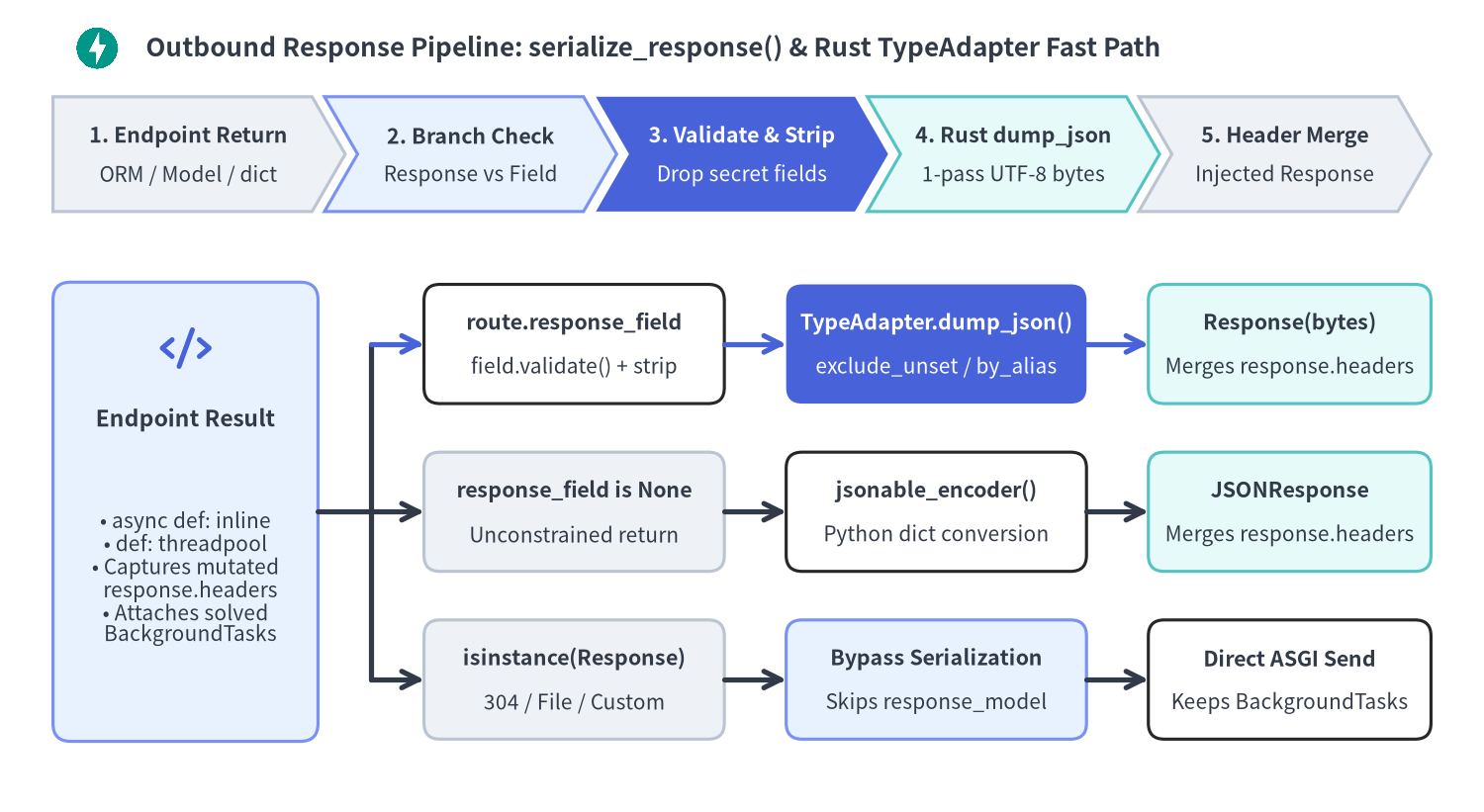
Source Code
from drawlib.canvas import save, setup
from drawlib.icons import code, phosphor
from drawlib.lines import line, lines
from drawlib.shapes import rectangle
from drawlib.smartarts import ChevronProcess
from drawlib.styles import Styles
from drawlib.text import text

setup(width=168, height=92, dpi=150)

# Title Banner
code.fastapi((11, 86.5), width=5.2, style=Styles.Primary)
text(
    (16.5, 86.5),
    "Outbound Response Pipeline: serialize_response() & Rust TypeAdapter Fast Path",
    style=Styles.DarkBold.patch(text_size=12.5, halign="left"),
)

# Top 5-Stage Macro Pipeline
macro = ChevronProcess(
    style=Styles.Neutral,
    text_style=Styles.DarkBold.patch(text_size=10.3),
    description_style=Styles.Dark.patch(text_size=10.0),
    corner_angle=60.0,
    spacing=1.4,
    flat_left_end=True,
)
macro.add("1. Endpoint Return", description="ORM / Model / dict")
macro.add("2. Branch Check", description="Response vs Field", style=Styles.PrimaryNeutral)
macro.add(
    "3. Validate & Strip",
    description="Drop secret fields",
    style=Styles.PrimaryFlat,
    text_style=Styles.WhiteBold.patch(text_size=10.3),
    description_style=Styles.White.patch(text_size=10.0),
)
macro.add("4. Rust dump_json", description="1-pass UTF-8 bytes", style=Styles.SecondaryNeutral)
macro.add("5. Header Merge", description="Injected Response")
macro.draw((6, 68), width=156, height=13)

# Bottom Detailed 3-Track Execution Architecture
# Left Source Card (x=6..36, y=8..60)
rectangle((21, 34), width=30, height=52, style=Styles.PrimaryNeutral.patch(shape_r=2.0))
phosphor.code((21, 52.5), width=6.0, style=Styles.PrimaryBold)
text((21, 44.5), "Endpoint Result", style=Styles.DarkBold.patch(text_size=11.0))
text(
    (21, 26.5),
    "• async def: inline\n• def: threadpool\n• Captures mutated\n  response.headers\n• Attaches solved\n  BackgroundTasks",
    style=Styles.Dark.patch(text_size=10.0),
)

# Track A (Top, y=53): Rust Fast-Path Serialization
# Track B (Middle, y=34): jsonable_encoder Fallback
# Track C (Bottom, y=15): Direct Response Subclass Bypass
tracks = [
    (
        53,
        ("route.response_field", "field.validate() + strip", Styles.White, False),
        ("TypeAdapter.dump_json()", "exclude_unset / by_alias", Styles.PrimaryFlat, True),
        ("Response(bytes)", "Merges response.headers", Styles.SecondaryNeutral, False),
    ),
    (
        34,
        ("response_field is None", "Unconstrained return", Styles.Neutral, False),
        ("jsonable_encoder()", "Python dict conversion", Styles.White, False),
        ("JSONResponse", "Merges response.headers", Styles.SecondaryNeutral, False),
    ),
    (
        15,
        ("isinstance(Response)", "304 / File / Custom", Styles.Neutral, False),
        ("Bypass Serialization", "Skips response_model", Styles.PrimaryNeutral, False),
        ("Direct ASGI Send", "Keeps BackgroundTasks", Styles.White, False),
    ),
]

# Orthogonal trunk fan-out from Left Source Card right edge (x=36) -> trunk (x=42) -> Col 1 left edge (x=48)
line((36, 34), (42, 34), style=Styles.DarkBold)
lines([(42, 15), (42, 53)], style=Styles.DarkBold)

for ty, s1, s2, s3 in tracks:
    line((42, ty), (48, ty), arrow_head="->", style=Styles.PrimaryBold if ty == 53 else Styles.DarkBold)

    # Col 1: cx=65, w=34 -> x=48..82
    rectangle((65, ty), width=34, height=13.5, style=s1[2].patch(shape_r=1.8))
    text((65, ty + 2.4), s1[0], style=Styles.DarkBold.patch(text_size=10.3))
    text((65, ty - 2.6), s1[1], style=Styles.Dark.patch(text_size=10.0))

    # Gap 82 -> 89 (7.0 units)
    line((82, ty), (89, ty), arrow_head="->", style=Styles.PrimaryBold if ty == 53 else Styles.DarkBold)

    # Col 2: cx=106, w=34 -> x=89..123
    rectangle((106, ty), width=34, height=13.5, style=s2[2].patch(shape_r=1.8))
    c2_h = Styles.WhiteBold if s2[3] else Styles.DarkBold
    c2_b = Styles.White if s2[3] else Styles.Dark
    text((106, ty + 2.4), s2[0], style=c2_h.patch(text_size=10.3))
    text((106, ty - 2.6), s2[1], style=c2_b.patch(text_size=10.0))

    # Gap 123 -> 130 (7.0 units)
    line((123, ty), (130, ty), arrow_head="->", style=Styles.PrimaryBold if ty == 53 else Styles.DarkBold)

    # Col 3: cx=146, w=32 -> x=130..162
    rectangle((146, ty), width=32, height=13.5, style=s3[2].patch(shape_r=1.8))
    text((146, ty + 2.4), s3[0], style=Styles.DarkBold.patch(text_size=10.3))
    text((146, ty - 2.6), s3[1], style=Styles.Dark.patch(text_size=10.0))

save()
Decoupling internal persistence models from outbound DTOs prevents accidental credential leaks while maximizing serialization throughput via Pydantic's compiled Rust core.
1. Outbound Serialization Pipeline (serialize_response)
During route initialization (_populate_api_route_state() in fastapi/routing.py), FastAPI determines route.response_field according to a strict precedence chain:
| Declaration Pattern | route.response_field |
Runtime Serialization Path in get_request_handler() |
|---|---|---|
@app.get(..., response_model=PublicDTO) |
ModelField(mode="serialization") |
Overrides return annotation; validates & runs Rust TypeAdapter.dump_json() |
async def ep(...) -> PublicDTO: (no response_model) |
ModelField(mode="serialization") |
Return annotation promoted automatically to response_model |
@app.get(..., response_model=None) or -> Response |
None |
Skips ModelField creation; allows `Response |
Endpoint returns isinstance(val, Response) at runtime |
(Bypassed) | Sends Response directly; skips serialize_response() |
When route.response_field exists and response_class remains the default JSONResponse (DefaultPlaceholder), get_request_handler() activates use_dump_json = True:
- Contract Validation & Security Filtering:
serialize_response()validates the returned object (ORMentity,BaseModel, ordict) viafield.validate(..., loc=("response",))usingfrom_attributes=True(executed inline forasync defroutes or viarun_in_threadpoolfor syncdefroutes). Unlisted fields—such ashashed_passwordortotp_secret—are stripped, and contract mismatches raise a server-sideResponseValidationError(500) rather than leaking malformed payloads. - One-Pass Rust JSON Bytes (
dump_json): Instead of converting models to intermediate Python dictionaries and callingjson.dumps(),field.serialize_json()invokesTypeAdapter.dump_json()withinclude,exclude,by_alias,exclude_unset,exclude_defaults, andexclude_none, wrapping the resulting UTF-8bytesdirectly inResponse(media_type="application/json"). - Status-Code Body Rules & Header Merging: Any headers or cookies recorded on an injected
response: Responsedependency parameter (solved_result.response.headers.raw) are appended onto the final response, and bodyless HTTP statuses (204,205,304,1xx) enforceresponse.body = b"".
Security Field Stripping & Sparse PATCH (exclude_unset)
Pairing an internal database model with response_model=UserPublic guarantees secret fields never cross the wire, while response_model_exclude_unset=True omits default fields that were not explicitly populated in partial PATCH payloads:
from typing import Any, Literal

from fastapi import FastAPI
from pydantic import BaseModel

app = FastAPI(title="Identity Profile API", version="1.0.0")


class UserRecordDB(BaseModel):
    user_id: str
    username: str
    email: str
    hashed_password: str
    totp_secret: str


class UserPublic(BaseModel):
    user_id: str
    username: str
    email: str


class ProfilePatch(BaseModel):
    display_name: str = "Anonymous"
    bio: str | None = None
    theme: Literal["light", "dark"] = "light"


@app.get("/users/{user_id}", response_model=UserPublic)
async def get_user_profile(user_id: str) -> Any:
    return UserRecordDB(
        user_id=user_id,
        username="alice",
        email="alice@example.com",
        hashed_password="$argon2id$v=19$m=65536,t=3,p=4$redacted",
        totp_secret="JBSWY3DPEHPK3PXP",
    )


@app.patch(
    "/users/{user_id}/preferences",
    response_model=ProfilePatch,
    response_model_exclude_unset=True,
)
async def patch_preferences(user_id: str, patch: ProfilePatch) -> ProfilePatch:
    _ = user_id
    return patch
Injected Response Mutation vs Direct Response Bypass
Inject response: Response as a parameter whenever you need custom headers or hardened cookies (__Host- prefix, httponly=True, secure=True, samesite="lax") while retaining response_model filtering. Return a raw Response instance (with response_model=None if mixed with other return types) only when intentionally bypassing serialization—such as 304 Not Modified cache hits:
from typing import Annotated

from fastapi import FastAPI, Header, Response, status
from fastapi.responses import JSONResponse
from pydantic import BaseModel, Field

app = FastAPI(title="Session & Cache API", version="1.0.0")


class SessionSummary(BaseModel):
    session_id: str
    active: bool
    internal_signing_kid: str = Field(exclude=True, default="kid_v3")


@app.post("/sessions", response_model=SessionSummary)
async def issue_session(response: Response) -> dict[str, object]:
    response.headers["Cache-Control"] = "no-store"
    response.set_cookie(
        key="__Host-session",
        value="tok_opaque_random",
        httponly=True,
        secure=True,
        samesite="lax",
        path="/",
    )
    return {
        "session_id": "sess_9001",
        "active": True,
        "unlisted_debug_token": "stripped-by-response-model",
    }


@app.get("/health/raw", response_model=None)
async def raw_probe(etag_match: Annotated[str | None, Header()] = None) -> Response:
    if etag_match == '"v1"':
        return Response(status_code=status.HTTP_304_NOT_MODIFIED)
    return JSONResponse(content={"status": "ok"}, headers={"ETag": '"v1"'})
2. Lazy OpenAPI 3.1.0 Synthesis & Split Input/Output Schemas
Rather than slowing down process boot, FastAPI.openapi() (fastapi/applications.py) synthesizes the OpenAPI 3.1.0 specification lazily on the first /openapi.json or app.openapi() call and caches it against router._get_routes_version() (_openapi_routes_version). If dynamic routers or webhooks are mounted later, the route version counter increments and automatically invalidates the cached dictionary.
Inside get_openapi() (fastapi/openapi/utils.py):
- Field Harvesting (
get_fields_from_routes): Walks every includedAPIRouteand webhook context, collectingbody_field(mode="validation"),response_field, status-keyedresponse_fieldsfromresponses={...},stream_item_field(mode="serialization"), callbacks, and flattenedDependantparameters. - Split Input/Output JSON Schema 2020-12 (
get_definitions): Withseparate_input_output_schemas=True(default), FastAPI feeds both"validation"and"serialization"CoreSchemaentries into Pydantic'sGenerateJsonSchema(ref_template="#/components/schemas/{model}"). Whenever a model's input and output representations differ—such asDecimalfields (acceptingnumber | stringon input, emitting exactstringon output),@computed_fieldproperties, orserialization_alias—OpenAPI automatically emits distinct<Model>-Inputand<Model>-Outputcomponent schemas. - Operation & Error Merging (
get_openapi_path): Deduplicates parameters across shared dependencies, bindsoperationId, merges customresponses={404: ..., 409: ...}viadeep_dict_update(), and auto-injects422(HTTPValidationError) whenever parameters or request bodies exist.
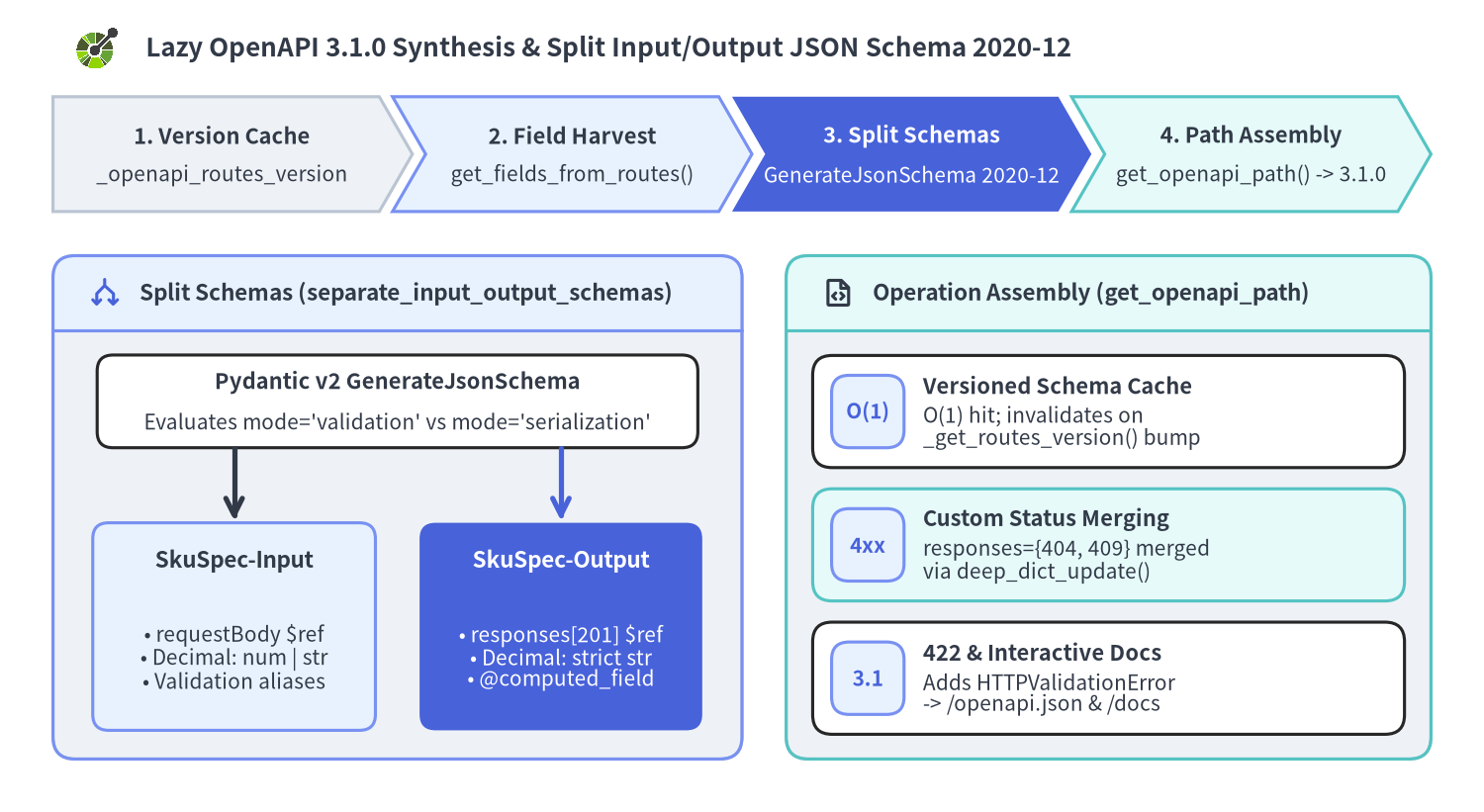
Source Code
from drawlib.canvas import save, setup
from drawlib.icons import code, phosphor
from drawlib.lines import line
from drawlib.shapes import rectangle
from drawlib.smartarts import CardList, ChevronProcess, Panel
from drawlib.styles import Styles
from drawlib.text import text

setup(width=168, height=92, dpi=150)

# Title Banner
code.openapi((11, 86.5), width=5.2, style=Styles.Primary)
text(
    (16.5, 86.5),
    "Lazy OpenAPI 3.1.0 Synthesis & Split Input/Output JSON Schema 2020-12",
    style=Styles.DarkBold.patch(text_size=12.5, halign="left"),
)

# Top 4-Stage Synthesis Pipeline
flow = ChevronProcess(
    style=Styles.Neutral,
    text_style=Styles.DarkBold.patch(text_size=10.5),
    description_style=Styles.Dark.patch(text_size=10.0),
    corner_angle=60.0,
    spacing=1.5,
    flat_left_end=True,
)
flow.add("1. Version Cache", description="_openapi_routes_version")
flow.add("2. Field Harvest", description="get_fields_from_routes()", style=Styles.PrimaryNeutral)
flow.add(
    "3. Split Schemas",
    description="GenerateJsonSchema 2020-12",
    style=Styles.PrimaryFlat,
    text_style=Styles.WhiteBold.patch(text_size=10.5),
    description_style=Styles.White.patch(text_size=10.0),
)
flow.add("4. Path Assembly", description="get_openapi_path() -> 3.1.0", style=Styles.SecondaryNeutral)
flow.draw((6, 68), width=156, height=13)

# Bottom-Left Panel: Split Input/Output Schema Generation
left_p = Panel(
    "Split Schemas (separate_input_output_schemas)",
    style=Styles.Neutral,
    header_style=Styles.PrimaryNeutral,
    text_style=Styles.DarkBold.patch(text_size=10.8),
    icon=phosphor.arrows_split,
    icon_style=Styles.PrimaryBold,
    header_height=8.5,
)
left_p.draw((6, 6), width=78, height=57)

rectangle((45, 46.5), width=68, height=10.5, style=Styles.White.patch(shape_r=1.8))
text((45, 48.7), "Pydantic v2 GenerateJsonSchema", style=Styles.DarkBold.patch(text_size=10.5))
text((45, 44.2), "Evaluates mode='validation' vs mode='serialization'", style=Styles.Dark.patch(text_size=10.0))

# Arrows down from y=41.2 to y=33.0 (8.2 units gap)
line((26.5, 41.2), (26.5, 33.0), arrow_head="->", style=Styles.DarkBold)
line((63.5, 41.2), (63.5, 33.0), arrow_head="->", style=Styles.PrimaryBold)

rectangle((26.5, 21.0), width=32, height=23.5, style=Styles.PrimaryNeutral.patch(shape_r=1.8))
text((26.5, 28.5), "SkuSpec-Input", style=Styles.DarkBold.patch(text_size=10.8))
text(
    (26.5, 17.5),
    "• requestBody $ref\n• Decimal: num | str\n• Validation aliases",
    style=Styles.Dark.patch(text_size=10.0),
)

rectangle((63.5, 21.0), width=32, height=23.5, style=Styles.PrimaryFlat.patch(shape_r=1.8))
text((63.5, 28.5), "SkuSpec-Output", style=Styles.WhiteBold.patch(text_size=10.8))
text(
    (63.5, 17.5),
    "• responses[201] $ref\n• Decimal: strict str\n• @computed_field",
    style=Styles.White.patch(text_size=10.0),
)

# Bottom-Right Panel: Operation & Custom Status Code Assembly
right_p = Panel(
    "Operation Assembly (get_openapi_path)",
    style=Styles.Neutral,
    header_style=Styles.SecondaryNeutral,
    text_style=Styles.DarkBold.patch(text_size=10.8),
    icon=phosphor.file_code,
    icon_style=Styles.DarkBold,
    header_height=8.5,
)
right_p.draw((89, 6), width=73, height=57)
r_xy, r_w, r_h = right_p.get_content_box((89, 6), width=73, height=57, padding=(3.0, 2.8))

ops = CardList(
    style=Styles.White,
    text_style=Styles.DarkBold.patch(text_size=10.5),
    description_style=Styles.Dark.patch(text_size=10.0),
    badge_shape="rounded_rect",
    badge_style=Styles.PrimaryNeutral,
    badge_text_style=Styles.PrimaryBold.patch(text_size=10.0),
    direction="vertical",
    spacing=2.4,
)
ops.add(
    "Versioned Schema Cache",
    "O(1) hit; invalidates on\n_get_routes_version() bump",
    badge_text="O(1)",
)
ops.add(
    "Custom Status Merging",
    "responses={404, 409} merged\nvia deep_dict_update()",
    badge_text="4xx",
    style=Styles.SecondaryNeutral,
)
ops.add(
    "422 & Interactive Docs",
    "Adds HTTPValidationError\n-> /openapi.json & /docs",
    badge_text="3.1",
)
ops.draw(r_xy, width=r_w, height=r_h)

save()
Documenting Error Contracts & Verifying Split OpenAPI 3.1 Schemas
Passing responses={404: {"model": ErrorDetail}, 409: {"model": ErrorDetail}} registers typed error schemas alongside status_code=201, while Decimal on SkuSpec triggers SkuSpec-Input and SkuSpec-Output in app.openapi():
from decimal import Decimal

from fastapi import FastAPI, status
from fastapi.responses import JSONResponse
from pydantic import BaseModel

app = FastAPI(title="Warehouse SKU API", version="2.0.0")


class ErrorDetail(BaseModel):
    code: str
    message: str


class SkuSpec(BaseModel):
    sku: str
    unit_price: Decimal = Decimal("19.99")


store: dict[str, SkuSpec] = {"SKU-100": SkuSpec(sku="SKU-100")}


@app.post(
    "/skus",
    response_model=SkuSpec,
    status_code=status.HTTP_201_CREATED,
    responses={
        404: {"model": ErrorDetail, "description": "Parent warehouse not found"},
        409: {"model": ErrorDetail, "description": "SKU already exists"},
    },
)
async def register_sku(spec: SkuSpec) -> SkuSpec | JSONResponse:
    if spec.sku in store:
        return JSONResponse(
            status_code=status.HTTP_409_CONFLICT,
            content={"code": "SKU_CONFLICT", "message": f"{spec.sku} already exists"},
        )
    store[spec.sku] = spec
    return spec


openapi_doc = app.openapi()
assert openapi_doc["openapi"] == "3.1.0"
assert "SkuSpec-Input" in openapi_doc["components"]["schemas"]
assert "SkuSpec-Output" in openapi_doc["components"]["schemas"]
assert set(openapi_doc["paths"]["/skus"]["post"]["responses"]) >= {"201", "404", "409", "422"}
For inbound parameter and multipart body classification, revisit Path, Query, Header, Cookie & Body. Next, explore how FastAPI resolves hierarchical Depends() graphs in Dependant DAG, Caching & Scopes, or how itemSchema powers streaming OpenAPI contracts in Native SSE, JSONL & WebSockets.