Custom Request & APIRoute Classes
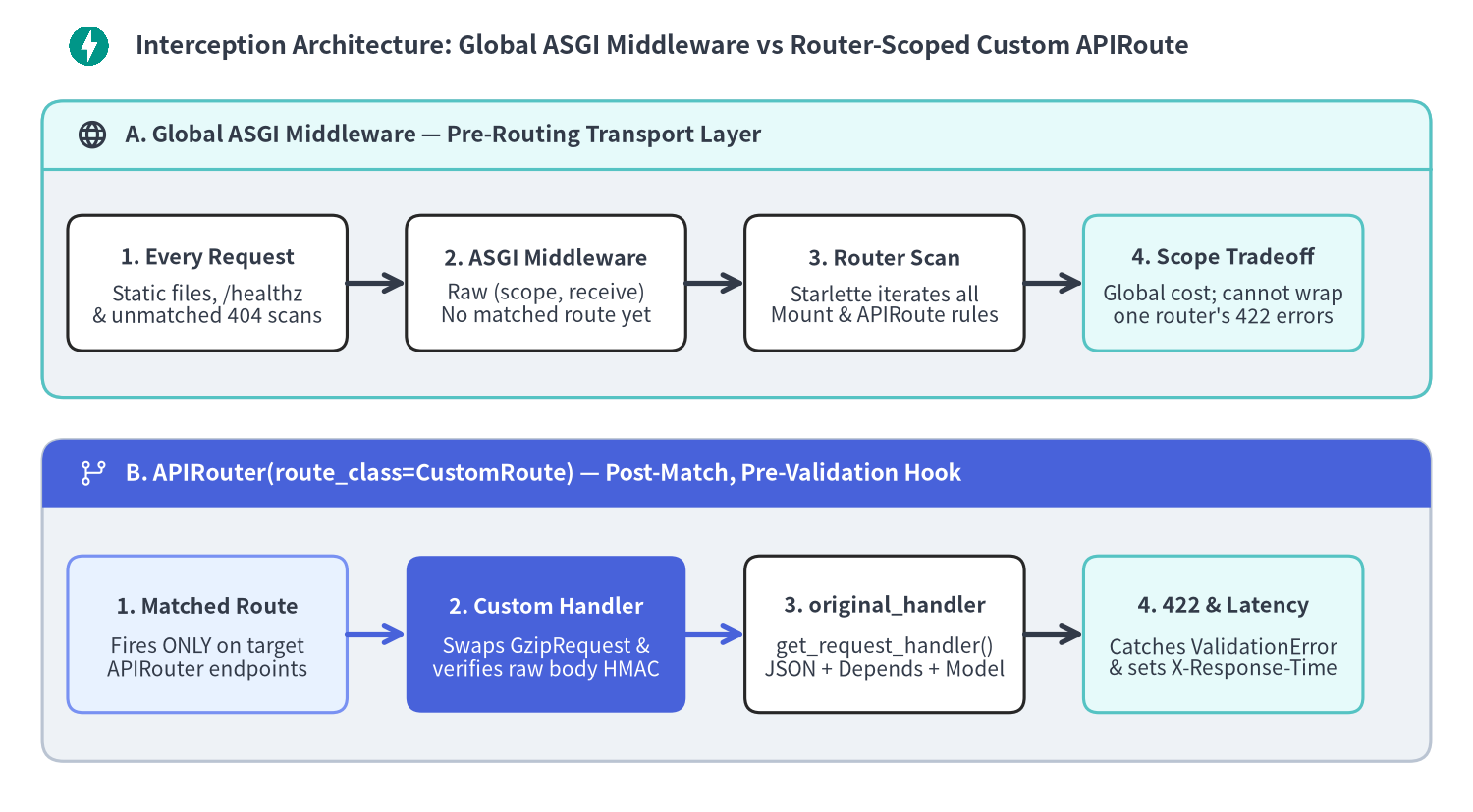
Subclassing APIRoute.get_route_handler() and Starlette's Request lets you intercept requests after router matching yet before FastAPI decodes JSON or runs Pydantic validation—enabling router-scoped gzip decompression, raw-byte HMAC verification, per-operation latency headers, and structured 422 validation error wrapping.
Source Code
from drawlib.canvas import save, setup
from drawlib.icons import code, phosphor
from drawlib.lines import line
from drawlib.shapes import rectangle
from drawlib.smartarts import Panel
from drawlib.styles import Styles
from drawlib.text import text

setup(width=174, height=96, dpi=150)

# Title Banner
code.fastapi((10.5, 90.5), width=5.2, style=Styles.Primary)
text(
    (16.0, 90.5),
    "Interception Architecture: Global ASGI Middleware vs Router-Scoped Custom APIRoute",
    style=Styles.DarkBold.patch(text_size=12.2, halign="left"),
)

# Lane A: Global ASGI Middleware (Pre-Routing)
p_asgi = Panel(
    "A. Global ASGI Middleware — Pre-Routing Transport Layer",
    style=Styles.Neutral,
    header_style=Styles.SecondaryNeutral,
    text_style=Styles.DarkBold.patch(text_size=11.0),
    icon=phosphor.globe,
    icon_style=Styles.DarkBold,
    header_height=8.0,
)
p_asgi.draw((5, 49), width=164, height=35)

asgi_steps = [
    (24.5, "1. Every Request", "Static files, /healthz\n& unmatched 404 scans", Styles.White, False),
    (64.5, "2. ASGI Middleware", "Raw (scope, receive)\nNo matched route yet", Styles.White, False),
    (104.5, "3. Router Scan", "Starlette iterates all\nMount & APIRoute rules", Styles.White, False),
    (144.5, "4. Scope Tradeoff", "Global cost; cannot wrap\none router's 422 errors", Styles.SecondaryNeutral, False),
]
for idx, (cx, st_title, st_sub, st_fill, _) in enumerate(asgi_steps):
    rectangle((cx, 62.5), width=33, height=16.0, style=st_fill.patch(shape_r=1.8))
    text((cx, 65.5), st_title, style=Styles.DarkBold.patch(text_size=10.4))
    text((cx, 60.0), st_sub, style=Styles.Dark.patch(text_size=10.0))
    if idx < len(asgi_steps) - 1:
        line((cx + 16.5, 62.5), (asgi_steps[idx + 1][0] - 16.5, 62.5), arrow_head="->", style=Styles.DarkBold)

# Lane B: APIRouter(route_class=CustomRoute) (Post-Match, Pre-Validation)
p_route = Panel(
    "B. APIRouter(route_class=CustomRoute) — Post-Match, Pre-Validation Hook",
    style=Styles.Neutral,
    header_style=Styles.PrimaryFlat,
    text_style=Styles.WhiteBold.patch(text_size=11.0),
    icon=phosphor.git_branch,
    icon_style=Styles.White,
    header_height=8.0,
)
p_route.draw((5, 6), width=164, height=38)

route_steps = [
    (24.5, "1. Matched Route", "Fires ONLY on target\nAPIRouter endpoints", Styles.PrimaryNeutral, False),
    (64.5, "2. Custom Handler", "Swaps GzipRequest &\nverifies raw body HMAC", Styles.PrimaryFlat, True),
    (104.5, "3. original_handler", "get_request_handler()\nJSON + Depends + Model", Styles.White, False),
    (144.5, "4. 422 & Latency", "Catches ValidationError\n& sets X-Response-Time", Styles.SecondaryNeutral, False),
]
for idx, (cx, rt_title, rt_sub, rt_fill, is_focal) in enumerate(route_steps):
    rectangle((cx, 21.0), width=33, height=18.5, style=rt_fill.patch(shape_r=1.8))
    t_h = Styles.WhiteBold if is_focal else Styles.DarkBold
    t_b = Styles.White if is_focal else Styles.Dark
    text((cx, 24.4), rt_title, style=t_h.patch(text_size=10.4))
    text((cx, 18.2), rt_sub, style=t_b.patch(text_size=10.0))
    if idx < len(route_steps) - 1:
        arr_st = Styles.PrimaryBold if idx in (0, 1) else Styles.DarkBold
        line((cx + 16.5, 21.0), (route_steps[idx + 1][0] - 16.5, 21.0), arrow_head="->", style=arr_st)

save()
Choosing the right extension hook in FastAPI depends on when during the ASGI lifecycle your logic must execute and how broadly it should apply across routers.
1. ASGI Middleware vs APIRoute.get_route_handler() Lifecycle
Inside fastapi/routing.py, every path operation registered on an APIRouter constructs an APIRoute (or the custom subclass passed to APIRouter(route_class=...)) and binds self.app = request_response(self.get_route_handler()). When a child router is mounted via app.include_router(), _EffectiveRouteContext.from_api_route() sets _effective_route_context_var and invokes original_route.get_route_handler() once per inclusion context—ensuring your custom wrapper automatically inherits merged parent prefixes, dependencies, and response settings while leaving sibling routers untouched.
Crucially, inspect the internal order inside get_request_handler() (fastapi/routing.py):
- Body Read & JSON Decoding (
await request.body()/await request.json()) runs first—raisingRequestValidationError(type="json_invalid")immediately if JSON syntax is malformed. - Dependency Resolution (
await solve_dependencies(...)) runs second—meaning aDepends()callable cannot decompress agzip-encoded JSON stream beforerequest.json()fails, nor canDepends()catchRequestValidationErrorraised by body or parameter validation.
| Dimension | Global Pure ASGI Middleware | APIRouter(route_class=CustomRoute) |
Depends() / Security() |
|---|---|---|---|
| Execution Timing | Before routing (runs on 404s, /static, all routers) |
After APIRoute.matches(), before JSON parse & Depends() |
After get_request_handler() decodes JSON/form body |
| Scope Granularity | Entire FastAPI app or mounted sub-app |
Exact APIRouter subtree (route_class=...) |
App, APIRouter, route dependencies=[...], or param |
Swap Request (body()) |
Requires manual low-level ASGI receive wrapper |
Native: instantiate CustomRequest(request.scope, request.receive) |
Too late (request.json() already ran) |
Catch RequestValidationError |
No (converted by outer ExceptionMiddleware unless handled globally) |
Yes: try: await original_route_handler(request) |
No (errors aggregated after solve_dependencies()) |
| Route Metadata Access | scope["route"] not yet populated pre-routing |
Direct self.operation_id, self.path, self.tags, self.dependant |
Via request.scope["route"] only |
2. Transparent GzipRequest, Error Wrapping & Webhook HMAC Routes
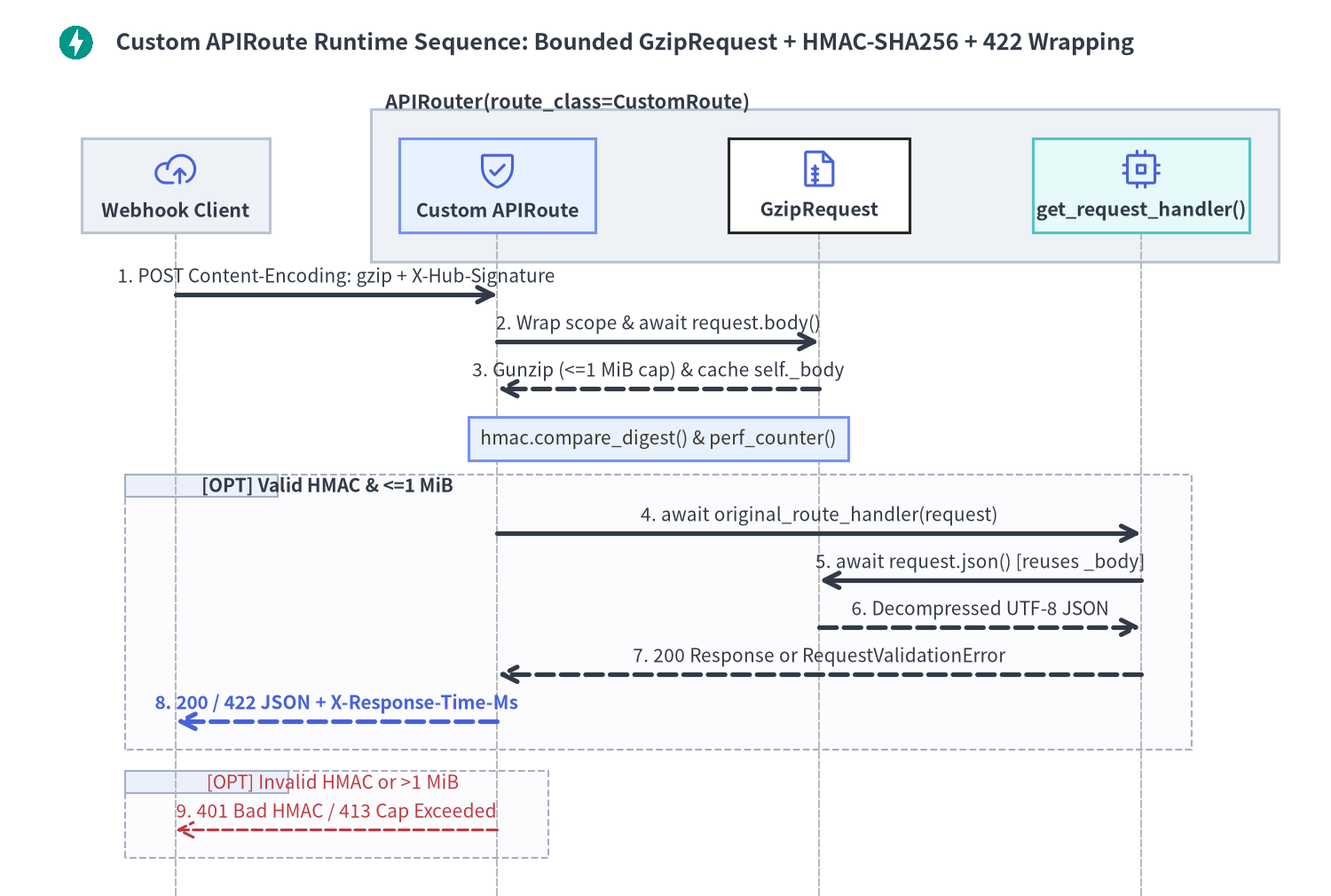
Combining a custom Request subclass with a custom APIRoute unlocks clean stream transformations and cryptographic pre-validation without polluting endpoint signatures.
Source Code
from drawlib.canvas import save, setup
from drawlib.diagrams.sequence import Participant, ParticipantGroup, PhosphorIcon, SequenceDiagram
from drawlib.icons import code
from drawlib.styles import Styles
from drawlib.text import text

setup(width=184, height=124, dpi=150)

# Title Banner
code.fastapi((10.5, 118.0), width=5.2, style=Styles.Primary)
text(
    (16.0, 118.0),
    "Custom APIRoute Runtime Sequence: Bounded GzipRequest + HMAC-SHA256 + 422 Wrapping",
    style=Styles.DarkBold.patch(text_size=12.2, halign="left"),
)

d = SequenceDiagram(
    node_style=Styles.Primary,
    node_text_style=Styles.DarkBold.patch(text_size=10.3),
    edge_style=Styles.DarkBold,
    edge_text_style=Styles.Dark.patch(text_size=10.0),
    node_card_style=Styles.White,
    autonumber=True,
    col_width=44.5,
    step_y=6.5,
)

client = d.add(
    Participant(
        "Webhook Client",
        width=26,
        height=13,
        icon=PhosphorIcon.CLOUD_ARROW_UP,
        icon_size=6.0,
        card_style=Styles.Neutral,
    )
)

router_grp = d.add(
    ParticipantGroup(
        title="APIRouter(route_class=CustomRoute)",
        padding=4.0,
        style=Styles.Neutral,
        text_style=Styles.DarkBold.patch(text_size=10.5, halign="left"),
    )
)
custom_route = router_grp.add(
    Participant(
        "Custom APIRoute",
        width=27,
        height=13,
        icon=PhosphorIcon.SHIELD_CHECK,
        icon_size=6.0,
        card_style=Styles.PrimaryNeutral,
    )
)
gzip_req = router_grp.add(
    Participant(
        "GzipRequest",
        width=25,
        height=13,
        icon=PhosphorIcon.FILE_ARCHIVE,
        icon_size=6.0,
    )
)
inner_handler = router_grp.add(
    Participant(
        "get_request_handler()",
        width=30,
        height=13,
        icon=PhosphorIcon.CPU,
        icon_size=6.0,
        card_style=Styles.SecondaryNeutral,
    )
)

client.request(custom_route, "POST Content-Encoding: gzip + X-Hub-Signature")
custom_route.request(gzip_req, "Wrap scope & await request.body()")
gzip_req.reply(custom_route, "Gunzip (<=1 MiB cap) & cache self._body")
d.note(
    "hmac.compare_digest() & perf_counter()",
    over=[custom_route, gzip_req],
    style=Styles.PrimaryNeutral.patch(text_size=10.0),
)

with d.opt("Valid HMAC & <=1 MiB") as ok_blk:
    ok_blk.text_style = Styles.DarkBold.patch(text_size=10.0, halign="left")
    custom_route.request(inner_handler, "await original_route_handler(request)")
    inner_handler.request(gzip_req, "await request.json() [reuses _body]")
    gzip_req.reply(inner_handler, "Decompressed UTF-8 JSON")
    inner_handler.reply(custom_route, "200 Response or RequestValidationError")
    custom_route.reply(
        client,
        "200 / 422 JSON + X-Response-Time-Ms",
        style=Styles.PrimaryBold,
        text_style=Styles.PrimaryBold.patch(text_size=10.0),
    )

with d.opt("Invalid HMAC or >1 MiB") as err_blk:
    err_blk.text_style = Styles.Danger.patch(text_size=10.0, halign="left")
    custom_route.reply(
        client,
        "401 Bad HMAC / 413 Cap Exceeded",
        style=Styles.Danger,
        text_style=Styles.Danger.patch(text_size=10.0),
    )

d.draw(xy=(92.0, 55.0), align="center")
save()
Bounded GzipRequest & GzipRoute Decompression
Starlette's Request.json() internally calls await self.body() and caches the result on self._body. Overriding async def body(self) -> bytes on GzipRequest—and reading through gzip.GzipFile.read(MAX_DECOMPRESSED_BYTES + 1) rather than unbounded gzip.decompress()—transparently feeds decompressed UTF-8 JSON to get_request_handler() while neutralizing zip-bomb denial-of-service payloads with 413 Content Too Large:
import gzip
import io
from typing import Any, Callable, Coroutine

from fastapi import APIRouter, FastAPI, HTTPException, Request, Response, status
from fastapi.routing import APIRoute
from pydantic import BaseModel

MAX_DECOMPRESSED_BYTES = 1024 * 1024  # 1 MiB decompression ceiling against zip bombs


class GzipRequest(Request):
    async def body(self) -> bytes:
        if not hasattr(self, "_body"):
            raw_body = await super().body()
            encodings = [
                token.strip().lower()
                for header in self.headers.getlist("Content-Encoding")
                for token in header.split(",")
            ]
            if "gzip" in encodings:
                try:
                    with gzip.GzipFile(fileobj=io.BytesIO(raw_body)) as gz_stream:
                        decompressed = gz_stream.read(MAX_DECOMPRESSED_BYTES + 1)
                except (OSError, EOFError) as exc:
                    raise HTTPException(
                        status_code=status.HTTP_400_BAD_REQUEST,
                        detail="Malformed gzip request stream",
                    ) from exc
                if len(decompressed) > MAX_DECOMPRESSED_BYTES:
                    raise HTTPException(
                        status_code=status.HTTP_413_CONTENT_TOO_LARGE,
                        detail="Decompressed payload exceeds 1 MiB limit",
                    )
                raw_body = decompressed
            self._body = raw_body
        return self._body


class GzipRoute(APIRoute):
    def get_route_handler(self) -> Callable[[Request], Coroutine[Any, Any, Response]]:
        original_route_handler = super().get_route_handler()

        async def custom_route_handler(request: Request) -> Response:
            gzip_request = GzipRequest(request.scope, request.receive)
            return await original_route_handler(gzip_request)

        return custom_route_handler


app = FastAPI(title="Telemetry Ingest API", version="1.0.0")
ingest_router = APIRouter(prefix="/ingest", route_class=GzipRoute)


class MetricBatch(BaseModel):
    service: str
    samples: list[float]


@ingest_router.post("/metrics")
async def ingest_metrics(batch: MetricBatch) -> dict[str, Any]:
    return {
        "service": batch.service,
        "count": len(batch.samples),
        "sum": sum(batch.samples),
    }


@app.get("/healthz")
async def healthz() -> dict[str, str]:
    return {"status": "ok"}


app.include_router(ingest_router)
Latency Timing, Structured 422 Wrapping & HMAC-SHA256 Verification
Webhook receivers must verify X-Hub-Signature-256 against the exact raw request bytes using constant-time hmac.compare_digest() before JSON deserialization—so forged requests are rejected with 401 Unauthorized without spending CPU on schema parsing or leaking validation errors. Wrapping await original_route_handler(request) in the same APIRoute subclass also lets you attach X-Response-Time-Ms latency headers and enrich legitimate callers' 422 validation failures with self.operation_id and a bounded payload preview:
import hashlib
import hmac
import logging
import os
import secrets
import time
from typing import Any, Callable, Coroutine

from fastapi import APIRouter, FastAPI, HTTPException, Request, Response, status
from fastapi.exceptions import RequestValidationError
from fastapi.responses import JSONResponse
from fastapi.routing import APIRoute
from pydantic import BaseModel, Field

logger = logging.getLogger(__name__)


def load_webhook_secret() -> bytes:
    configured = os.environ.get("WEBHOOK_HMAC_SECRET")
    if configured:
        return configured.encode("utf-8")
    logger.warning("WEBHOOK_HMAC_SECRET unset; using ephemeral instance-isolated key")
    return secrets.token_bytes(32)


WEBHOOK_SECRET: bytes = load_webhook_secret()
MAX_PREVIEW_CHARS = 256


class HmacTimedRoute(APIRoute):
    def get_route_handler(self) -> Callable[[Request], Coroutine[Any, Any, Response]]:
        original_route_handler = super().get_route_handler()
        operation_id = self.operation_id or self.name

        async def custom_route_handler(request: Request) -> Response:
            started = time.perf_counter()

            # 1. Verify HMAC-SHA256 over raw bytes BEFORE Pydantic parses JSON
            raw_body = await request.body()
            provided_sig = request.headers.get("X-Hub-Signature-256", "")
            expected_sig = (
                "sha256="
                + hmac.new(WEBHOOK_SECRET, raw_body, hashlib.sha256).hexdigest()
            )
            if not hmac.compare_digest(expected_sig, provided_sig):
                raise HTTPException(
                    status_code=status.HTTP_401_UNAUTHORIZED,
                    detail="Invalid or missing X-Hub-Signature-256 header",
                )

            # 2. Execute inner FastAPI handler & catch RequestValidationError
            try:
                response = await original_route_handler(request)
            except RequestValidationError as exc:
                elapsed_ms = (time.perf_counter() - started) * 1000.0
                preview = raw_body.decode("utf-8", errors="replace")[:MAX_PREVIEW_CHARS]
                return JSONResponse(
                    status_code=status.HTTP_422_UNPROCESSABLE_CONTENT,
                    content={
                        "operation_id": operation_id,
                        "detail": exc.errors(),
                        "raw_body_preview": preview,
                    },
                    headers={"X-Response-Time-Ms": f"{elapsed_ms:.2f}"},
                )

            elapsed_ms = (time.perf_counter() - started) * 1000.0
            response.headers["X-Response-Time-Ms"] = f"{elapsed_ms:.2f}"
            return response

        return custom_route_handler


app = FastAPI(title="Signed Webhook Receiver", version="1.0.0")
webhook_router = APIRouter(prefix="/webhooks", route_class=HmacTimedRoute)


class PaymentDeliveredEvent(BaseModel):
    event_id: str
    invoice_id: str
    amount_cents: int = Field(gt=0)


@webhook_router.post("/payments")
async def receive_payment_webhook(
    event: PaymentDeliveredEvent,
) -> dict[str, Any]:
    return {"accepted": True, "event_id": event.event_id}


app.include_router(webhook_router)
[!TIP] Because
await request.body()cachesrequest._bodyin memory, callingawait request.body()insideHmacTimedRoutedoes not consume the ASGI stream away fromoriginal_route_handler(request)—get_request_handler()reuses the cached bytes immediately. Avoid overridingRequest.body()only on multi-megabyte multipart file uploads whererequest.stream()should stream chunks directly toSpooledTemporaryFile.
With Chapter 3's routing and model layer complete—spanning Path, Query, Header, Cookie & Body, Response Serialization & OpenAPI 3.1, and Parameter Models, Extra Types & Examples—continue to Chapter 4's Dependant DAG, Caching & Scopes, ASGI Middleware & Threadpool for transport-level middleware, Native OpenTelemetry & Exceptions for app-wide exception handlers, and Webhooks, Callbacks, SDKs & Docs UI for documenting @app.webhooks schemas.