カスタム Request と APIRoute クラスの拡張
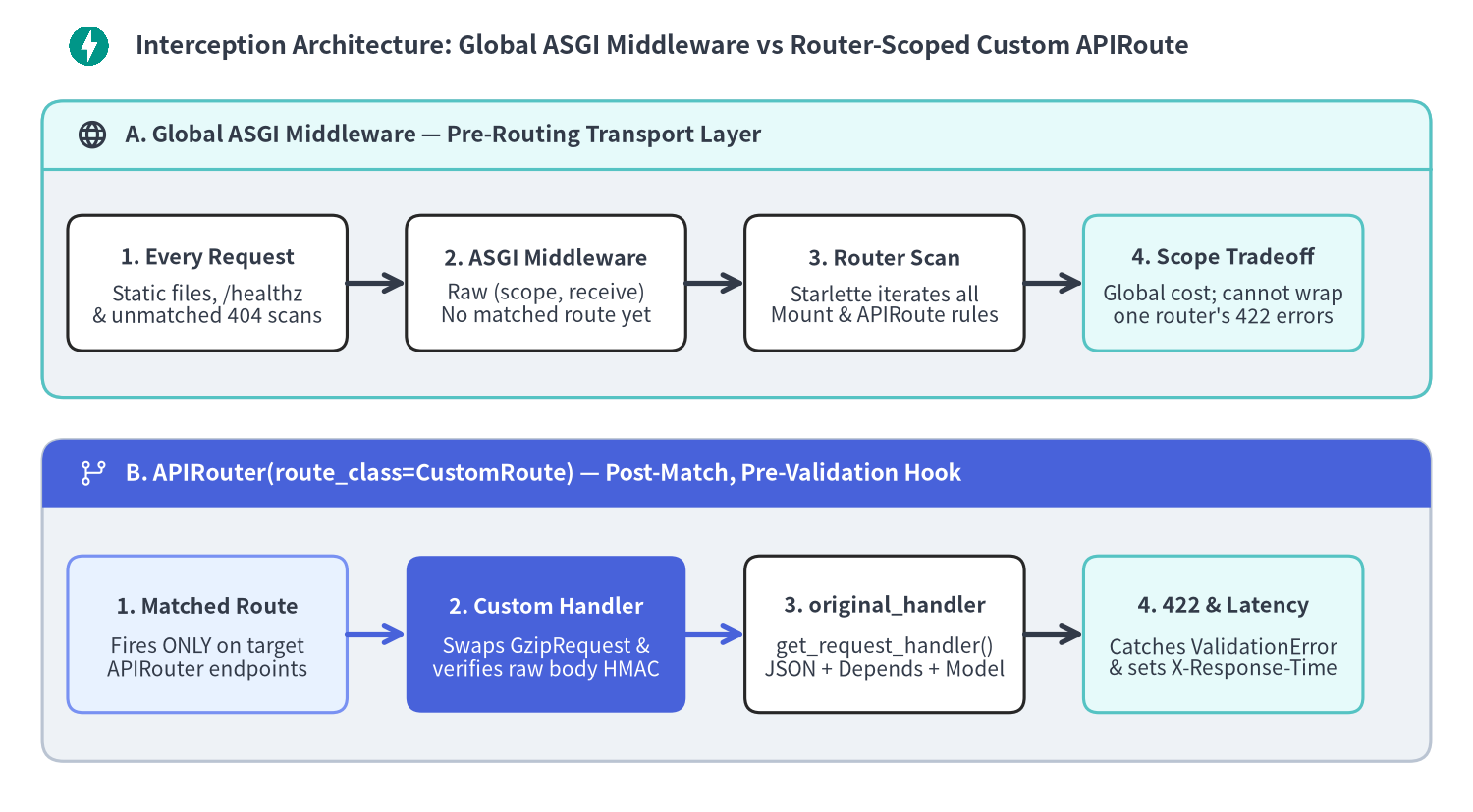
APIRoute.get_route_handler() と Starlette の Request をサブクラス化すると、ルーターのパス照合が成功した直後かつ FastAPI が JSON デコードや Pydantic 検証を実行する直前に処理を挟み込むことができ、ルーター単位での透過的 gzip 解凍・生バイト列に対する HMAC 署名検証・オペレーション別レイテンシ計測・構造化 422 エラー拡張を実現できます。
Source Code
from drawlib.canvas import save, setup
from drawlib.icons import code, phosphor
from drawlib.lines import line
from drawlib.shapes import rectangle
from drawlib.smartarts import Panel
from drawlib.styles import Styles
from drawlib.text import text

setup(width=174, height=96, dpi=150)

# Title Banner
code.fastapi((10.5, 90.5), width=5.2, style=Styles.Primary)
text(
    (16.0, 90.5),
    "Interception Architecture: Global ASGI Middleware vs Router-Scoped Custom APIRoute",
    style=Styles.DarkBold.patch(text_size=12.2, halign="left"),
)

# Lane A: Global ASGI Middleware (Pre-Routing)
p_asgi = Panel(
    "A. Global ASGI Middleware — Pre-Routing Transport Layer",
    style=Styles.Neutral,
    header_style=Styles.SecondaryNeutral,
    text_style=Styles.DarkBold.patch(text_size=11.0),
    icon=phosphor.globe,
    icon_style=Styles.DarkBold,
    header_height=8.0,
)
p_asgi.draw((5, 49), width=164, height=35)

asgi_steps = [
    (24.5, "1. Every Request", "Static files, /healthz\n& unmatched 404 scans", Styles.White, False),
    (64.5, "2. ASGI Middleware", "Raw (scope, receive)\nNo matched route yet", Styles.White, False),
    (104.5, "3. Router Scan", "Starlette iterates all\nMount & APIRoute rules", Styles.White, False),
    (144.5, "4. Scope Tradeoff", "Global cost; cannot wrap\none router's 422 errors", Styles.SecondaryNeutral, False),
]
for idx, (cx, st_title, st_sub, st_fill, _) in enumerate(asgi_steps):
    rectangle((cx, 62.5), width=33, height=16.0, style=st_fill.patch(shape_r=1.8))
    text((cx, 65.5), st_title, style=Styles.DarkBold.patch(text_size=10.4))
    text((cx, 60.0), st_sub, style=Styles.Dark.patch(text_size=10.0))
    if idx < len(asgi_steps) - 1:
        line((cx + 16.5, 62.5), (asgi_steps[idx + 1][0] - 16.5, 62.5), arrow_head="->", style=Styles.DarkBold)

# Lane B: APIRouter(route_class=CustomRoute) (Post-Match, Pre-Validation)
p_route = Panel(
    "B. APIRouter(route_class=CustomRoute) — Post-Match, Pre-Validation Hook",
    style=Styles.Neutral,
    header_style=Styles.PrimaryFlat,
    text_style=Styles.WhiteBold.patch(text_size=11.0),
    icon=phosphor.git_branch,
    icon_style=Styles.White,
    header_height=8.0,
)
p_route.draw((5, 6), width=164, height=38)

route_steps = [
    (24.5, "1. Matched Route", "Fires ONLY on target\nAPIRouter endpoints", Styles.PrimaryNeutral, False),
    (64.5, "2. Custom Handler", "Swaps GzipRequest &\nverifies raw body HMAC", Styles.PrimaryFlat, True),
    (104.5, "3. original_handler", "get_request_handler()\nJSON + Depends + Model", Styles.White, False),
    (144.5, "4. 422 & Latency", "Catches ValidationError\n& sets X-Response-Time", Styles.SecondaryNeutral, False),
]
for idx, (cx, rt_title, rt_sub, rt_fill, is_focal) in enumerate(route_steps):
    rectangle((cx, 21.0), width=33, height=18.5, style=rt_fill.patch(shape_r=1.8))
    t_h = Styles.WhiteBold if is_focal else Styles.DarkBold
    t_b = Styles.White if is_focal else Styles.Dark
    text((cx, 24.4), rt_title, style=t_h.patch(text_size=10.4))
    text((cx, 18.2), rt_sub, style=t_b.patch(text_size=10.0))
    if idx < len(route_steps) - 1:
        arr_st = Styles.PrimaryBold if idx in (0, 1) else Styles.DarkBold
        line((cx + 16.5, 21.0), (route_steps[idx + 1][0] - 16.5, 21.0), arrow_head="->", style=arr_st)

save()
FastAPI で横断的関心事を実装する際は、ASGI ライフサイクルのどの時点で介入する必要があるか、そしてどの範囲のルーターに適用すべきかに応じて拡張フックを選択します。
1. ASGI ミドルウェアと APIRoute.get_route_handler() のライフサイクル
fastapi/routing.py では、APIRouter に登録される各パスオペレーションが APIRoute(または APIRouter(route_class=...) に指定したカスタムサブクラス)を生成し、self.app = request_response(self.get_route_handler()) を構築します。さらに子ルーターを app.include_router() で統合する際も、_EffectiveRouteContext.from_api_route() が _effective_route_context_var を設定したうえで統合コンテキストごとに一度だけ original_route.get_route_handler() を再呼び出しするため、親ルーターから継承したプレフィックスや依存関係を含むハンドラを確実にラップでき、他の兄弟ルーターには一切影響を与えません。
特に重要なのが、get_request_handler()(fastapi/routing.py)内部の実行順序です。
- ボディ読み取りと JSON デコード(
await request.body()/await request.json())が最初に実行され、JSON 構文が不正な場合は即座にRequestValidationError(type="json_invalid")が送出されます。 - 依存関係の解決(
await solve_dependencies(...))はその後に実行されます。したがって、Depends()関数ではrequest.json()が失敗する前にgzip圧縮ストリームを解凍することはできず、ボディやパラメータ検証が送出するRequestValidationErrorを捕捉することもできません。
| 比較軸 | グローバル純粋 ASGI ミドルウェア | APIRouter(route_class=CustomRoute) |
Depends() / Security() |
|---|---|---|---|
| 実行タイミング | ルーティング前(404・/static・全ルーターで常時実行) |
APIRoute.matches() 成功後、JSON 解析および Depends() の直前 |
get_request_handler() による JSON/Form 解析の後 |
| 適用スコープの粒度 | FastAPI アプリ全体(またはマウントされたサブアプリ) |
対象の APIRouter サブツリーのみ(route_class=...) |
アプリ・APIRouter・ルート dependencies・個別引数 |
Request(body())の差し替え |
低レベル ASGI receive ラッパーの手動実装が必要 |
ネイティブ対応(CustomRequest(request.scope, request.receive)) |
不可(すでに request.json() が実行済み) |
RequestValidationError の捕捉 |
不可(外側の ExceptionMiddleware 等で一括処理) |
可能(try: await original_route_handler(request) で捕捉) |
不可(solve_dependencies() 完了後に送出されるため) |
| ルートメタデータへの参照 | ルーティング前のため scope["route"] 未確定 |
self.operation_id・self.path・self.tags・self.dependant を直接参照 |
request.scope["route"] 経由のみ |
2. 透過的 GzipRequest・422 エラー拡張・Webhook HMAC 検証ルート
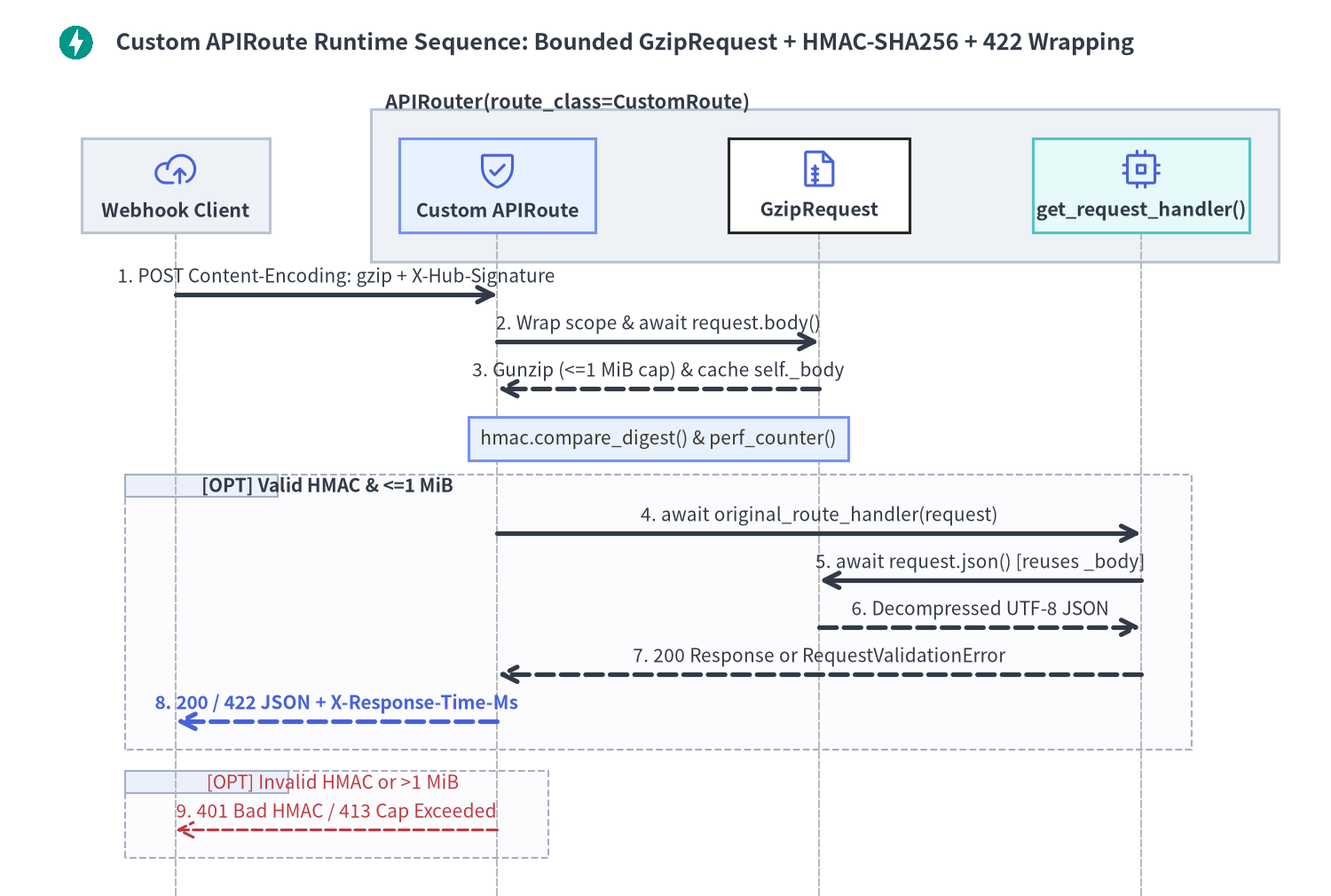
カスタム Request サブクラスとカスタム APIRoute を組み合わせることで、各エンドポイントの関数署名を一切汚さずにストリーム変換や暗号学的署名検証を組み込めます。
Source Code
from drawlib.canvas import save, setup
from drawlib.diagrams.sequence import Participant, ParticipantGroup, PhosphorIcon, SequenceDiagram
from drawlib.icons import code
from drawlib.styles import Styles
from drawlib.text import text

setup(width=184, height=124, dpi=150)

# Title Banner
code.fastapi((10.5, 118.0), width=5.2, style=Styles.Primary)
text(
    (16.0, 118.0),
    "Custom APIRoute Runtime Sequence: Bounded GzipRequest + HMAC-SHA256 + 422 Wrapping",
    style=Styles.DarkBold.patch(text_size=12.2, halign="left"),
)

d = SequenceDiagram(
    node_style=Styles.Primary,
    node_text_style=Styles.DarkBold.patch(text_size=10.3),
    edge_style=Styles.DarkBold,
    edge_text_style=Styles.Dark.patch(text_size=10.0),
    node_card_style=Styles.White,
    autonumber=True,
    col_width=44.5,
    step_y=6.5,
)

client = d.add(
    Participant(
        "Webhook Client",
        width=26,
        height=13,
        icon=PhosphorIcon.CLOUD_ARROW_UP,
        icon_size=6.0,
        card_style=Styles.Neutral,
    )
)

router_grp = d.add(
    ParticipantGroup(
        title="APIRouter(route_class=CustomRoute)",
        padding=4.0,
        style=Styles.Neutral,
        text_style=Styles.DarkBold.patch(text_size=10.5, halign="left"),
    )
)
custom_route = router_grp.add(
    Participant(
        "Custom APIRoute",
        width=27,
        height=13,
        icon=PhosphorIcon.SHIELD_CHECK,
        icon_size=6.0,
        card_style=Styles.PrimaryNeutral,
    )
)
gzip_req = router_grp.add(
    Participant(
        "GzipRequest",
        width=25,
        height=13,
        icon=PhosphorIcon.FILE_ARCHIVE,
        icon_size=6.0,
    )
)
inner_handler = router_grp.add(
    Participant(
        "get_request_handler()",
        width=30,
        height=13,
        icon=PhosphorIcon.CPU,
        icon_size=6.0,
        card_style=Styles.SecondaryNeutral,
    )
)

client.request(custom_route, "POST Content-Encoding: gzip + X-Hub-Signature")
custom_route.request(gzip_req, "Wrap scope & await request.body()")
gzip_req.reply(custom_route, "Gunzip (<=1 MiB cap) & cache self._body")
d.note(
    "hmac.compare_digest() & perf_counter()",
    over=[custom_route, gzip_req],
    style=Styles.PrimaryNeutral.patch(text_size=10.0),
)

with d.opt("Valid HMAC & <=1 MiB") as ok_blk:
    ok_blk.text_style = Styles.DarkBold.patch(text_size=10.0, halign="left")
    custom_route.request(inner_handler, "await original_route_handler(request)")
    inner_handler.request(gzip_req, "await request.json() [reuses _body]")
    gzip_req.reply(inner_handler, "Decompressed UTF-8 JSON")
    inner_handler.reply(custom_route, "200 Response or RequestValidationError")
    custom_route.reply(
        client,
        "200 / 422 JSON + X-Response-Time-Ms",
        style=Styles.PrimaryBold,
        text_style=Styles.PrimaryBold.patch(text_size=10.0),
    )

with d.opt("Invalid HMAC or >1 MiB") as err_blk:
    err_blk.text_style = Styles.Danger.patch(text_size=10.0, halign="left")
    custom_route.reply(
        client,
        "401 Bad HMAC / 413 Cap Exceeded",
        style=Styles.Danger,
        text_style=Styles.Danger.patch(text_size=10.0),
    )

d.draw(xy=(92.0, 55.0), align="center")
save()
上限付き GzipRequest と GzipRoute による透過解凍
Starlette の Request.json() は内部で await self.body() を呼び出し、結果を self._body にキャッシュします。GzipRequest で async def body(self) -> bytes をオーバーライドし、無制限な gzip.decompress() ではなく gzip.GzipFile.read(MAX_DECOMPRESSED_BYTES + 1) で展開バイト数に上限を設けることで、gzip 圧縮爆弾(DoS)を 413 Content Too Large で遮断しつつ、解凍済み UTF-8 JSON を get_request_handler() へ透過的に引き渡せます。
import gzip
import io
from typing import Any, Callable, Coroutine

from fastapi import APIRouter, FastAPI, HTTPException, Request, Response, status
from fastapi.routing import APIRoute
from pydantic import BaseModel

MAX_DECOMPRESSED_BYTES = 1024 * 1024  # 1 MiB decompression ceiling against zip bombs


class GzipRequest(Request):
    async def body(self) -> bytes:
        if not hasattr(self, "_body"):
            raw_body = await super().body()
            encodings = [
                token.strip().lower()
                for header in self.headers.getlist("Content-Encoding")
                for token in header.split(",")
            ]
            if "gzip" in encodings:
                try:
                    with gzip.GzipFile(fileobj=io.BytesIO(raw_body)) as gz_stream:
                        decompressed = gz_stream.read(MAX_DECOMPRESSED_BYTES + 1)
                except (OSError, EOFError) as exc:
                    raise HTTPException(
                        status_code=status.HTTP_400_BAD_REQUEST,
                        detail="Malformed gzip request stream",
                    ) from exc
                if len(decompressed) > MAX_DECOMPRESSED_BYTES:
                    raise HTTPException(
                        status_code=status.HTTP_413_CONTENT_TOO_LARGE,
                        detail="Decompressed payload exceeds 1 MiB limit",
                    )
                raw_body = decompressed
            self._body = raw_body
        return self._body


class GzipRoute(APIRoute):
    def get_route_handler(self) -> Callable[[Request], Coroutine[Any, Any, Response]]:
        original_route_handler = super().get_route_handler()

        async def custom_route_handler(request: Request) -> Response:
            gzip_request = GzipRequest(request.scope, request.receive)
            return await original_route_handler(gzip_request)

        return custom_route_handler


app = FastAPI(title="Telemetry Ingest API", version="1.0.0")
ingest_router = APIRouter(prefix="/ingest", route_class=GzipRoute)


class MetricBatch(BaseModel):
    service: str
    samples: list[float]


@ingest_router.post("/metrics")
async def ingest_metrics(batch: MetricBatch) -> dict[str, Any]:
    return {
        "service": batch.service,
        "count": len(batch.samples),
        "sum": sum(batch.samples),
    }


@app.get("/healthz")
async def healthz() -> dict[str, str]:
    return {"status": "ok"}


app.include_router(ingest_router)
レイテンシ計測・構造化 422 ラッピング・HMAC-SHA256 署名検証
Webhook 受信エンドポイントでは、JSON デシリアライズを実行する前に、受信した生のバイト列に対して定数時間比較 hmac.compare_digest() で X-Hub-Signature-256 を検証する必要があります。これにより、偽造されたリクエストに対してスキーマ解析の CPU コストを消費したり内部検証エラーを漏洩したりすることなく 401 Unauthorized で即座に拒否できます。さらに同じ APIRoute サブクラス内で await original_route_handler(request) をラップすれば、X-Response-Time-Ms ヘッダの付与と、正規送信元のスキーマ不整合(RequestValidationError)に対する operation_id および長さ制限付き生ボディプレビューを含む構造化 422 応答を同時に実装できます。
import hashlib
import hmac
import logging
import os
import secrets
import time
from typing import Any, Callable, Coroutine

from fastapi import APIRouter, FastAPI, HTTPException, Request, Response, status
from fastapi.exceptions import RequestValidationError
from fastapi.responses import JSONResponse
from fastapi.routing import APIRoute
from pydantic import BaseModel, Field

logger = logging.getLogger(__name__)


def load_webhook_secret() -> bytes:
    configured = os.environ.get("WEBHOOK_HMAC_SECRET")
    if configured:
        return configured.encode("utf-8")
    logger.warning("WEBHOOK_HMAC_SECRET unset; using ephemeral instance-isolated key")
    return secrets.token_bytes(32)


WEBHOOK_SECRET: bytes = load_webhook_secret()
MAX_PREVIEW_CHARS = 256


class HmacTimedRoute(APIRoute):
    def get_route_handler(self) -> Callable[[Request], Coroutine[Any, Any, Response]]:
        original_route_handler = super().get_route_handler()
        operation_id = self.operation_id or self.name

        async def custom_route_handler(request: Request) -> Response:
            started = time.perf_counter()

            # 1. Verify HMAC-SHA256 over raw bytes BEFORE Pydantic parses JSON
            raw_body = await request.body()
            provided_sig = request.headers.get("X-Hub-Signature-256", "")
            expected_sig = (
                "sha256="
                + hmac.new(WEBHOOK_SECRET, raw_body, hashlib.sha256).hexdigest()
            )
            if not hmac.compare_digest(expected_sig, provided_sig):
                raise HTTPException(
                    status_code=status.HTTP_401_UNAUTHORIZED,
                    detail="Invalid or missing X-Hub-Signature-256 header",
                )

            # 2. Execute inner FastAPI handler & catch RequestValidationError
            try:
                response = await original_route_handler(request)
            except RequestValidationError as exc:
                elapsed_ms = (time.perf_counter() - started) * 1000.0
                preview = raw_body.decode("utf-8", errors="replace")[:MAX_PREVIEW_CHARS]
                return JSONResponse(
                    status_code=status.HTTP_422_UNPROCESSABLE_CONTENT,
                    content={
                        "operation_id": operation_id,
                        "detail": exc.errors(),
                        "raw_body_preview": preview,
                    },
                    headers={"X-Response-Time-Ms": f"{elapsed_ms:.2f}"},
                )

            elapsed_ms = (time.perf_counter() - started) * 1000.0
            response.headers["X-Response-Time-Ms"] = f"{elapsed_ms:.2f}"
            return response

        return custom_route_handler


app = FastAPI(title="Signed Webhook Receiver", version="1.0.0")
webhook_router = APIRouter(prefix="/webhooks", route_class=HmacTimedRoute)


class PaymentDeliveredEvent(BaseModel):
    event_id: str
    invoice_id: str
    amount_cents: int = Field(gt=0)


@webhook_router.post("/payments")
async def receive_payment_webhook(
    event: PaymentDeliveredEvent,
) -> dict[str, Any]:
    return {"accepted": True, "event_id": event.event_id}


app.include_router(webhook_router)
[!TIP]
await request.body()は読み取ったバイト列をrequest._bodyにキャッシュするため、HmacTimedRoute内で先にawait request.body()を呼び出しても後続のoriginal_route_handler(request)でストリームが枯渇することはなく、get_request_handler()はキャッシュ済みのバイト列を即座に再利用します。ただし数メガバイト規模のマルチパートファイルアップロード(request.stream()からSpooledTemporaryFileへ逐次書き出すルート)では、メモリ一括展開を避けるためRequest.body()の事前読み取りを行わないルーターへ分離してください。
以上で第 3 章(Path・Query・Header・Cookie・Body、レスポンス直列化と OpenAPI 3.1、パラメータモデル合成・特殊型・例示、および本ページ)のルーティング・モデル基盤が完結します。続いて第 4 章の Dependant DAG・キャッシュ・yield スコープ、トランスポート層ミドルウェアを扱う ASGI ミドルウェアとスレッドプール制御、アプリ全体の例外ハンドラを扱う ネイティブ OpenTelemetry と例外処理、および @app.webhooks スキーマ文書化を扱う Webhooks・Callbacks・SDK 生成・Docs UI へ進んでください。