ネイティブ OpenTelemetry と例外処理
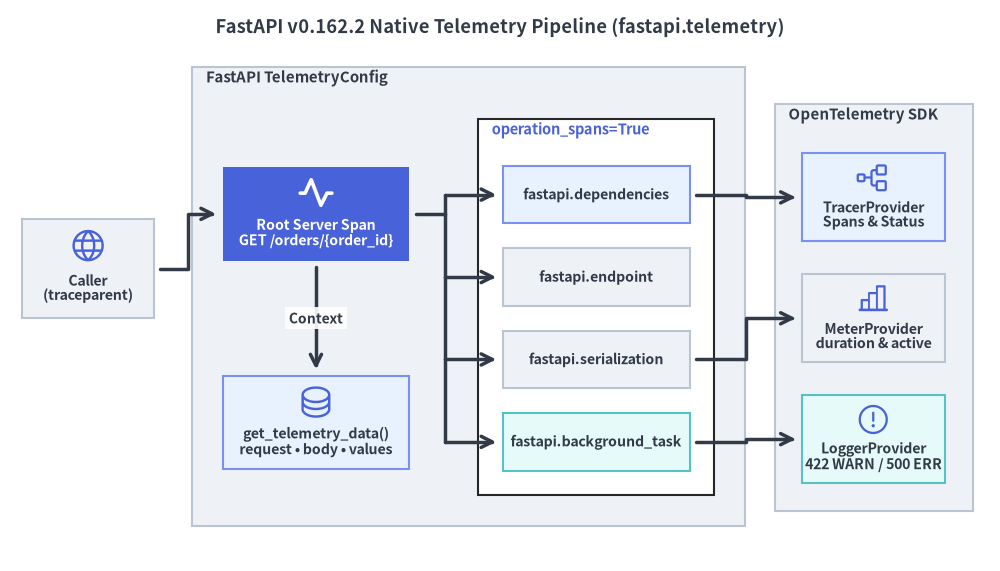
FastAPI v0.162.2 は、外部モンキーパッチ不要のネイティブ OpenTelemetry 計装(fastapi.telemetry の TelemetryConfig と get_telemetry_data())を本体に組み込み、クライアント起因の 4xx / 422 エラーとサーバー側の契約違反である 500 エラーを 2 段階の例外境界で明確に分離します。
Source Code
from drawlib.canvas import save, setup
from drawlib.diagrams.architecture import ArchitectureDiagram, Node, NodeGroup, PhosphorIcon
from drawlib.styles import Styles
from drawlib.text import text

setup(width=182, height=104)

text(
    (91.0, 99.0),
    "FastAPI v0.162.2 Native Telemetry Pipeline (fastapi.telemetry)",
    style=Styles.DarkBold.patch(text_size=13.2),
)

d = ArchitectureDiagram(
    node_style=Styles.Primary,
    node_text_style=Styles.DarkBold.patch(text_size=10.2),
    edge_style=Styles.DarkBold,
    edge_text_style=Styles.DarkBold.patch(text_size=10.0),
    node_card_style=Styles.Neutral,
)

caller = d.add(
    Node("Caller\n(traceparent)", width=24, height=18, icon=PhosphorIcon.GLOBE, icon_size=7.0),
    xy=(13.0, 52.0),
)

# Central FastAPI Runtime Group (bottom-left at (32, 4))
runtime = d.add(
    NodeGroup(
        title="FastAPI TelemetryConfig",
        padding=5.5,
        style=Styles.Neutral,
        text_style=Styles.DarkBold.patch(text_size=10.8, halign="left"),
    ),
    xy=(32.0, 4.0),
)

root_span = runtime.add(
    Node(
        "Root Server Span\nGET /orders/{order_id}",
        width=34,
        height=17,
        icon=PhosphorIcon.ACTIVITY,
        icon_size=7.0,
        card_style=Styles.PrimaryFlat,
        style=Styles.WhiteBold,
        text_style=Styles.WhiteBold.patch(text_size=10.2),
    ),
    xy=(22.5, 58.0),
)

ctx_reader = runtime.add(
    Node(
        "get_telemetry_data()\nrequest • body • values",
        width=34,
        height=17,
        icon=PhosphorIcon.DATABASE,
        icon_size=7.0,
        card_style=Styles.PrimaryNeutral,
    ),
    xy=(22.5, 20.0),
)

# Nested Operation Spans Group inside runtime (global left = 32 + 52 = 84)
ops = runtime.add(
    NodeGroup(
        title="operation_spans=True",
        padding=4.5,
        style=Styles.White,
        text_style=Styles.PrimaryBold.patch(text_size=10.5, halign="left"),
    ),
    xy=(52.0, 5.0),
)
s_dep = ops.add(Node("fastapi.dependencies", width=34, height=10.5, card_style=Styles.PrimaryNeutral), xy=(21.5, 56.5))
s_end = ops.add(Node("fastapi.endpoint", width=34, height=10.5, card_style=Styles.Neutral), xy=(21.5, 41.5))
s_ser = ops.add(Node("fastapi.serialization", width=34, height=10.5, card_style=Styles.Neutral), xy=(21.5, 26.5))
s_bg = ops.add(Node("fastapi.background_task", width=34, height=10.5, card_style=Styles.SecondaryNeutral), xy=(21.5, 11.5))

# Right OpenTelemetry SDK Providers Group
otel_sdk = d.add(
    NodeGroup(
        title="OpenTelemetry SDK",
        padding=5.0,
        style=Styles.Neutral,
        text_style=Styles.DarkBold.patch(text_size=10.8, halign="left"),
    ),
    xy=(138.0, 9.0),
)
p_trace = otel_sdk.add(
    Node("TracerProvider\nSpans & Status", width=26, height=16, icon=PhosphorIcon.TREE_STRUCTURE, icon_size=6.5, card_style=Styles.PrimaryNeutral),
    xy=(18.0, 56.0),
)
p_meter = otel_sdk.add(
    Node("MeterProvider\nduration & active", width=26, height=16, icon=PhosphorIcon.CHART_BAR, icon_size=6.5),
    xy=(18.0, 34.0),
)
p_logs = otel_sdk.add(
    Node("LoggerProvider\n422 WARN / 500 ERR", width=26, height=16, icon=PhosphorIcon.WARNING_CIRCLE, icon_size=6.5, card_style=Styles.SecondaryNeutral),
    xy=(18.0, 12.0),
)

d.connect(caller, root_span, padding=1.2)
d.connect(root_span, ctx_reader, label="Context", padding=1.2)
j_root = d.junction((78.0, 62.0))
d.connect(root_span, j_root, arrow="-", padding=(1.2, 0.0))
j_rows = [d.junction((78.0, gy)) for gy in (65.5, 50.5, 35.5, 20.5)]
d.connect(j_root, j_rows[0], arrow="-")
d.connect(j_root, j_rows[1], arrow="-")
d.connect(j_rows[1], j_rows[2], arrow="-")
d.connect(j_rows[2], j_rows[3], arrow="-")
for j_row, child_span in zip(j_rows, (s_dep, s_end, s_ser, s_bg)):
    d.connect(j_row, child_span, padding=(0.0, 1.2))
d.connect(s_dep, p_trace, padding=1.2)
d.connect(s_ser, p_meter, padding=1.2)
d.connect(s_bg, p_logs, padding=1.2)

d.draw(xy=(3.0, 3.0))
save()
1. ネイティブ fastapi.telemetry のアーキテクチャ
従来の外部 ASGI ミドルウェアによる計装では生の ASGI メッセージしか観測できず、依存性注入や Pydantic 直列化、入力検証エラーの内訳までは追跡できませんでした。FastAPI v0.162.2 では FastAPI(telemetry=TelemetryConfig(...)) を渡すだけで、OpenTelemetry セマンティック規約(1.44.0)に準拠した詳細なシグナルがネイティブに出力されます。
- ルート HTTP / WebSocket スパン(
tracing=True): W3Ctraceparentとbaggageを抽出し、署名付き URL クエリ(sig、X-Amz-Signature、X-Goog-Signatureなど)を自動マスクした上で、ルート確定時にスパン名を"{METHOD} {http.route}"(例:GET /orders/{order_id})へ更新します。 - 4 つの子操作スパン(
operation_spans=True):code.function.name属性付きで内部フェーズの所要時間を個別に計測します。fastapi.dependencies:DependantDAG 全体の依存解決時間(solve_dependencies)。fastapi.endpoint: コルーチンawaitまたはスレッドプール上でのエンドポイント実行時間(run_endpoint_function)。fastapi.serialization: Pydantic 出力検証および Rust 製 JSON 直列化時間(serialize_response)。fastapi.background_task:BackgroundTasks内の各バックグラウンド処理。
- メトリクスと構造化ログ(
metrics=True,logs=True):http.server.request.durationヒストグラムとhttp.server.active_requestsカウンターを記録し、422入力検証失敗時にはWARNイベント(fastapi.validation.failed)、未処理例外時にはERRORイベント(http.server.request.exception)を送出します。 - 同期コンテキスト参照(
get_telemetry_data()): リクエスト処理中に限り、読み取り専用のTelemetryData(request、websocket、body、values、errors)をカスタム SpanProcessor / LogProcessor 等から安全に参照できます。生ペイロードをデフォルトで外部エクスポートせず、レスポンス完了と同時に参照をNoneクリアしてメモリリークを防ぎます。
from typing import Annotated

from fastapi import BackgroundTasks, Depends, FastAPI, Header
from fastapi.telemetry import TelemetryConfig, get_telemetry_data
from fastapi.testclient import TestClient
from opentelemetry.sdk.trace import TracerProvider
from opentelemetry.sdk.trace.export import SimpleSpanProcessor
from opentelemetry.sdk.trace.export.in_memory_span_exporter import InMemorySpanExporter
from pydantic import BaseModel

exporter = InMemorySpanExporter()
provider = TracerProvider()
provider.add_span_processor(SimpleSpanProcessor(exporter))

telemetry_cfg: TelemetryConfig = {
    "tracer_provider": provider,
    "tracing": True,
    "operation_spans": True,
    "metrics": False,
    "logs": False,
    "exclude": lambda scope: scope.get("path") == "/healthz",
}
app = FastAPI(title="Orders Service", telemetry=telemetry_cfg)


class OrderOut(BaseModel):
    order_id: int
    tenant: str
    traced_route: bool


async def resolve_tenant(x_tenant: Annotated[str, Header()] = "acme") -> str:
    return x_tenant


@app.get("/healthz")
async def healthz() -> dict[str, str]:
    return {"status": "ok"}


@app.get("/orders/{order_id}", response_model=OrderOut)
async def get_order(
    order_id: int,
    tenant: Annotated[str, Depends(resolve_tenant)],
    tasks: BackgroundTasks,
) -> OrderOut:
    tdata = get_telemetry_data()
    has_context = (
        tdata is not None
        and tdata.request is not None
        and tdata.values is not None
    )
    tasks.add_task(lambda: None)
    return OrderOut(order_id=order_id, tenant=tenant, traced_route=has_context)


client = TestClient(app)
assert client.get("/healthz").status_code == 200
assert len(exporter.get_finished_spans()) == 0  # Excluded via scope filter

res = client.get("/orders/99", headers={"X-Tenant": "globex"})
assert res.json()["traced_route"] is True

span_names = {s.name for s in exporter.get_finished_spans()}
assert {
    "GET /orders/{order_id}",
    "fastapi.dependencies",
    "fastapi.endpoint",
    "fastapi.serialization",
    "fastapi.background_task",
}.issubset(span_names)
2. 例外階層と RFC 9457 エラーエンベロープ設計
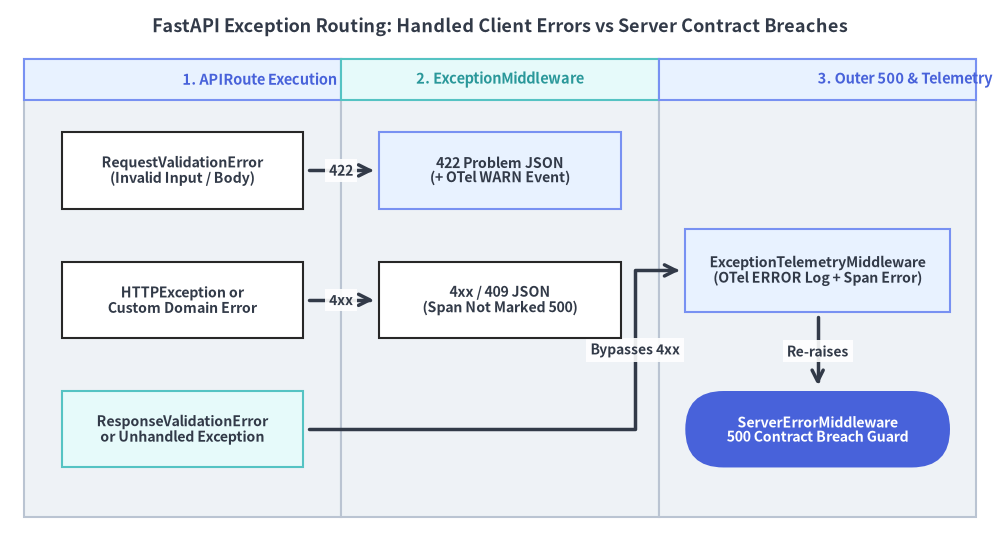
FastAPI は ASGI ミドルウェアオニオン の中で、例外処理を意図的に 2 つの異なるミドルウェア境界 に分割しています。
Source Code
from drawlib.canvas import save, setup
from drawlib.diagrams.flow import End, FlowDiagram, Process
from drawlib.styles import Styles
from drawlib.text import text

setup(width=170, height=92)

text(
    (85.0, 87.5),
    "FastAPI Exception Routing: Handled Client Errors vs Server Contract Breaches",
    style=Styles.DarkBold.patch(text_size=13.0),
)

node_txt = Styles.DarkBold.patch(text_size=10.2)

flow = FlowDiagram(
    node_style=Styles.Neutral.patch(text_size=10.2),
    edge_style=Styles.DarkBold,
    edge_text_style=Styles.DarkBold.patch(text_size=10.0),
    width=162,
    height=78,
    lane_orientation="vertical",
)

# 3 Swimlanes: 54 + 54 + 54 = 162 (centerlines X = 27, 81, 135)
flow.add_lane(
    "1. APIRoute Execution",
    width=54,
    style=Styles.Neutral,
    header_style=Styles.PrimaryNeutral,
    text_style=Styles.PrimaryBold.patch(text_size=10.5, halign="left"),
    header_size=7.0,
)
flow.add_lane(
    "2. ExceptionMiddleware",
    width=54,
    style=Styles.Neutral,
    header_style=Styles.SecondaryNeutral,
    text_style=Styles.SecondaryBold.patch(text_size=10.5),
    header_size=7.0,
)
flow.add_lane(
    "3. Outer 500 & Telemetry",
    width=54,
    style=Styles.Neutral,
    header_style=Styles.PrimaryNeutral,
    text_style=Styles.PrimaryBold.patch(text_size=10.5, halign="left"),
    header_size=7.0,
)

req_val = flow.add(
    Process("RequestValidationError\n(Invalid Input / Body)", width=41, height=13, style=Styles.White, text_style=node_txt),
    xy=(27, 59),
)
dom_err = flow.add(
    Process("HTTPException or\nCustom Domain Error", width=41, height=13, style=Styles.White, text_style=node_txt),
    xy=(27, 37),
)
resp_val = flow.add(
    Process("ResponseValidationError\nor Unhandled Exception", width=41, height=13, style=Styles.SecondaryNeutral, text_style=node_txt),
    xy=(27, 15),
)

h_422 = flow.add(
    Process("422 Problem JSON\n(+ OTel WARN Event)", width=41, height=13, style=Styles.PrimaryNeutral, text_style=node_txt),
    xy=(81, 59),
)
h_4xx = flow.add(
    Process("4xx / 409 JSON\n(Span Not Marked 500)", width=41, height=13, style=Styles.White, text_style=node_txt),
    xy=(81, 37),
)

otel_err = flow.add(
    Process("ExceptionTelemetryMiddleware\n(OTel ERROR Log + Span Error)", width=45, height=14, style=Styles.PrimaryNeutral, text_style=node_txt),
    xy=(135, 42),
)
srv_500 = flow.add(
    End("ServerErrorMiddleware\n500 Contract Breach Guard", width=45, height=13, style=Styles.PrimaryFlat, text_style=Styles.WhiteBold.patch(text_size=10.2)),
    xy=(135, 15),
)

req_val.connect(h_422, label="422", padding=1.0)
dom_err.connect(h_4xx, label="4xx", padding=1.0)
resp_val.connect(otel_err, label="Bypasses 4xx", start_side="right", end_side="left", padding=1.0).via((104, 15), (104, 42))
otel_err.connect(srv_500, label="Re-raises", start_side="bottom", end_side="top", padding=1.0)

flow.draw(xy=(4.0, 4.0))
save()
なぜ ResponseValidationError は 422 ではなく 500 になるのか
- クライアント起因のエラー(
RequestValidationError->422、HTTPException->4xx): 内側のExceptionMiddlewareで捕捉されます。サーバー自体は仕様どおり正常動作しているため、FastAPI はルートスパンを500異常扱いにせず、入力検証失敗はWARNイベントとして記録します。 - サーバー側の出力契約違反(
ResponseValidationError->500): バックエンド実装がresponse_modelの必須フィールド欠落や型不一致データを返した場合、ResponseValidationErrorが発生します。これはクライアントの誤りではなく サーバー実装のバグ であるため、ExceptionMiddlewareを素通りしてExceptionTelemetryMiddleware(StatusCode.ERRORとスタックトレース記録)およびServerErrorMiddlewareへ到達し、内部データの漏洩を防ぎつつ CI テストで即座に検知できるよう設計されています。
RFC 9457(application/problem+json)によるエラー応答の標準化
複数チームが開発する大規模 API では、ドメイン固有例外と RequestValidationError にカスタムハンドラーを登録し、内部スタックトレースや DB エラー詳細を外部へ漏らさず機械可読な RFC 9457 Problem Details 形式に統一します。
from typing import Annotated, Any

from fastapi import FastAPI, Request, status
from fastapi.exceptions import RequestValidationError, ResponseValidationError
from fastapi.responses import JSONResponse
from fastapi.testclient import TestClient
from pydantic import BaseModel, Field
import pytest

app = FastAPI()


class InsufficientInventoryError(Exception):
    def __init__(self, sku: str, requested: int, available: int) -> None:
        self.sku = sku
        self.requested = requested
        self.available = available


@app.exception_handler(InsufficientInventoryError)
async def inventory_error_handler(
    request: Request, exc: InsufficientInventoryError
) -> JSONResponse:
    return JSONResponse(
        status_code=status.HTTP_409_CONFLICT,
        media_type="application/problem+json",
        content={
            "type": "https://api.example.com/problems/insufficient-inventory",
            "title": "Insufficient Inventory",
            "status": 409,
            "detail": f"SKU '{exc.sku}' has {exc.available} units; {exc.requested} requested.",
            "instance": request.url.path,
        },
    )


@app.exception_handler(RequestValidationError)
async def validation_problem_handler(
    request: Request, exc: RequestValidationError
) -> JSONResponse:
    fields = [
        {"loc": ".".join(str(p) for p in err["loc"]), "msg": err["msg"]}
        for err in exc.errors()
    ]
    return JSONResponse(
        status_code=status.HTTP_422_UNPROCESSABLE_CONTENT,
        media_type="application/problem+json",
        content={
            "type": "https://api.example.com/problems/invalid-parameters",
            "title": "Request Validation Failed",
            "status": 422,
            "instance": request.url.path,
            "errors": fields,
        },
    )


class OrderItem(BaseModel):
    sku: str
    qty: Annotated[int, Field(gt=0)]


class PublicInvoice(BaseModel):
    invoice_id: str
    total_cents: int


@app.post("/reservations")
async def reserve_stock(item: OrderItem) -> dict[str, Any]:
    if item.qty > 5:
        raise InsufficientInventoryError(item.sku, item.qty, available=5)
    return {"reserved": item.sku, "qty": item.qty}


@app.get("/broken-contract", response_model=PublicInvoice)
async def broken_contract() -> Any:
    return {"invoice_id": "inv-001"}  # Missing `total_cents`!


client = TestClient(app)
assert client.post("/reservations", json={"sku": "SSD-2TB", "qty": 0}).status_code == 422
assert client.post("/reservations", json={"sku": "SSD-2TB", "qty": 12}).status_code == 409

with pytest.raises(ResponseValidationError):
    client.get("/broken-contract")
最終節の 実践テスト手法と本番 ASGI 運用 では、lifespan や非同期トランスポートを用いた高速テスト手法と、ヘルスプローブ・グレースフルシャットダウンを備えた本番運用構成を解説します。