Dependant DAG・リクエスト単位キャッシュ・yield スコープ
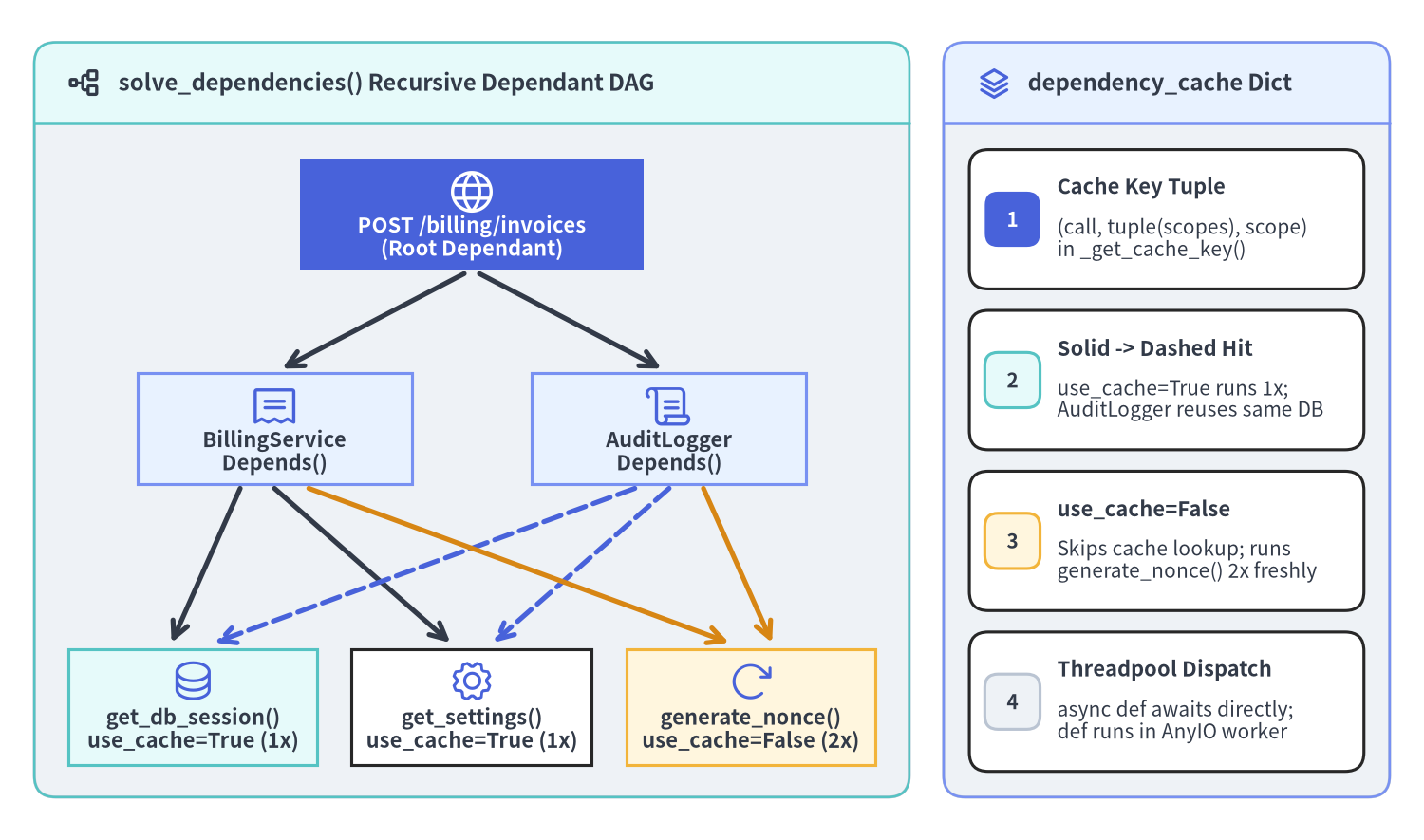
FastAPI v0.162.2 はすべてのパスオペレーションとサブ依存関数を再帰的な Dependant 有向非巡回グラフ(DAG)として構築し、リクエスト単位のメモ化キャッシュと二重 AsyncExitStack による yield の解放タイミングを厳密に制御します。
Source Code
from drawlib.canvas import save, setup
from drawlib.diagrams.architecture import ArchitectureDiagram, Node, PhosphorIcon
from drawlib.icons import phosphor
from drawlib.lines import line
from drawlib.smartarts import CardList, Panel
from drawlib.styles import Styles

setup(width=166, height=98, dpi=150)

# Left Zone: Outer Panel framing the Multi-Level Dependant DAG
dag_panel = Panel(
    "solve_dependencies() Recursive Dependant DAG",
    style=Styles.Neutral,
    header_style=Styles.SecondaryNeutral.patch(shape_line_width=1.2),
    text_style=Styles.DarkBold.patch(text_size=11.5),
    icon=phosphor.tree_structure,
    icon_style=Styles.DarkBold,
    header_variant="filled",
    header_height=9.5,
)
dag_panel.draw((4.0, 5.0), width=102.0, height=88.0, align="bottom_left")

dag = ArchitectureDiagram(
    width=96.0,
    height=75.0,
    node_style=Styles.Primary,
    node_text_style=Styles.DarkBold.patch(text_size=10.5),
    edge_style=Styles.DarkBold,
    edge_text_style=Styles.Dark.patch(text_size=10.0),
    node_card_style=Styles.Neutral,
)

endpoint = dag.add(
    Node(
        "POST /billing/invoices\n(Root Dependant)",
        width=40,
        height=13,
        icon=PhosphorIcon.GLOBE,
        icon_size=5.8,
        style=Styles.White,
        card_style=Styles.PrimaryFlat,
        text_style=Styles.WhiteBold.patch(text_size=10.5),
    ),
    xy=(48.0, 66.5),
)

billing = dag.add(
    Node(
        "BillingService\nDepends()",
        width=32,
        height=13,
        icon=PhosphorIcon.RECEIPT,
        icon_size=5.8,
        card_style=Styles.PrimaryNeutral,
    ),
    xy=(25.0, 41.5),
)

audit = dag.add(
    Node(
        "AuditLogger\nDepends()",
        width=32,
        height=13,
        icon=PhosphorIcon.SCROLL,
        icon_size=5.8,
        card_style=Styles.PrimaryNeutral,
    ),
    xy=(71.0, 41.5),
)

db_dep = dag.add(
    Node(
        "get_db_session()\nuse_cache=True (1x)",
        width=29,
        height=13.5,
        icon=PhosphorIcon.DATABASE,
        icon_size=5.5,
        card_style=Styles.SecondaryNeutral,
    ),
    xy=(15.5, 9.0),
)

settings_dep = dag.add(
    Node(
        "get_settings()\nuse_cache=True (1x)",
        width=28,
        height=13.5,
        icon=PhosphorIcon.GEAR,
        icon_size=5.5,
        card_style=Styles.White,
    ),
    xy=(48.0, 9.0),
)

nonce_dep = dag.add(
    Node(
        "generate_nonce()\nuse_cache=False (2x)",
        width=29,
        height=13.5,
        icon=PhosphorIcon.ARROW_CLOCKWISE,
        icon_size=5.5,
        card_style=Styles.WarningNeutral,
    ),
    xy=(80.5, 9.0),
)

# Root fan-out (|dx|=23 < |dy|=25 -> clean bottom-to-top anchors)
dag.connect(endpoint, billing, routing="direct", padding=1.0)
dag.connect(endpoint, audit, routing="direct", padding=1.0)
dag.draw(xy=(7.0, 6.5))

# Sub-dependency edges across open canvas corridor y=[23.0, 41.0]
# 1. First-time executions from BillingService (solid dark strokes)
line((28.0, 41.0), (20.0, 23.0), arrow_head="->", style=Styles.DarkBold)
line((32.0, 41.0), (52.5, 23.0), arrow_head="->", style=Styles.DarkBold)

# 2. Per-request cache hits from AuditLogger (dashed primary strokes)
line((74.0, 41.0), (25.0, 23.0), arrow_head="->", style=Styles.PrimaryDashedBold)
line((78.0, 41.0), (57.5, 23.0), arrow_head="->", style=Styles.PrimaryDashedBold)

# 3. Uncached fresh invocations with use_cache=False (warning strokes)
line((36.0, 41.0), (85.0, 23.0), arrow_head="->", style=Styles.WarningBold)
line((82.0, 41.0), (90.0, 23.0), arrow_head="->", style=Styles.WarningBold)

# Right Zone: Per-Request Cache Mechanics Panel
cache_panel = Panel(
    "dependency_cache Dict",
    style=Styles.Neutral,
    header_style=Styles.PrimaryNeutral.patch(shape_line_width=1.2),
    text_style=Styles.DarkBold.patch(text_size=11.5),
    icon=phosphor.stack,
    icon_style=Styles.PrimaryBold,
    header_variant="filled",
    header_height=9.5,
)
cache_panel.draw((110.0, 5.0), width=52.0, height=88.0, align="bottom_left")
c_xy, c_w, c_h = cache_panel.get_content_box(
    (110.0, 5.0),
    width=52.0,
    height=88.0,
    padding=(3.0, 3.0),
    align="bottom_left",
)

cards = CardList(
    style=Styles.White,
    text_style=Styles.DarkBold.patch(text_size=10.5),
    description_style=Styles.Dark.patch(text_size=10.0),
    badge_style=Styles.PrimaryFlat,
    badge_text_style=Styles.WhiteBold.patch(text_size=10.0),
    spacing=2.5,
)
cards.add(
    "Cache Key Tuple",
    "(call, tuple(scopes), scope)\nin _get_cache_key()",
    badge_text="1",
)
cards.add(
    "Solid -> Dashed Hit",
    "use_cache=True runs 1x;\nAuditLogger reuses same DB",
    badge_text="2",
    badge_style=Styles.SecondaryNeutral,
    badge_text_style=Styles.DarkBold.patch(text_size=10.0),
)
cards.add(
    "use_cache=False",
    "Skips cache lookup; runs\ngenerate_nonce() 2x freshly",
    badge_text="3",
    badge_style=Styles.WarningNeutral,
    badge_text_style=Styles.DarkBold.patch(text_size=10.0),
)
cards.add(
    "Threadpool Dispatch",
    "async def awaits directly;\ndef runs in AnyIO worker",
    badge_text="4",
    badge_style=Styles.Neutral,
    badge_text_style=Styles.DarkBold.patch(text_size=10.0),
)
cards.draw(c_xy, width=c_w, height=c_h)

save()
1. Dependant DAG の構築と解決アルゴリズム
FastAPI はルート登録時に get_dependant() を呼び出し、すべてのエンドポイント引数・Annotated[..., Depends()] マーカー・Security() 宣言を解析して不変の Dependant データクラス木(fastapi/dependencies/models.py)へとコンパイルします。リクエスト処理時のホットパスでは型リフレクションを行わず、solve_dependencies()(fastapi/dependencies/utils.py)が構築済みの DAG を深さ優先で走査します。
Dependant / 解決機構 |
内部モジュール位置 | リクエスト実行時の責務 |
|---|---|---|
Dependant データクラス |
fastapi/dependencies/models.py |
抽出対象の path_params・query_params・header_params・cookie_params・body_params、子の dependencies、OAuth2 スコープ、use_cache、scope を保持します。 |
_get_cache_key() |
fastapi/dependencies/models.py |
(dependant.call, scopes_for_cache, computed_scope) のタプルを算出し、累積 OAuth2 スコープが一致する場合にのみセキュリティ依存のキャッシュを共有します。 |
solve_dependencies() |
fastapi/dependencies/utils.py |
子 Dependant ノードを再帰的に解決し、app.dependency_overrides の適用・dependency_cache への格納・検証エラーの集約を行ったうえで親 Callable を呼び出します。 |
| 実行ディスパッチ | fastapi/dependencies/utils.py |
async def コルーチンはイベントループ上で直接 await し、同期 def は run_in_threadpool() へ委譲し、ジェネレータは AsyncExitStack に登録します。 |
1.1 リクエスト単位メモ化(use_cache=True と use_cache=False)
実践的なレイヤード設計では、エンドポイントが BillingService と AuditLogger の両方を注入し、その双方が get_db_session と get_settings に依存するような「ひし形(ダイヤモンド)依存」が頻出します。FastAPI はデフォルトで Depends(..., use_cache=True) を有効にしており、solve_dependencies() 内でリクエスト固有の辞書 dependency_cache: dict[DependencyCacheKey, Any] を管理します。
- リクエスト内シングルトン共有(
use_cache=True): 先に解決されるBillingServiceがget_db_session()を 1 回だけ実行し、戻り値を(get_db_session, (), "")キーで保存します。直後に同一リクエスト内でAuditLoggerがget_db_sessionを要求すると、FastAPI はキャッシュから同一の Python オブジェクト(billing.db is billing.audit.db)を返し、複数サービス間のトランザクション整合性を保証します。 - 毎回新規実行(
use_cache=False):Depends(generate_trace_nonce, use_cache=False)を指定するとキャッシュ参照をスキップし、注入箇所ごとに毎回新しく関数を呼び出します。 - OAuth2 スコープを考慮したキャッシュ分離: サブ依存が
SecurityScopesを受け取る場合(詳細は 認証・OAuth2 スコープ認可・抽出器 を参照)、_uses_scopes()によってtuple(sorted(set(oauth_scopes)))がキャッシュキーへ組み込まれ、要求スコープの異なる呼び出し同士の衝突を防ぎます。
[!IMPORTANT] FastAPI の依存関数や Pydantic モデルをネストしたスコープ内で定義するモジュールでは、
from __future__ import annotationsの使用を避けてください。FastAPI はルート登録時にAnnotated[T, Depends(...)]の型メタデータを評価するため、解決不能なローカルシンボルを参照する文字列化アノテーションは依存として認識されず、必須クエリパラメータ(422 Unprocessable Entity)として扱われます。
1.2 多階層サブ依存・クラス依存・パラメータ化 Callable
FastAPI では通常の関数だけでなく、クラスのコンストラクタ(__init__)や呼び出し可能インスタンス(__call__)もそのまま依存ノードとして利用できます。
- クラス依存の省略記法(
Annotated[BillingService, Depends()]):Depends()の引数を省略すると、FastAPI はパラメータの型注釈(BillingService)を検査し、サブ依存を再帰解決したうえで__init__を呼び出します。 - パラメータ化された Callable インスタンス(
RoleChecker(["admin", "finance"])): 設定値を受け取るクラスにasync def __call__(self, ...)を実装することで、クロージャやグローバル変数に頼らず再利用可能な認可ガードを量産できます。 - ルーター/アプリ単位のガード(
dependencies=[Depends(...)]):APIRouter(...)・@router.post(..., dependencies=[...])・FastAPI(dependencies=[...])にdependenciesを渡すと、各エンドポイントの関数シグネチャを汚さずに共通検証や認可ガードを実行できます(リクエスト単位キャッシュも同様に共有されます)。
import secrets
from dataclasses import dataclass
from typing import Annotated

from fastapi import APIRouter, Depends, FastAPI, Header, HTTPException, status
from fastapi.testclient import TestClient


@dataclass(frozen=True)
class AppSettings:
    tenant_header: str = "X-Tenant-ID"
    currency: str = "USD"


def get_settings() -> AppSettings:
    return AppSettings()


session_counter = 0


async def get_db_session() -> dict[str, int | str]:
    global session_counter
    session_counter += 1
    return {"session_id": session_counter, "driver": "asyncpg"}


def generate_trace_nonce() -> str:
    return secrets.token_hex(4)


class AuditLogger:
    def __init__(
        self,
        db: Annotated[dict[str, int | str], Depends(get_db_session)],
        settings: Annotated[AppSettings, Depends(get_settings)],
        nonce: Annotated[str, Depends(generate_trace_nonce, use_cache=False)],
    ) -> None:
        self.db = db
        self.settings = settings
        self.nonce = nonce


class BillingService:
    def __init__(
        self,
        db: Annotated[dict[str, int | str], Depends(get_db_session)],
        settings: Annotated[AppSettings, Depends(get_settings)],
        audit: Annotated[AuditLogger, Depends()],
        nonce: Annotated[str, Depends(generate_trace_nonce, use_cache=False)],
    ) -> None:
        self.db = db
        self.settings = settings
        self.audit = audit
        self.nonce = nonce


class RoleChecker:
    def __init__(self, allowed_roles: list[str]) -> None:
        self.allowed_roles = set(allowed_roles)

    async def __call__(self, x_role: Annotated[str, Header()] = "viewer") -> str:
        if x_role not in self.allowed_roles:
            raise HTTPException(
                status_code=status.HTTP_403_FORBIDDEN,
                detail="Insufficient role privileges",
            )
        return x_role


async def verify_tenant_header(
    settings: Annotated[AppSettings, Depends(get_settings)],
    x_tenant_id: Annotated[str | None, Header()] = None,
) -> str:
    if not x_tenant_id:
        raise HTTPException(
            status_code=status.HTTP_400_BAD_REQUEST,
            detail=f"Missing {settings.tenant_header}",
        )
    return x_tenant_id


require_billing_admin = RoleChecker(["admin", "finance"])

billing_router = APIRouter(
    prefix="/billing",
    dependencies=[
        Depends(verify_tenant_header),
        Depends(require_billing_admin),
    ],
)


@billing_router.post("/invoices")
async def create_invoice(
    billing: Annotated[BillingService, Depends()],
) -> dict[str, object]:
    return {
        "db_session_id": billing.db["session_id"],
        "shared_same_db": billing.db is billing.audit.db,
        "distinct_nonces": billing.nonce != billing.audit.nonce,
        "currency": billing.settings.currency,
    }


app = FastAPI()
app.include_router(billing_router)
上の構成では get_settings() が 3 箇所(verify_tenant_header・AuditLogger・BillingService)で宣言されていますが、dependency_cache によってリクエストあたり 1 回しか実行されず、billing.db is billing.audit.db も常に True となります。また結合テスト時には app.dependency_overrides[get_db_session] = override_db を設定するだけで、DAG 全体の末端ノードを一括差し替えできます(大規模 DI・Lifespan 管理・テスト戦略 および 実践テスト手法と本番 ASGI 運用 を参照)。
2. yield によるリソース管理と二重 AsyncExitStack
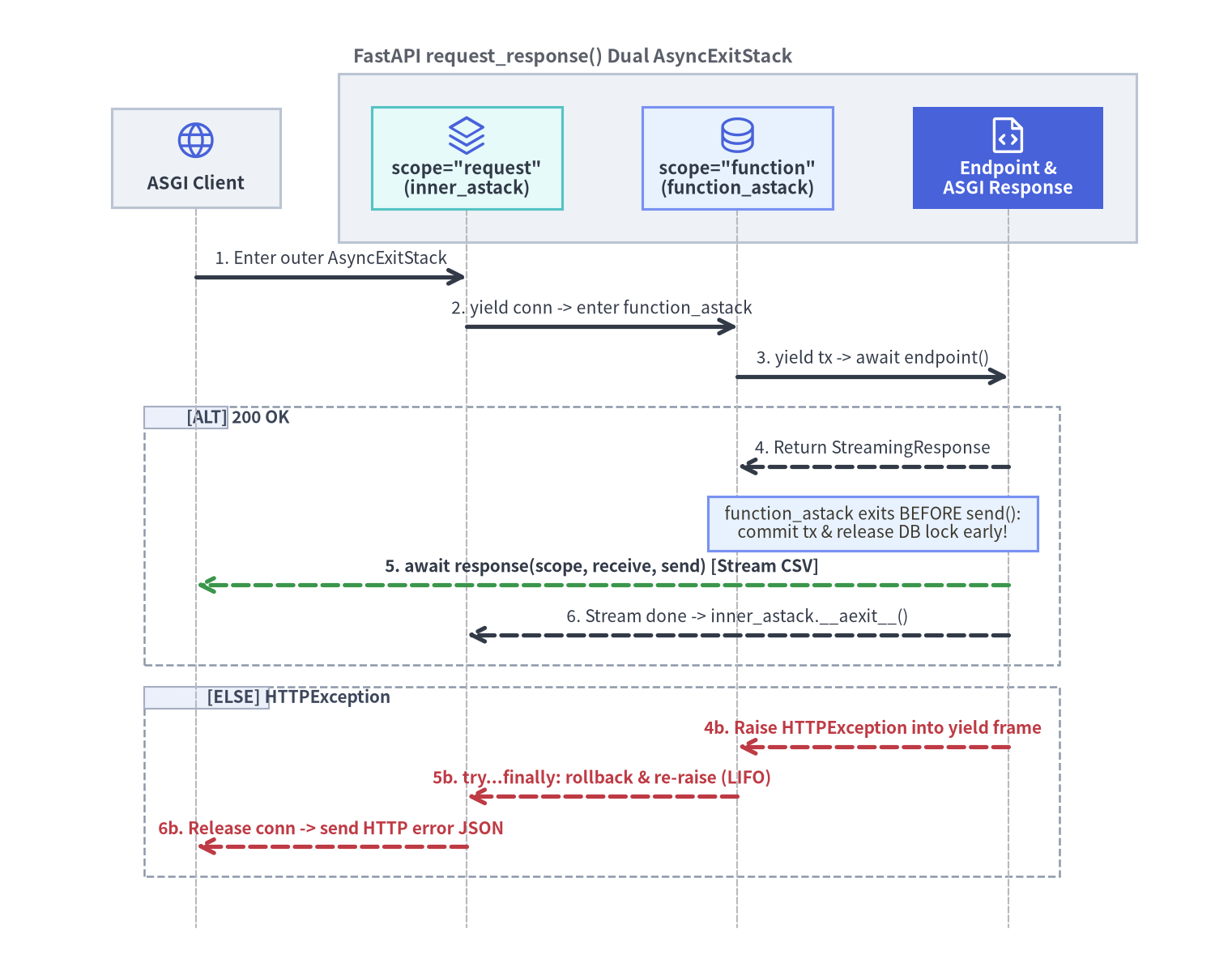
async def または同期 def 内で yield を使うジェネレータ依存は、処理を yield 前のセットアップフェーズ と yield 後のティアダウンフェーズ に分割します。FastAPI v0.162.2 では、fastapi/routing.py の request_response() がすべての HTTP リクエストを ASGI scope 上の 入れ子になった 2 つの AsyncExitStack で包んでいます。
scope["fastapi_function_astack"](scope="function"): パスオペレーション関数がResponseオブジェクトを返した 直後、すなわちawait response(scope, receive, send)がネットワークへバイト列を送信したりストリーミングを開始する 前 にクリーンアップを実行します。scope["fastapi_inner_astack"](scope="request"、デフォルト): パスオペレーションとawait response(scope, receive, send)の双方を外側から包み、HTTP レスポンス送信・ストリーミングチャンク送出・バックグラウンドタスクが すべて完了した後 にクリーンアップを実行します。
Source Code
from drawlib.canvas import save, setup
from drawlib.diagrams.sequence import Participant, ParticipantGroup, PhosphorIcon, SequenceDiagram
from drawlib.styles import Style, Styles

setup(width=166, height=134, dpi=150)

seq = SequenceDiagram(
    node_style=Styles.Primary,
    node_text_style=Styles.DarkBold.patch(text_size=10.5),
    edge_style=Styles.DarkBold,
    edge_text_style=Styles.Dark.patch(text_size=10.0),
    node_card_style=Styles.Neutral,
    col_width=37.0,
    step_y=6.8,
    margin=5.0,
)

client = seq.add(
    Participant(
        "ASGI Client",
        width=23,
        height=13.5,
        icon=PhosphorIcon.GLOBE,
        icon_size=5.8,
    )
)

runtime = seq.add(
    ParticipantGroup(
        title="FastAPI request_response() Dual AsyncExitStack",
        padding=4.5,
        style=Styles.Neutral,
        text_style=Style(text_size=11.0),
    )
)

req_stack = runtime.add(
    Participant(
        'scope="request"\n(inner_astack)',
        width=26,
        height=14,
        icon=PhosphorIcon.STACK,
        icon_size=5.8,
        card_style=Styles.SecondaryNeutral,
    )
)

fn_stack = runtime.add(
    Participant(
        'scope="function"\n(function_astack)',
        width=26,
        height=14,
        icon=PhosphorIcon.DATABASE,
        icon_size=5.8,
        card_style=Styles.PrimaryNeutral,
    )
)

endpoint = runtime.add(
    Participant(
        "Endpoint &\nASGI Response",
        width=26,
        height=14,
        icon=PhosphorIcon.FILE_CODE,
        icon_size=5.8,
        style=Styles.White,
        card_style=Styles.PrimaryFlat,
        text_style=Styles.WhiteBold.patch(text_size=10.5),
    )
)

client.request(req_stack, "1. Enter outer AsyncExitStack")
req_stack.request(fn_stack, "2. yield conn -> enter function_astack")
fn_stack.request(endpoint, "3. yield tx -> await endpoint()")

with seq.alt("200 OK") as alt_blk:
    alt_blk.style = Styles.MutedDashed.patch(shape_line_width=1.2)
    alt_blk.text_style = Style(text_size=10.0, halign="left")
    endpoint.reply(fn_stack, "4. Return StreamingResponse")
    seq.note(
        "function_astack exits BEFORE send():\ncommit tx & release DB lock early!",
        over=[fn_stack, endpoint],
        style=Styles.PrimaryNeutral.patch(text_size=10.0),
    )
    endpoint.reply(
        client,
        "5. await response(scope, receive, send) [Stream CSV]",
        style=Styles.SuccessBold,
        text_style=Styles.DarkBold.patch(text_size=10.0),
    )
    endpoint.reply(req_stack, "6. Stream done -> inner_astack.__aexit__()")

with seq.else_("HTTPException") as else_blk:
    else_blk.style = Styles.MutedDashed.patch(shape_line_width=1.2)
    else_blk.text_style = Style(text_size=10.0, halign="left")
    endpoint.reply(
        fn_stack,
        "4b. Raise HTTPException into yield frame",
        style=Styles.DangerBold,
        text_style=Styles.DangerBold.patch(text_size=10.0),
    )
    fn_stack.reply(
        req_stack,
        "5b. try...finally: rollback & re-raise (LIFO)",
        style=Styles.DangerBold,
        text_style=Styles.DangerBold.patch(text_size=10.0),
    )
    req_stack.reply(
        client,
        "6b. Release conn -> send HTTP error JSON",
        style=Styles.DangerBold,
        text_style=Styles.DangerBold.patch(text_size=10.0),
    )

seq.draw(xy=(83.0, 67.0), align="center")
save()
2.1 scope="function" と scope="request" の使い分け
scope を省略(scope=None)した場合、_get_computed_scope() はストリーミング応答のジェネレータ内からも安全にリソースを参照できるようデフォルトで "request" を選択します。低速なクライアント回線下で DB コネクションプールの枯渇を防ぐには、用途に応じて scope="function" と scope="request" を明示的に使い分けます。
| 比較項目 | Depends(dep, scope="function") |
Depends(dep, scope="request") (yield のデフォルト) |
|---|---|---|
| 登録先スタック | request.scope["fastapi_function_astack"] |
request.scope["fastapi_inner_astack"] |
| 解放タイミング | await response(scope, receive, send) の 実行前 |
レスポンス送信・ストリーミング・背景タスクの 完了後 |
| 主な適用場面 | 書き込みトランザクション、行ロック、ハンドラ固有の RPC スパン | StreamingResponse や SSE 内で読み取るカーソル、リクエスト全体の監査文脈 |
| サブ依存の制約 | "request" と "function" の両方に依存可能 |
より寿命の短い "function" スコープ依存を子に持つことは不可 |
2.2 必須の try...finally クリーンアップと例外再送出
あなたの yield 依存が開始された 後 に、兄弟となる別の依存関数やエンドポイント本体が例外(HTTPException やドメイン例外など)を送出すると、Python の AsyncExitStack は待機中の yield 行へ athrow() / throw() でその例外を再注入します。本番コードでは次の 2 原則が絶対条件となります。
- 必ず
try ... finally:でyieldを囲む:finally:を使わずyieldの後ろにそのまま後処理を記述すると、未捕捉例外でリクエストが中断された際にクリーンアップがスキップされ、DB セッションやセマフォがリークします。 yield後に例外を握りつぶさない: ロールバック処理のためにexcept Exception:で捕捉する場合(except Exception: await tx.rollback(); raise)も、必ず例外を再送出(raise) してください。レスポンス送信前にscope="request"の依存が例外を握りつぶすと、FastAPIv0.162.2はFastAPIError: Response not awaitedを送出して停止します。
from collections.abc import AsyncIterator
from typing import Annotated

from fastapi import Depends, FastAPI, HTTPException, status
from fastapi.responses import StreamingResponse
from fastapi.testclient import TestClient

events: list[str] = []
app = FastAPI()


async def get_request_connection() -> AsyncIterator[str]:
    events.append("req_conn:enter")
    try:
        yield "conn_pool_1"
    finally:
        events.append("req_conn:exit")


async def get_db_transaction(
    conn: Annotated[str, Depends(get_request_connection, scope="request")],
) -> AsyncIterator[str]:
    events.append(f"fn_tx:enter({conn})")
    try:
        yield "tx_active"
        events.append("fn_tx:commit")
    except Exception:
        events.append("fn_tx:rollback")
        raise
    finally:
        events.append("fn_tx:exit")


@app.get("/reports/export")
async def export_report(
    tx: Annotated[str, Depends(get_db_transaction, scope="function")],
    fail: bool = False,
) -> StreamingResponse:
    events.append(f"endpoint:body({tx})")
    if fail:
        raise HTTPException(
            status_code=status.HTTP_409_CONFLICT,
            detail="Report snapshot locked",
        )

    async def stream_rows() -> AsyncIterator[bytes]:
        events.append("stream:chunk_1")
        yield b"id,amount\n1,250\n"

    return StreamingResponse(stream_rows(), media_type="text/csv")
GET /reports/export を実行すると、events には ["req_conn:enter", "fn_tx:enter(conn_pool_1)", "endpoint:body(tx_active)", "fn_tx:commit", "fn_tx:exit", "stream:chunk_1", "req_conn:exit"] の順序が記録されます。"function" スコープのトランザクションは stream_rows() が最初のチャンクを送出する 前 にコミット・解放され、一方で "request" スコープのコネクションはストリーミング完了後まで維持されます。また ?fail=true で 409 Conflict が発生した場合も、except での再送出と finally: によって ["req_conn:enter", "fn_tx:enter(conn_pool_1)", "endpoint:body(tx_active)", "fn_tx:rollback", "fn_tx:exit", "req_conn:exit"] と LIFO 順で確実に解放されます。
続いて次節 認証・OAuth2 スコープ認可・抽出器 では、fastapi.security がこの Dependant DAG の上に資格情報抽出・階層的 SecurityScopes・OpenAPI 3.1 securitySchemes をどのように統合しているかを解説し、ストリーミングとの組み合わせについては ネイティブ SSE・JSONL・WebSocket で掘り下げます。