実践テスト手法と本番 ASGI 運用
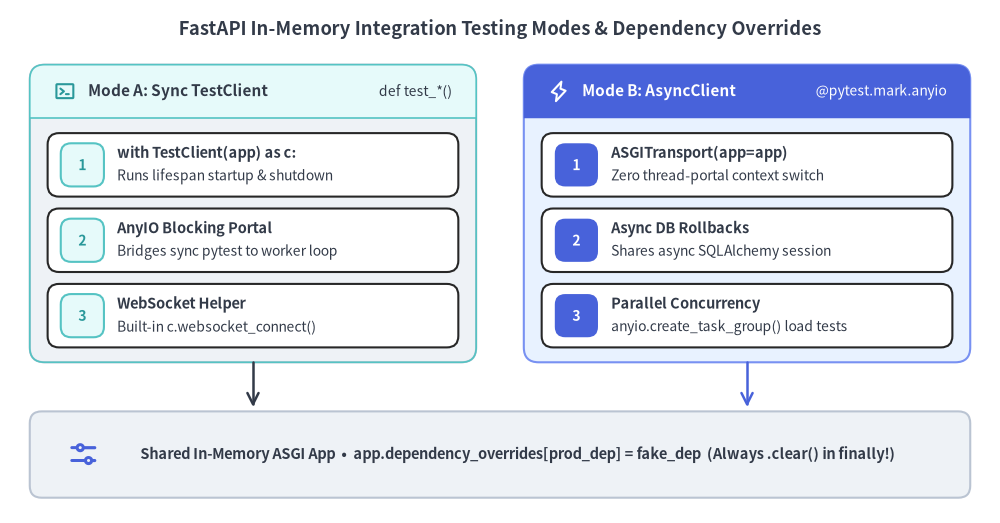
FastAPI v0.162.2 は、同期的な with TestClient(app) as client: と非同期イベントループ直結の httpx.ASGITransport の双方でミリ秒未満のインメモリ統合テストを実現し、本番環境ではリバースプロキシ配下の ASGI ワーカー・ヘルスプローブ・lifespan による安全なドレイン終了とシームレスに連携します。
Source Code
from drawlib.canvas import save, setup
from drawlib.icons import phosphor
from drawlib.lines import line
from drawlib.shapes import rectangle
from drawlib.smartarts import CardList, Panel
from drawlib.styles import Styles
from drawlib.text import text

setup(width=168, height=88)

text(
    (84.0, 83.0),
    "FastAPI In-Memory Integration Testing Modes & Dependency Overrides",
    style=Styles.DarkBold.patch(text_size=13.2),
)

# Left Panel: Sync TestClient
p_sync = Panel(
    "Mode A: Sync TestClient",
    "def test_*()",
    style=Styles.Neutral,
    header_style=Styles.SecondaryNeutral.patch(shape_line_width=1.2),
    text_style=Styles.DarkBold.patch(text_size=11.0),
    description_style=Styles.Dark.patch(text_size=10.0),
    icon=phosphor.terminal_window,
    icon_style=Styles.SecondaryBold,
    header_height=9.0,
)
p_sync.draw((5.0, 27.0), width=75.0, height=50.0)
l_xy, l_w, l_h = p_sync.get_content_box((5.0, 27.0), width=75.0, height=50.0, padding=(3.0, 2.5))

cl_sync = CardList(
    style=Styles.White,
    text_style=Styles.DarkBold.patch(text_size=10.5),
    description_style=Styles.Dark.patch(text_size=10.0),
    badge_style=Styles.SecondaryNeutral,
    badge_text_style=Styles.SecondaryBold.patch(text_size=10.0),
    spacing=2.0,
)
cl_sync.add("with TestClient(app) as c:", "Runs lifespan startup & shutdown", badge_text="1")
cl_sync.add("AnyIO Blocking Portal", "Bridges sync pytest to worker loop", badge_text="2")
cl_sync.add("WebSocket Helper", "Built-in c.websocket_connect()", badge_text="3")
cl_sync.draw(l_xy, width=l_w, height=l_h)

# Right Panel: Native Async ASGITransport
p_async = Panel(
    "Mode B: AsyncClient",
    "@pytest.mark.anyio",
    style=Styles.PrimaryNeutral,
    header_style=Styles.PrimaryFlat,
    text_style=Styles.WhiteBold.patch(text_size=11.0),
    description_style=Styles.White.patch(text_size=10.0),
    icon=phosphor.lightning,
    icon_style=Styles.WhiteBold,
    header_height=9.0,
)
p_async.draw((88.0, 27.0), width=75.0, height=50.0)
r_xy, r_w, r_h = p_async.get_content_box((88.0, 27.0), width=75.0, height=50.0, padding=(3.0, 2.5))

cl_async = CardList(
    style=Styles.White,
    text_style=Styles.DarkBold.patch(text_size=10.5),
    description_style=Styles.Dark.patch(text_size=10.0),
    badge_style=Styles.PrimaryFlat,
    badge_text_style=Styles.WhiteBold.patch(text_size=10.0),
    spacing=2.0,
)
cl_async.add("ASGITransport(app=app)", "Zero thread-portal context switch", badge_text="1")
cl_async.add("Async DB Rollbacks", "Shares async SQLAlchemy session", badge_text="2")
cl_async.add("Parallel Concurrency", "anyio.create_task_group() load tests", badge_text="3")
cl_async.draw(r_xy, width=r_w, height=r_h)

# Shared Target FastAPI App + dependency_overrides Banner
line((42.5, 27.0), (42.5, 19.5), arrow_head="->", style=Styles.DarkBold.patch(line_width=1.8))
line((125.5, 27.0), (125.5, 19.5), arrow_head="->", style=Styles.PrimaryBold.patch(line_width=1.8))

rectangle((84.0, 11.5), width=158.0, height=14.5, style=Styles.Neutral.patch(shape_r=2.0))
phosphor.sliders_horizontal((14.0, 11.5), width=5.5, style=Styles.PrimaryBold)
text(
    (87.0, 11.5),
    "Shared In-Memory ASGI App  •  app.dependency_overrides[prod_dep] = fake_dep  (Always .clear() in finally!)",
    style=Styles.DarkBold.patch(text_size=10.5),
)

save()
1. 同期 TestClient vs ネイティブ非同期 ASGITransport
どちらのテストハーネスも TCP ソケットを開かずにメモリ上で直接 ASGI メッセージをやり取りしますが、大規模 DI・Lifespan 管理・テスト戦略 で扱った設計に基づき、テスト対象に応じて使い分けます。
| 比較軸 | with TestClient(app) as client: |
httpx.AsyncClient(transport=ASGITransport(app=app)) |
|---|---|---|
| テスト関数の形式 | 標準的な同期関数 def test_...() |
非同期コルーチン @pytest.mark.anyio async def test_...() |
| Lifespan の実行 | with ブロック開始時に起動し、終了時にシャットダウンを実行 |
状態を明示制御するか、非同期 lifespan フィクスチャと併用 |
| リアルタイム通信 | HTTP・SSE・JSONL に加え client.websocket_connect(...) を標準提供 |
同一ループ上で HTTP・SSE(ac.stream(...))・JSONL を検証可能 |
| 非同期 DB ロールバック | ポータル経由で別ループになるため非同期 DB セッション共有に不向き | 非同期 DB トランザクションフィクスチャと 完全に同一のイベントループ を共有 |
with TestClient による Lifespan 起動と安全な dependency_overrides 解放
大規模リポジトリのテストスイートで頻発するフレーキーテストの主な原因は次の 2 点です。
TestClientでwith文を省略してしまう:client = TestClient(app)を単体で生成すると、@asynccontextmanagerで定義したlifespanの初期化・終了フックが一切実行されません。必ずwith TestClient(app) as client:として使用します。app.dependency_overridesのテスト間リーク:app.dependency_overridesはFastAPIインスタンス上の辞書を直接書き換えるため、try ... finally: app.dependency_overrides.clear()(またはyield型 pytest フィクスチャ)で確実にリセットし、後続テストへのモック残留を防ぎます。
from collections.abc import AsyncGenerator
from contextlib import asynccontextmanager
from typing import Annotated

from fastapi import Depends, FastAPI, Request, Response, status
from fastapi.testclient import TestClient


def create_production_app() -> FastAPI:
    @asynccontextmanager
    async def lifespan(app: FastAPI) -> AsyncGenerator[None, None]:
        app.state.db_ready = True
        app.state.events = ["startup:complete"]
        try:
            yield
        finally:
            app.state.db_ready = False
            app.state.events.append("shutdown:complete")

    app = FastAPI(lifespan=lifespan)

    def get_exchange_rate() -> float:
        return 152.40

    app.state.get_exchange_rate = get_exchange_rate

    @app.get("/healthz")
    async def liveness_probe() -> dict[str, str]:
        return {"status": "alive"}

    @app.get("/readyz")
    async def readiness_probe(request: Request, response: Response) -> dict[str, str]:
        if not getattr(request.app.state, "db_ready", False):
            response.status_code = status.HTTP_503_SERVICE_UNAVAILABLE
            return {"status": "draining"}
        return {"status": "ready"}

    @app.get("/quotes/usd-jpy")
    async def quote_usd_jpy(
        rate: Annotated[float, Depends(get_exchange_rate)],
    ) -> dict[str, float]:
        return {"usd_jpy": rate}

    return app


app = create_production_app()
app.dependency_overrides[app.state.get_exchange_rate] = lambda: 150.00
try:
    with TestClient(app) as client:
        assert client.get("/readyz").status_code == 200
        assert client.get("/quotes/usd-jpy").json() == {"usd_jpy": 150.0}
finally:
    app.dependency_overrides.clear()

assert app.state.events == ["startup:complete", "shutdown:complete"]
@pytest.mark.anyio と httpx.ASGITransport によるネイティブ非同期テスト
非同期データベーストランザクションのロールバック検証、ネイティブ OpenTelemetry スパン の検査、並行リクエストの競合テストには、httpx.ASGITransport でアプリを直接駆動します。
import httpx
import pytest


@pytest.mark.anyio
async def test_async_readiness_transitions() -> None:
    app = create_production_app()
    app.state.db_ready = False  # Simulate cold pool before readiness

    transport = httpx.ASGITransport(app=app)
    async with httpx.AsyncClient(
        transport=transport, base_url="http://testserver"
    ) as ac:
        assert (await ac.get("/healthz")).status_code == 200
        assert (await ac.get("/readyz")).status_code == 503

        app.state.db_ready = True
        assert (await ac.get("/readyz")).status_code == 200
2. 本番 ASGI トポロジ・ヘルスプローブ・グレースフルシャットダウン
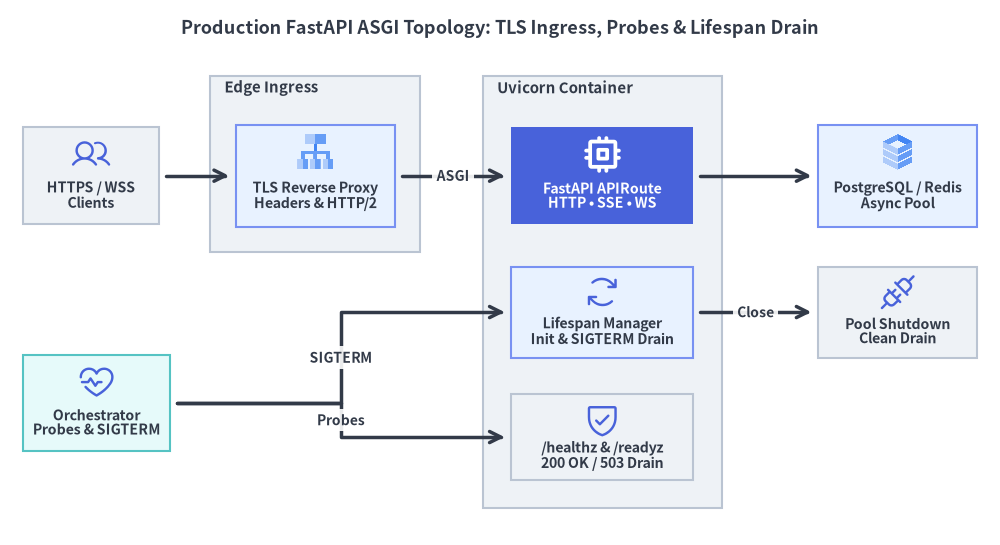
Kubernetes、Cloud Run、systemd などの本番環境では、TLS 終端を行うリバースプロキシやロードバランサーの背後に単一プロセスの Uvicorn ASGI ワーカーを配置し、水平スケーリングはコンテナオーケストレーター側のレプリカ制御に委ねます。
Source Code
from drawlib.canvas import save, setup
from drawlib.diagrams.architecture import ArchitectureDiagram, GcpIcon, Node, NodeGroup, PhosphorIcon
from drawlib.styles import Styles
from drawlib.text import text

setup(width=176, height=96)

text(
    (88.0, 91.0),
    "Production FastAPI ASGI Topology: TLS Ingress, Probes & Lifespan Drain",
    style=Styles.DarkBold.patch(text_size=13.0),
)

d = ArchitectureDiagram(
    node_style=Styles.Primary,
    node_text_style=Styles.DarkBold.patch(text_size=10.2),
    edge_style=Styles.DarkBold,
    edge_text_style=Styles.DarkBold.patch(text_size=10.0),
    node_card_style=Styles.Neutral,
)

clients = d.add(
    Node("HTTPS / WSS\nClients", width=24, height=17, icon=PhosphorIcon.USERS, icon_size=6.8),
    xy=(13.0, 62.0),
)
kubelet = d.add(
    Node("Orchestrator\nProbes & SIGTERM", width=26, height=17, icon=PhosphorIcon.HEARTBEAT, icon_size=6.8, card_style=Styles.SecondaryNeutral),
    xy=(14.0, 22.0),
)

edge = d.add(
    NodeGroup(
        title="Edge Ingress",
        padding=4.5,
        style=Styles.Neutral,
        text_style=Styles.DarkBold.patch(text_size=10.8, halign="left"),
    ),
    xy=(34.0, 44.0),
)
proxy = edge.add(
    Node(
        "TLS Reverse Proxy\nHeaders & HTTP/2",
        width=28,
        height=18,
        icon=GcpIcon.CLOUD_LOAD_BALANCING,
        icon_size=7.0,
        card_style=Styles.PrimaryNeutral,
    ),
    xy=(18.5, 18.0),
)

pod = d.add(
    NodeGroup(
        title="Uvicorn Container",
        padding=5.0,
        style=Styles.Neutral,
        text_style=Styles.DarkBold.patch(text_size=10.8, halign="left"),
    ),
    xy=(80.0, 4.0),
)
worker = pod.add(
    Node(
        "FastAPI APIRoute\nHTTP • SSE • WS",
        width=32,
        height=17,
        icon=PhosphorIcon.CPU,
        icon_size=7.0,
        card_style=Styles.PrimaryFlat,
        style=Styles.WhiteBold,
        text_style=Styles.WhiteBold.patch(text_size=10.2),
    ),
    xy=(23.0, 58.0),
)
lifespan_node = pod.add(
    Node(
        "Lifespan Manager\nInit & SIGTERM Drain",
        width=32,
        height=16,
        icon=PhosphorIcon.ARROWS_CLOCKWISE,
        icon_size=6.8,
        card_style=Styles.PrimaryNeutral,
    ),
    xy=(23.0, 34.0),
)
probes = pod.add(
    Node(
        "/healthz & /readyz\n200 OK / 503 Drain",
        width=32,
        height=15,
        icon=PhosphorIcon.SHIELD_CHECK,
        icon_size=6.8,
    ),
    xy=(23.0, 12.0),
)

db = d.add(
    Node("PostgreSQL / Redis\nAsync Pool", width=28, height=18, icon=GcpIcon.CLOUD_SQL, icon_size=7.0, card_style=Styles.PrimaryNeutral),
    xy=(155.0, 62.0),
)
cache = d.add(
    Node("Pool Shutdown\nClean Drain", width=28, height=16, icon=PhosphorIcon.PLUGS, icon_size=6.8),
    xy=(155.0, 38.0),
)

d.connect(clients, proxy, padding=1.2)
d.connect(proxy, worker, label="ASGI", padding=1.2)
d.connect(kubelet, probes, label="Probes", padding=1.2)
d.connect(kubelet, lifespan_node, label="SIGTERM", padding=1.2)
d.connect(worker, db, padding=1.2)
d.connect(lifespan_node, cache, label="Close", padding=1.2)

d.draw(xy=(3.0, 3.0))
save()
本番 ASGI 運用チェックリスト
- Liveness(
/healthz)と Readiness(/readyz)を厳格に分離する:/healthz(生存確認)は外部 DB 等に一切依存せず、イベントループが応答可能であることだけを即座に200 OKで返します。/healthz内で外部 DB を叩くと、一時的な DB 瞬断で健全な全 Pod が一斉再起動する連鎖障害を招きます。/readyz(受信準備確認)はlifespanの初期化完了やコネクションプール状態を検査し、起動直後やシャットダウン開始時には503 Service Unavailableを返してロードバランサーからの新規流入を止めます。またテレメトリのノイズを防ぐため、exclude=lambda s: s.get("path") in {"/healthz", "/readyz"}でプローブをトレース対象から除外します。
- 1 コンテナ 1 プロセスで水平スケールさせる: Kubernetes や Cloud Run では 1 コンテナあたり単一の
uvicornプロセスを起動し、--timeout-graceful-shutdownを Pod のterminationGracePeriodSecondsに合わせることで、SIGTERM受信時に処理中の SSE / WebSocket ストリーム を安全に完了させてからlifespanのfinallyブロックでプールを閉じられます。 - プロキシヘッダーの信頼境界を明示する: サイドカー構成では
127.0.0.1にバインドする(または--forwarded-allow-ipsを既知のロードバランサー CIDR に限定する)ことで、外部クライアントによるX-Forwarded-ForやX-Forwarded-Protoの偽装を防止します。
uvicorn app.main:app \
  --host 127.0.0.1 \
  --port 8000 \
  --proxy-headers \
  --timeout-graceful-shutdown 30 \
  --no-access-log
全 6 章の全体像を振り返るには、ガイド概要と全体マップ へ戻って FastAPI v0.162.2 のアーキテクチャマップを参照してください。