Authentication, OAuth2 Scopes & Credential Extractors
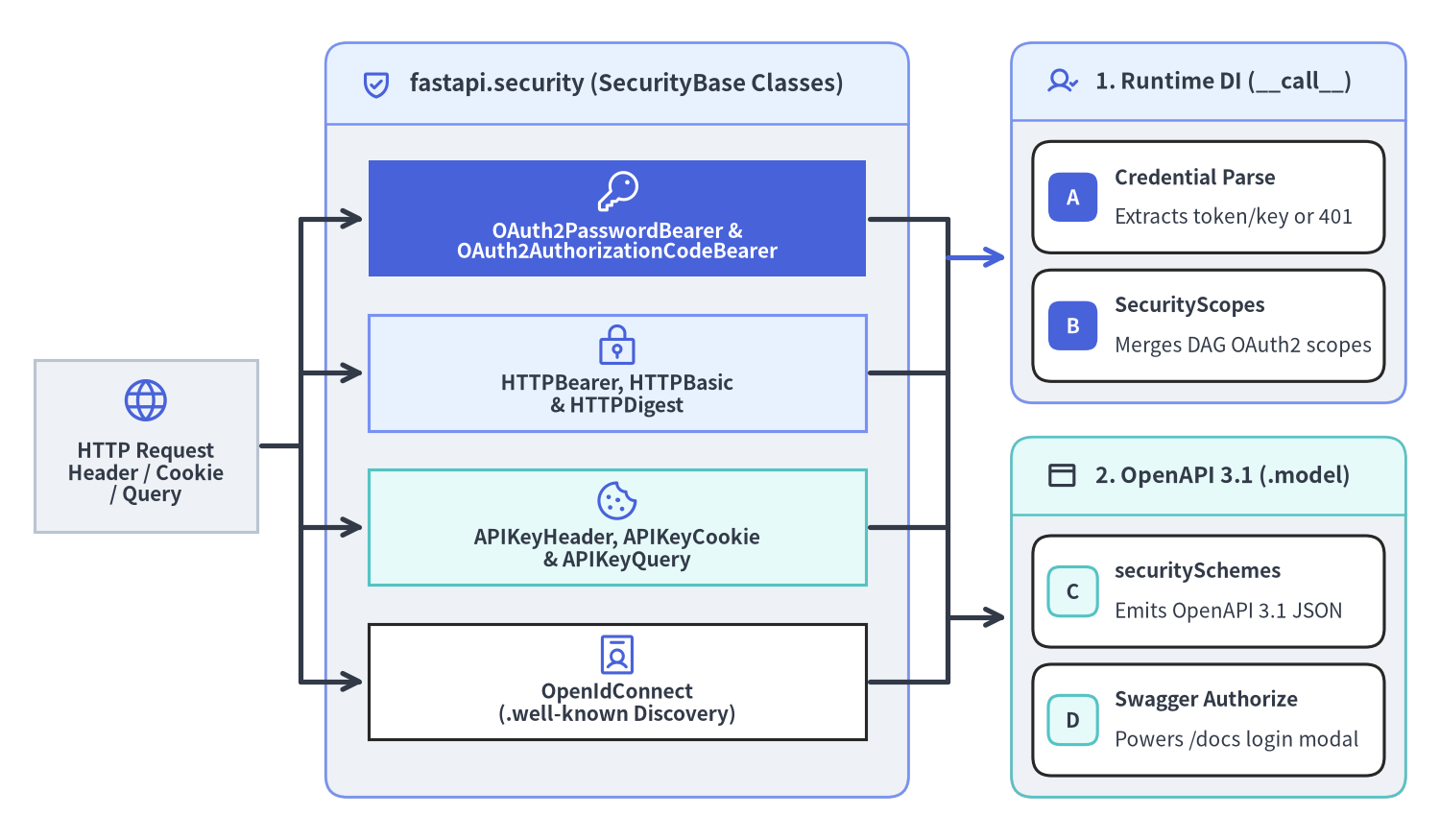
FastAPI v0.162.2's fastapi.security module unifies runtime credential extraction and OpenAPI 3.1 schema generation: every SecurityBase dependency parses incoming HTTP credentials in the Dependant DAG while automatically populating components.securitySchemes and Swagger UI's interactive "Authorize" modal.
Source Code
from drawlib.canvas import save, setup
from drawlib.diagrams.architecture import ArchitectureDiagram, Node, PhosphorIcon
from drawlib.icons import phosphor
from drawlib.lines import line, lines
from drawlib.smartarts import CardList, Panel
from drawlib.styles import Styles

setup(width=168, height=98, dpi=150)

# Center Panel: fastapi.security SecurityBase Subclasses
sec_panel = Panel(
    "fastapi.security (SecurityBase Classes)",
    style=Styles.Neutral,
    header_style=Styles.PrimaryNeutral.patch(shape_line_width=1.2),
    text_style=Styles.DarkBold.patch(text_size=11.5),
    icon=phosphor.shield_check,
    icon_style=Styles.PrimaryBold,
    header_variant="filled",
    header_height=9.5,
)
sec_panel.draw((38.0, 5.0), width=68.0, height=88.0, align="bottom_left")

arch = ArchitectureDiagram(
    width=106.0,
    height=88.0,
    node_style=Styles.Primary,
    node_text_style=Styles.DarkBold.patch(text_size=10.0),
    edge_style=Styles.DarkBold,
    edge_text_style=Styles.Dark.patch(text_size=10.0),
    node_card_style=Styles.Neutral,
)

http_req = arch.add(
    Node(
        "HTTP Request\nHeader / Cookie\n/ Query",
        width=26,
        height=20,
        icon=PhosphorIcon.GLOBE,
        icon_size=6.0,
        card_style=Styles.Neutral,
    ),
    xy=(17.0, 46.0),
)

oauth2_node = arch.add(
    Node(
        "OAuth2PasswordBearer &\nOAuth2AuthorizationCodeBearer",
        width=58,
        height=13.5,
        icon=PhosphorIcon.KEY,
        icon_size=5.4,
        style=Styles.White,
        card_style=Styles.PrimaryFlat,
        text_style=Styles.WhiteBold.patch(text_size=10.0),
    ),
    xy=(72.0, 72.5),
)

http_node = arch.add(
    Node(
        "HTTPBearer, HTTPBasic\n& HTTPDigest",
        width=58,
        height=13.5,
        icon=PhosphorIcon.LOCK_KEY,
        icon_size=5.4,
        card_style=Styles.PrimaryNeutral,
    ),
    xy=(72.0, 54.5),
)

apikey_node = arch.add(
    Node(
        "APIKeyHeader, APIKeyCookie\n& APIKeyQuery",
        width=58,
        height=13.5,
        icon=PhosphorIcon.COOKIE,
        icon_size=5.4,
        card_style=Styles.SecondaryNeutral,
    ),
    xy=(72.0, 36.5),
)

oidc_node = arch.add(
    Node(
        "OpenIdConnect\n(.well-known Discovery)",
        width=58,
        height=13.5,
        icon=PhosphorIcon.IDENTIFICATION_BADGE,
        icon_size=5.4,
        card_style=Styles.White,
    ),
    xy=(72.0, 18.5),
)

arch.draw(xy=(0.0, 0.0))

# Left Fan-Out Bus from HTTP Request (x=30.0 -> spine x=35.0 -> nodes x=42.5)
line((30.5, 46.0), (35.0, 46.0), style=Styles.DarkBold)
line((35.0, 18.5), (35.0, 72.5), style=Styles.DarkBold)
for ny in (72.5, 54.5, 36.5, 18.5):
    line((35.0, ny), (42.5, ny), arrow_head="->", style=Styles.DarkBold)

# Right Dual-Output Panels: (1) Runtime DI & (2) OpenAPI 3.1 Schema
rt_panel = Panel(
    "1. Runtime DI (__call__)",
    style=Styles.Neutral,
    header_style=Styles.PrimaryNeutral.patch(shape_line_width=1.2),
    text_style=Styles.DarkBold.patch(text_size=11.0),
    icon=phosphor.user_check,
    icon_style=Styles.PrimaryBold,
    header_variant="filled",
    header_height=9.0,
)
rt_panel.draw((118.0, 51.0), width=46.0, height=42.0, align="bottom_left")
rt_xy, rt_w, rt_h = rt_panel.get_content_box(
    (118.0, 51.0),
    width=46.0,
    height=42.0,
    padding=(2.5, 2.5),
    align="bottom_left",
)

rt_cards = CardList(
    style=Styles.White,
    text_style=Styles.DarkBold.patch(text_size=10.0),
    description_style=Styles.Dark.patch(text_size=10.0),
    badge_style=Styles.PrimaryFlat,
    badge_text_style=Styles.WhiteBold.patch(text_size=10.0),
    spacing=2.0,
)
rt_cards.add("Credential Parse", "Extracts token/key or 401", badge_text="A")
rt_cards.add("SecurityScopes", "Merges DAG OAuth2 scopes", badge_text="B")
rt_cards.draw(rt_xy, width=rt_w, height=rt_h)

oa_panel = Panel(
    "2. OpenAPI 3.1 (.model)",
    style=Styles.Neutral,
    header_style=Styles.SecondaryNeutral.patch(shape_line_width=1.2),
    text_style=Styles.DarkBold.patch(text_size=11.0),
    icon=phosphor.browser,
    icon_style=Styles.DarkBold,
    header_variant="filled",
    header_height=9.0,
)
oa_panel.draw((118.0, 5.0), width=46.0, height=42.0, align="bottom_left")
oa_xy, oa_w, oa_h = oa_panel.get_content_box(
    (118.0, 5.0),
    width=46.0,
    height=42.0,
    padding=(2.5, 2.5),
    align="bottom_left",
)

oa_cards = CardList(
    style=Styles.White,
    text_style=Styles.DarkBold.patch(text_size=10.0),
    description_style=Styles.Dark.patch(text_size=10.0),
    badge_style=Styles.SecondaryNeutral,
    badge_text_style=Styles.DarkBold.patch(text_size=10.0),
    spacing=2.0,
)
oa_cards.add("securitySchemes", "Emits OpenAPI 3.1 JSON", badge_text="C")
oa_cards.add("Swagger Authorize", "Powers /docs login modal", badge_text="D")
oa_cards.draw(oa_xy, width=oa_w, height=oa_h)

# Right Convergence Spine (nodes x=101.5 -> spine x=110.5 -> panels x=117.5)
for ny in (72.5, 54.5, 36.5, 18.5):
    line((101.5, ny), (110.5, ny), style=Styles.DarkBold)
line((110.5, 18.5), (110.5, 72.5), style=Styles.DarkBold)
line((110.5, 68.0), (117.5, 68.0), arrow_head="->", style=Styles.PrimaryBold)
lines([(110.5, 26.0), (117.5, 26.0)], arrow_head="->", style=Styles.DarkBold)

save()
1. Dual-Role Design of fastapi.security
Unlike traditional middleware that intercepts every URL path indiscriminately, FastAPI integrates security directly into the Dependant DAG. Every security class in fastapi/security/* inherits from SecurityBase and fulfills two responsibilities from a single Python instance:
- Runtime Credential Extractor (
async def __call__(self, request: HTTPConnection)): Parses theAuthorizationheader, custom header, cookie, or query parameter. Whenauto_error=True(default), missing or malformed credentials immediately abort the request with401 Unauthorizedand a spec-compliantWWW-Authenticatechallenge header; whenauto_error=False, the extractor returnsNoneso downstream dependencies can implement multi-scheme fallbacks or optional authentication. - OpenAPI 3.1 Metadata Provider (
self.model&self.scheme_name): During/openapi.jsongeneration,_get_openapi_security_definitions()(fastapi/openapi/utils.py) walks every route'sDependanttree, serializessecurity_scheme.modelintocomponents.securitySchemes, attaches operation-levelsecurityrequirements, and enables the lock icons and "Authorize" dialog in Swagger UI (/docs).
Security Class (fastapi.security) |
Extracted Location & Format | Return Type (auto_error=True) |
OpenAPI 3.1 type / scheme |
|---|---|---|---|
OAuth2PasswordBearer |
Authorization: Bearer <token> |
str (raw bearer token) |
oauth2 (flows.password) |
OAuth2AuthorizationCodeBearer |
Authorization: Bearer <token> |
str (raw bearer token) |
oauth2 (flows.authorizationCode) |
HTTPBearer |
Authorization: Bearer <token> |
HTTPAuthorizationCredentials |
http (scheme: "bearer") |
HTTPBasic |
Authorization: Basic <b64> |
HTTPBasicCredentials (username, password) |
http (scheme: "basic") |
APIKeyHeader / Cookie / Query |
Named header, cookie, or query param | str (raw API key) |
apiKey (in: header | cookie | query) |
OpenIdConnect |
Authorization header + discovery URL |
str (raw header; subclass to verify JWT) |
openIdConnect (openIdConnectUrl) |
2. OAuth2 Bearer Flows & Hierarchical SecurityScopes
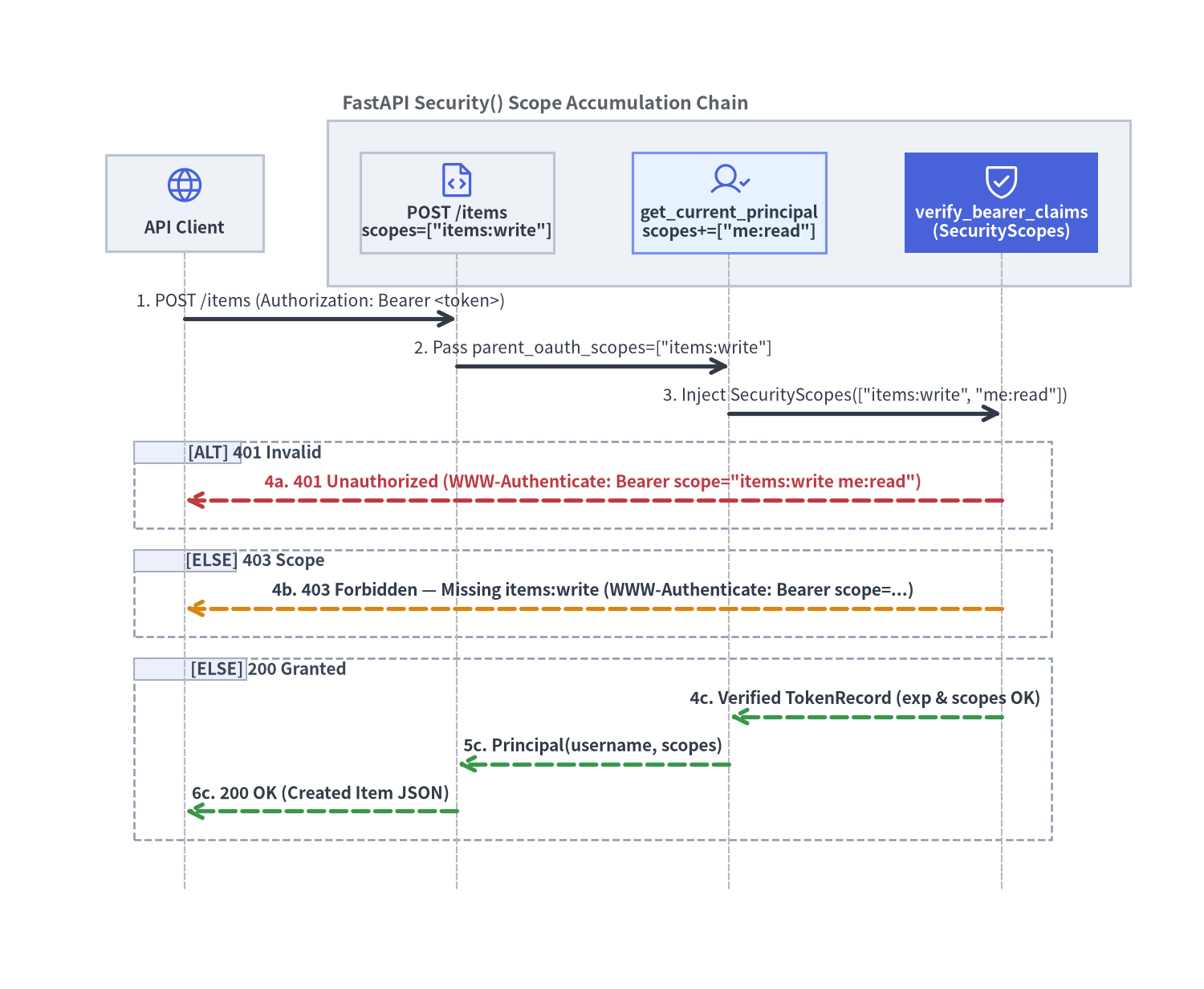
While Depends() resolves any callable, Security(callable, scopes=[...]) (fastapi/param_functions.py) extends Depends() with declarative OAuth2 permission strings. When dependencies are nested across layers—for example, a route requires scopes=["items:write"] on get_current_principal, which in turn requires scopes=["me:read"] on verify_bearer_claims—FastAPI merges parent_oauth_scopes and own_oauth_scopes top-down through _get_oauth_scopes() and injects the combined list into a SecurityScopes parameter.
Source Code
from drawlib.canvas import save, setup
from drawlib.diagrams.sequence import Participant, ParticipantGroup, PhosphorIcon, SequenceDiagram
from drawlib.styles import Style, Styles

setup(width=168, height=138, dpi=150)

seq = SequenceDiagram(
    node_style=Styles.Primary,
    node_text_style=Styles.DarkBold.patch(text_size=10.0),
    edge_style=Styles.DarkBold,
    edge_text_style=Styles.Dark.patch(text_size=10.0),
    node_card_style=Styles.Neutral,
    col_width=38.0,
    step_y=6.6,
    margin=5.0,
)

client = seq.add(
    Participant(
        "API Client",
        width=22,
        height=13.5,
        icon=PhosphorIcon.GLOBE,
        icon_size=5.8,
    )
)

chain = seq.add(
    ParticipantGroup(
        title="FastAPI Security() Scope Accumulation Chain",
        padding=4.5,
        style=Styles.Neutral,
        text_style=Style(text_size=11.0),
    )
)

route_sec = chain.add(
    Participant(
        'POST /items\nscopes=["items:write"]',
        width=27,
        height=14,
        icon=PhosphorIcon.FILE_CODE,
        icon_size=5.6,
        card_style=Styles.Neutral,
    )
)

principal_dep = chain.add(
    Participant(
        'get_current_principal\nscopes+=["me:read"]',
        width=27,
        height=14,
        icon=PhosphorIcon.USER_CHECK,
        icon_size=5.6,
        card_style=Styles.PrimaryNeutral,
    )
)

verifier = chain.add(
    Participant(
        "verify_bearer_claims\n(SecurityScopes)",
        width=27,
        height=14,
        icon=PhosphorIcon.SHIELD_CHECK,
        icon_size=5.6,
        style=Styles.White,
        card_style=Styles.PrimaryFlat,
        text_style=Styles.WhiteBold.patch(text_size=10.0),
    )
)

client.request(route_sec, "1. POST /items (Authorization: Bearer <token>)")
route_sec.request(principal_dep, '2. Pass parent_oauth_scopes=["items:write"]')
principal_dep.request(
    verifier,
    '3. Inject SecurityScopes(["items:write", "me:read"])',
)

with seq.alt("401 Invalid") as blk_401:
    blk_401.style = Styles.MutedDashed.patch(shape_line_width=1.2)
    blk_401.text_style = Style(text_size=10.0, halign="left")
    verifier.reply(
        client,
        '4a. 401 Unauthorized (WWW-Authenticate: Bearer scope="items:write me:read")',
        style=Styles.DangerBold,
        text_style=Styles.DangerBold.patch(text_size=10.0),
    )

with seq.else_("403 Scope") as blk_403:
    blk_403.style = Styles.MutedDashed.patch(shape_line_width=1.2)
    blk_403.text_style = Style(text_size=10.0, halign="left")
    verifier.reply(
        client,
        '4b. 403 Forbidden — Missing items:write (WWW-Authenticate: Bearer scope=...)',
        style=Styles.WarningBold,
        text_style=Styles.DarkBold.patch(text_size=10.0),
    )

with seq.else_("200 Granted") as blk_200:
    blk_200.style = Styles.MutedDashed.patch(shape_line_width=1.2)
    blk_200.text_style = Style(text_size=10.0, halign="left")
    verifier.reply(
        principal_dep,
        "4c. Verified TokenRecord (exp & scopes OK)",
        style=Styles.SuccessBold,
        text_style=Styles.DarkBold.patch(text_size=10.0),
    )
    principal_dep.reply(
        route_sec,
        "5c. Principal(username, scopes)",
        style=Styles.SuccessBold,
        text_style=Styles.DarkBold.patch(text_size=10.0),
    )
    route_sec.reply(
        client,
        "6c. 200 OK (Created Item JSON)",
        style=Styles.SuccessBold,
        text_style=Styles.DarkBold.patch(text_size=10.0),
    )

seq.draw(xy=(84.0, 69.0), align="center")
save()
2.1 Distinguishing 401 Unauthorized vs 403 Forbidden
RFC 6750 and RFC 9110 define distinct status codes for authentication failure versus insufficient authorization scopes:
401 Unauthorized(Unauthenticated / Invalid Token): Returned when theAuthorizationheader is missing, malformed, signed with an invalid key, or past itsexptimestamp. Always includeWWW-Authenticate: Bearer(orBearer scope="..."when scopes apply).403 Forbidden(Authenticated, Insufficient Scope): Returned when the token cryptographically identifies a valid principal, butsecurity_scopes.scopescontains at least one permission not granted to that token. Includingheaders={"WWW-Authenticate": f'Bearer scope="{security_scopes.scope_str}"'}informs OAuth2 clients which scopes must be requested at/token.
2.2 End-to-End /token Login & Nested SecurityScopes Verification
Note that OAuth2PasswordRequestForm requires application/x-www-form-urlencoded form fields (username, password, optional space-delimited scope) per the OAuth 2.0 specification (parsed via python-multipart; see Path, Query, Header, Cookie & Body). Always verify password hashes with memory-hard KDFs (scrypt or Argon2) plus secrets.compare_digest, enforce finite token expiration (exp), and never hardcode signing keys in source code:
import hashlib
import secrets
import time
from dataclasses import dataclass
from typing import Annotated

from fastapi import Depends, FastAPI, HTTPException, Security, status
from fastapi.security import (
    OAuth2PasswordBearer,
    OAuth2PasswordRequestForm,
    SecurityScopes,
)
from pydantic import BaseModel


def hash_password(password: str, salt: bytes) -> bytes:
    return hashlib.scrypt(password.encode("utf-8"), salt=salt, n=16384, r=8, p=1)


@dataclass(frozen=True)
class StoredUser:
    salt: bytes
    pw_hash: bytes
    allowed_scopes: set[str]


class TokenRecord(BaseModel):
    sub: str
    scopes: list[str]
    exp: float


class Principal(BaseModel):
    username: str
    scopes: list[str]


alice_salt = secrets.token_bytes(16)
bootstrap_password = secrets.token_urlsafe(12)
users_db: dict[str, StoredUser] = {
    "alice": StoredUser(
        salt=alice_salt,
        pw_hash=hash_password(bootstrap_password, alice_salt),
        allowed_scopes={"me:read", "items:read", "items:write"},
    )
}
token_store: dict[str, TokenRecord] = {}

oauth2_scheme = OAuth2PasswordBearer(
    tokenUrl="/token",
    scopes={
        "me:read": "Read current user profile",
        "items:read": "Read inventory items",
        "items:write": "Create or update inventory items",
    },
)

app = FastAPI()


@app.post("/token")
async def issue_token(
    form_data: Annotated[OAuth2PasswordRequestForm, Depends()],
) -> dict[str, str]:
    user = users_db.get(form_data.username)
    candidate_hash = hash_password(
        form_data.password,
        user.salt if user else alice_salt,
    )
    expected_hash = user.pw_hash if user else hash_password("invalid", alice_salt)
    if not user or not secrets.compare_digest(candidate_hash, expected_hash):
        raise HTTPException(
            status_code=status.HTTP_401_UNAUTHORIZED,
            detail="Invalid username or password",
            headers={"WWW-Authenticate": "Bearer"},
        )
    granted = [s for s in form_data.scopes if s in user.allowed_scopes]
    raw_token = secrets.token_urlsafe(24)
    token_store[raw_token] = TokenRecord(
        sub=form_data.username,
        scopes=granted,
        exp=time.time() + 900,
    )
    return {"access_token": raw_token, "token_type": "bearer"}


async def verify_bearer_claims(
    security_scopes: SecurityScopes,
    token: Annotated[str, Depends(oauth2_scheme)],
) -> TokenRecord:
    auth_header = (
        f'Bearer scope="{security_scopes.scope_str}"'
        if security_scopes.scopes
        else "Bearer"
    )
    record = token_store.get(token)
    if record is None or record.exp < time.time():
        raise HTTPException(
            status_code=status.HTTP_401_UNAUTHORIZED,
            detail="Invalid or expired bearer token",
            headers={"WWW-Authenticate": auth_header},
        )
    granted_set = set(record.scopes)
    for required_scope in security_scopes.scopes:
        if required_scope not in granted_set:
            raise HTTPException(
                status_code=status.HTTP_403_FORBIDDEN,
                detail=f"Not enough permissions (missing {required_scope})",
                headers={"WWW-Authenticate": auth_header},
            )
    return record


async def get_current_principal(
    claims: Annotated[
        TokenRecord,
        Security(verify_bearer_claims, scopes=["me:read"]),
    ],
) -> Principal:
    return Principal(username=claims.sub, scopes=claims.scopes)


@app.post("/items")
async def create_item(
    name: str,
    principal: Annotated[
        Principal,
        Security(get_current_principal, scopes=["items:write"]),
    ],
) -> dict[str, object]:
    return {"item": name, "created_by": principal.username}
Inspecting app.openapi()["paths"]["/items"]["post"]["security"] yields [{"OAuth2PasswordBearer": ["items:write", "me:read"]}]: FastAPI automatically merges the route's "items:write" scope with the sub-dependency's "me:read" scope in both runtime enforcement and the published OpenAPI 3.1 contract (see Response Serialization & OpenAPI 3.1).
3. Constant-Time HTTPBasic & Multi-Scheme APIKeyHeader Fallback
Internal operational endpoints frequently need to support machine-to-machine API keys (X-API-Key) alongside browser-friendly HTTP Basic challenges (HTTPBasic). Combining auto_error=False on multiple SecurityBase extractors lets a single dependency orchestrate fallback authentication cleanly.
3.1 Preventing Timing Side-Channels with secrets.compare_digest
Never compare passwords or API keys with Python's == operator, which short-circuits at the first mismatched byte and leaks prefix length over statistical network measurements. Instead, encode both strings to UTF-8 bytes and evaluate both username and password comparisons unconditionally via secrets.compare_digest() before branching:
import os
import secrets
from dataclasses import dataclass
from typing import Annotated

from fastapi import Depends, FastAPI, HTTPException, Security, status
from fastapi.security import APIKeyHeader, HTTPBasic, HTTPBasicCredentials


@dataclass(frozen=True)
class OpsAuthSettings:
    basic_user: str
    basic_password: str
    service_api_key: str


ephemeral_pw = os.environ.get("OPS_BASIC_PASSWORD") or secrets.token_urlsafe(16)
ephemeral_key = os.environ.get("OPS_SERVICE_API_KEY") or secrets.token_urlsafe(24)


def get_ops_auth_settings() -> OpsAuthSettings:
    return OpsAuthSettings(
        basic_user="ops_admin",
        basic_password=ephemeral_pw,
        service_api_key=ephemeral_key,
    )


basic_scheme = HTTPBasic(realm="OpsConsole", auto_error=False)
api_key_header = APIKeyHeader(name="X-API-Key", auto_error=False)


async def require_ops_caller(
    settings: Annotated[OpsAuthSettings, Depends(get_ops_auth_settings)],
    api_key: Annotated[str | None, Security(api_key_header)] = None,
    basic_creds: Annotated[HTTPBasicCredentials | None, Security(basic_scheme)] = None,
) -> dict[str, str]:
    if api_key is not None:
        key_ok = secrets.compare_digest(
            api_key.encode("utf-8"),
            settings.service_api_key.encode("utf-8"),
        )
        if key_ok:
            return {"principal": "automation_bot", "method": "api_key"}

    if basic_creds is not None:
        # Evaluate BOTH digests before branching so username validity never leaks via timing
        user_ok = secrets.compare_digest(
            basic_creds.username.encode("utf-8"),
            settings.basic_user.encode("utf-8"),
        )
        pass_ok = secrets.compare_digest(
            basic_creds.password.encode("utf-8"),
            settings.basic_password.encode("utf-8"),
        )
        if user_ok and pass_ok:
            return {"principal": basic_creds.username, "method": "http_basic"}

    raise HTTPException(
        status_code=status.HTTP_401_UNAUTHORIZED,
        detail="Valid X-API-Key or HTTP Basic credentials required",
        headers={"WWW-Authenticate": 'Basic realm="OpsConsole"'},
    )


app = FastAPI()


@app.get("/ops/health-audit")
async def ops_health_audit(
    caller: Annotated[dict[str, str], Depends(require_ops_caller)],
) -> dict[str, str]:
    return caller
[!TIP] When provisioning browser session cookies (
APIKeyCookie), enforce__Host-cookie prefixes,HttpOnly,Secure,SameSite="lax", and state-changing CSRF defenses, and terminate TLS 1.2+ at your edge proxy. Continue to ASGI Middleware & Threadpool for CORS, trusted-host middleware, and ASGI request wrapping.